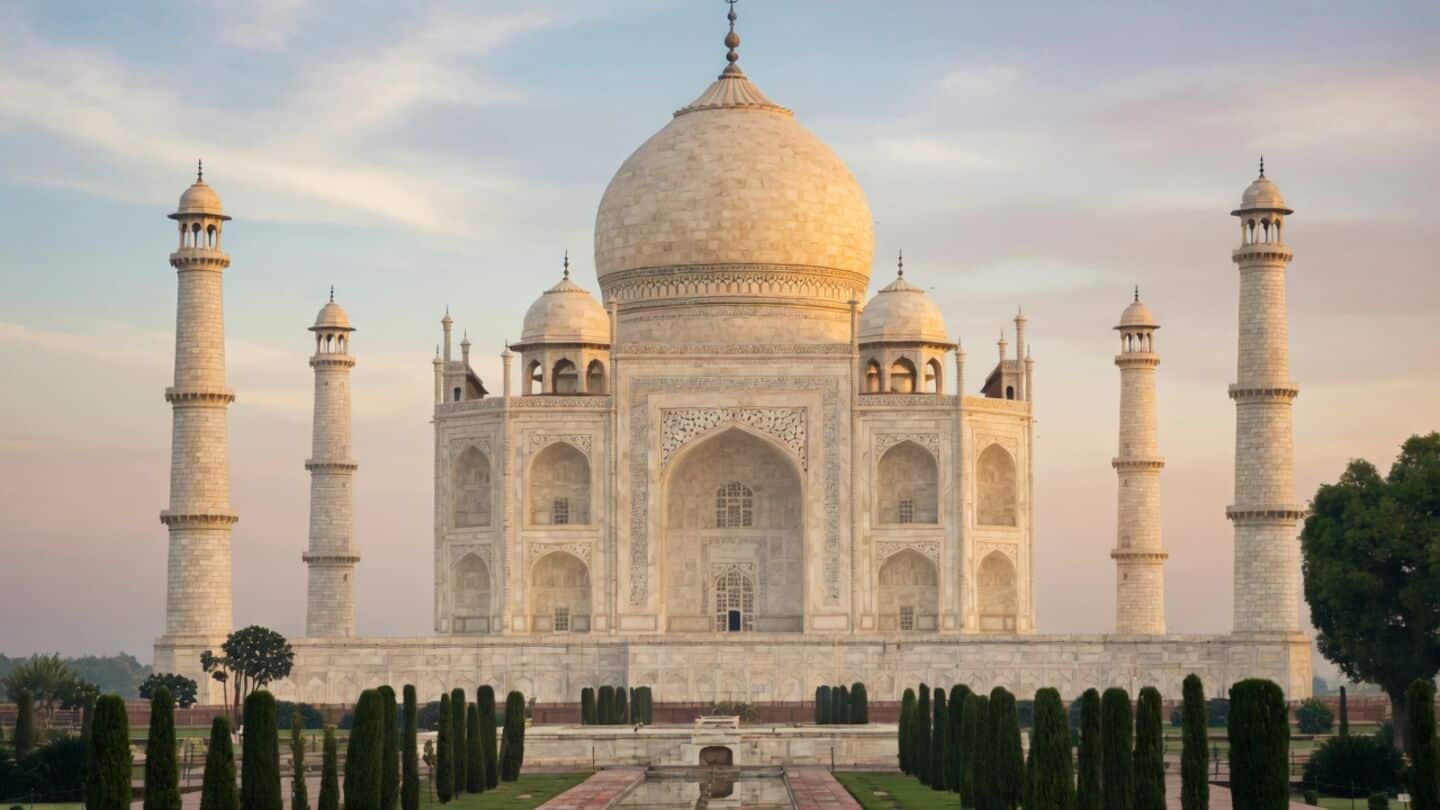
'Taj Mahal was Tejo Mahalaya': Petition seeks monument's survey
What's the story
The Allahabad High Court has asked the central government and Archaeological Survey of India (ASI) to respond to a petition challenging an Agra court's decision, which refused a survey of the Taj Mahal. The petition claims the monument is an ancient temple called "Tejo Mahalaya" dedicated to Lord Shiva. The petitioners, represented by Hari Shankar Jain on behalf of deity "Lord Sri Agreshwar Mahadev Nagnatheswar Virajman," argue Hindus have a constitutional right under Article 25 to worship at the site.
Legal proceedings
Petitioners approached Allahabad High Court after Agra court's dismissal
In 2019, the petitioners had approached an Agra court to appoint an advocate commissioner for a Taj Mahal survey.
Their request was rejected as they couldn't produce revenue records matching the defendants' records.
An additional district judge in Agra later dismissed their revision petition as not maintainable in April this year.
The petitioners then moved to the high court, reiterating their historical and architectural claims about the monument.
Historical claims
Claims about Taj Mahal's history in petition
The petition states that the ancient Tejo Mahalaya Temple, where Agreshwar Mahadev Nagnatheswar Virajman is said to preside, was built by Raja Paramardi Dev in 1155-56 AD.
It further claims that the monument later came under the ownership of Raja Man Singh and subsequently Raja Jai Singh of Jaipur.
The petitioners allege Mughal emperor Shah Jahan took over the structure from Raja Jai Singh and converted it into a mausoleum for his wife Mumtaz Mahal by incorporating Islamic architectural features.
Architectural evidence
Petitioners list evidence of Hindu links to monument
The petitioners claim there are at least 109 archeological and historical features that establish the monument was originally a Hindu temple.
They point to a kalash atop the marble dome decorated with lotus petals, which they say are characteristic of Hindu temple architecture.
They also cite a structure at the southeast corner of the complex, which they claim is recorded in ASI records as a "gaushala," arguing that it is associated with Hindu temples rather than Muslim mausoleums.
Legal arguments
Petitioners allege ASI has violated rules at site
The petitioners also allege that ASI has illegally permitted Muslims to offer namaz on Fridays while restricting visitors' access and locking several floors of the monument.
They argue that the Agra court's order suffers from "patent illegality," "material irregularity," and a failure to exercise jurisdiction.
The petitioners contend their application was rejected on irrelevant grounds, especially since there's no dispute about the monument's identity.
Court intervention
Petitioners seek to overturn Agra court's orders
The petitioners argue that unrestricted access to the ASI-protected monument is not available to them, making it necessary for a court commissioner to conduct photography and videography.
They have asked the high court to set aside the Agra courts' orders and direct the trial court to decide on appointing an advocate commissioner on merits.
An interim application has also been filed seeking directions from ASI's director for photographing the Taj Mahal's interior and exterior in petitioners' presence.