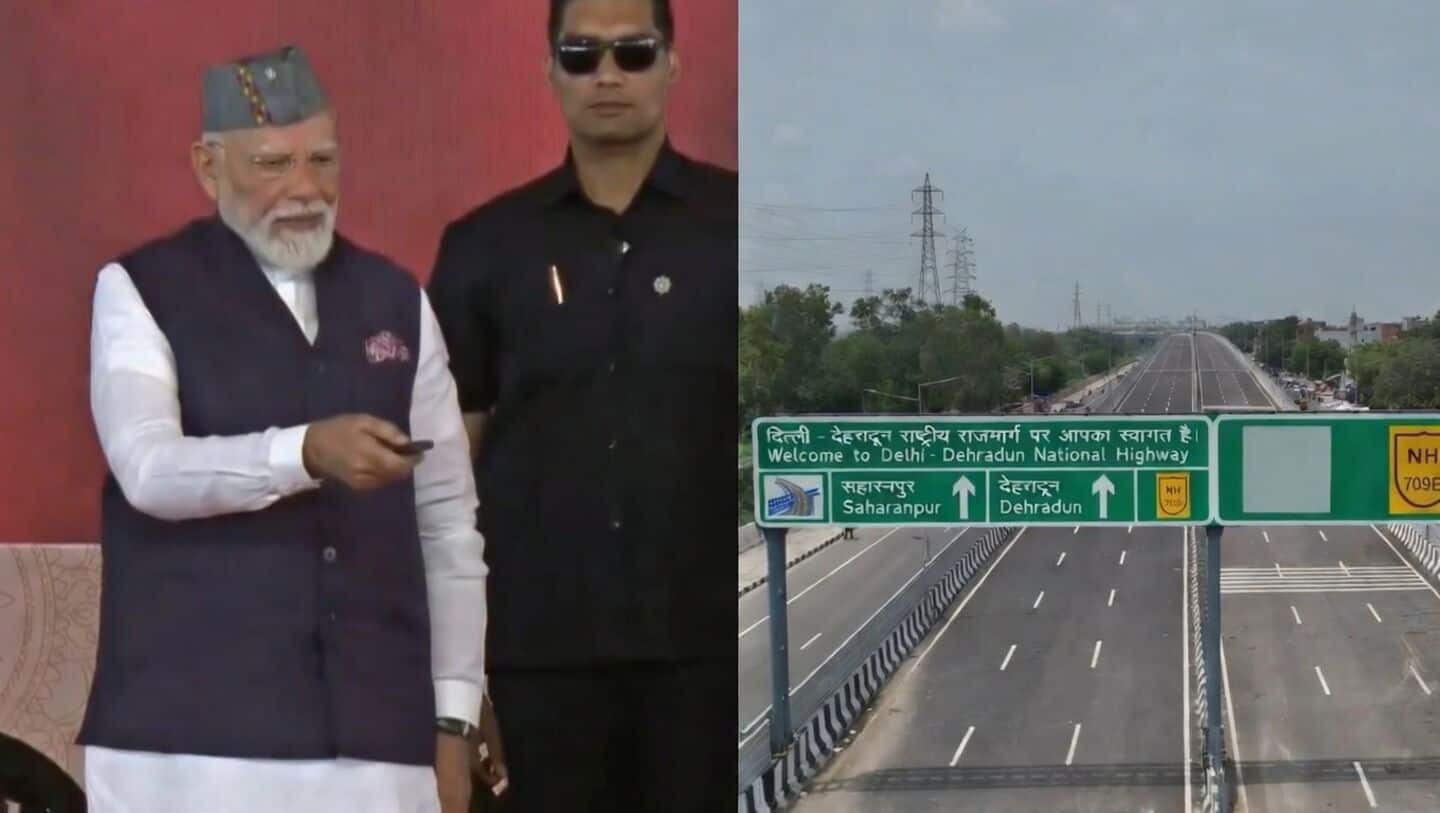
What's special about Delhi-Dehradun Expressway Modi inaugurated
What's the story
Prime Minister Narendra Modi on Tuesday inaugurated the Delhi-Dehradun Expressway, a major infrastructure project aimed at reducing travel time between the two cities. The 213-kilometer expressway will cut down the journey from six hours to just two-and-a-half hours. Built at an estimated cost of ₹12,000 crore, it is expected to ease traffic congestion in Delhi and on connecting highways like the Delhi-Meerut Expressway.
Project details
Developed in 4 phases
The Delhi-Dehradun Expressway has been developed in four phases. Phase 1 runs from Akshardham to the Eastern Peripheral Expressway (EPE) Junction in Uttar Pradesh. Phase 2 extends from the EPE Junction to Saharanpur Bypass, while Phase 3 covers Saharanpur Bypass to Ganeshpur in Uttarakhand. Finally, Phase 4 connects Ganeshpur to Dehradun. The six-lane access-controlled expressway has 10 interchanges, three rail overbridges (ROBs), four major bridges and 14 wayside amenities for high-speed travel with convenience and road safety.
Eco-friendly initiative
Asia's largest elevated wildlife corridor
The expressway also boasts an eco-friendly design with Asia's largest 12-km elevated wildlife corridor. This includes two elephant underpasses and six animal passes for safe animal crossings. A 370-meter-long tunnel near the Daat Kali temple further adds to its environmental sustainability. The corridor is designed to reduce accidents and ensure uninterrupted wildlife movement while providing a safer travel experience for commuters.
Future plans
Travel on expressway will be tolled
Once fully operational, toll charges will be applicable. Reports suggest that a one-way trip could cost up to ₹670 and around ₹1,000 for a round-trip car journey between Delhi and Dehradun. However, these rates are yet to be confirmed. The expressway is also projected to boost tourism in Dehradun, Mussoorie, Haridwar, and the Char Dham Circuit. It will also boost trade and economic activity between Delhi, western Uttar Pradesh, and Uttarakhand, while alleviating traffic congestion on existing routes.