Boost your child's creativity with these science projects
What's the story
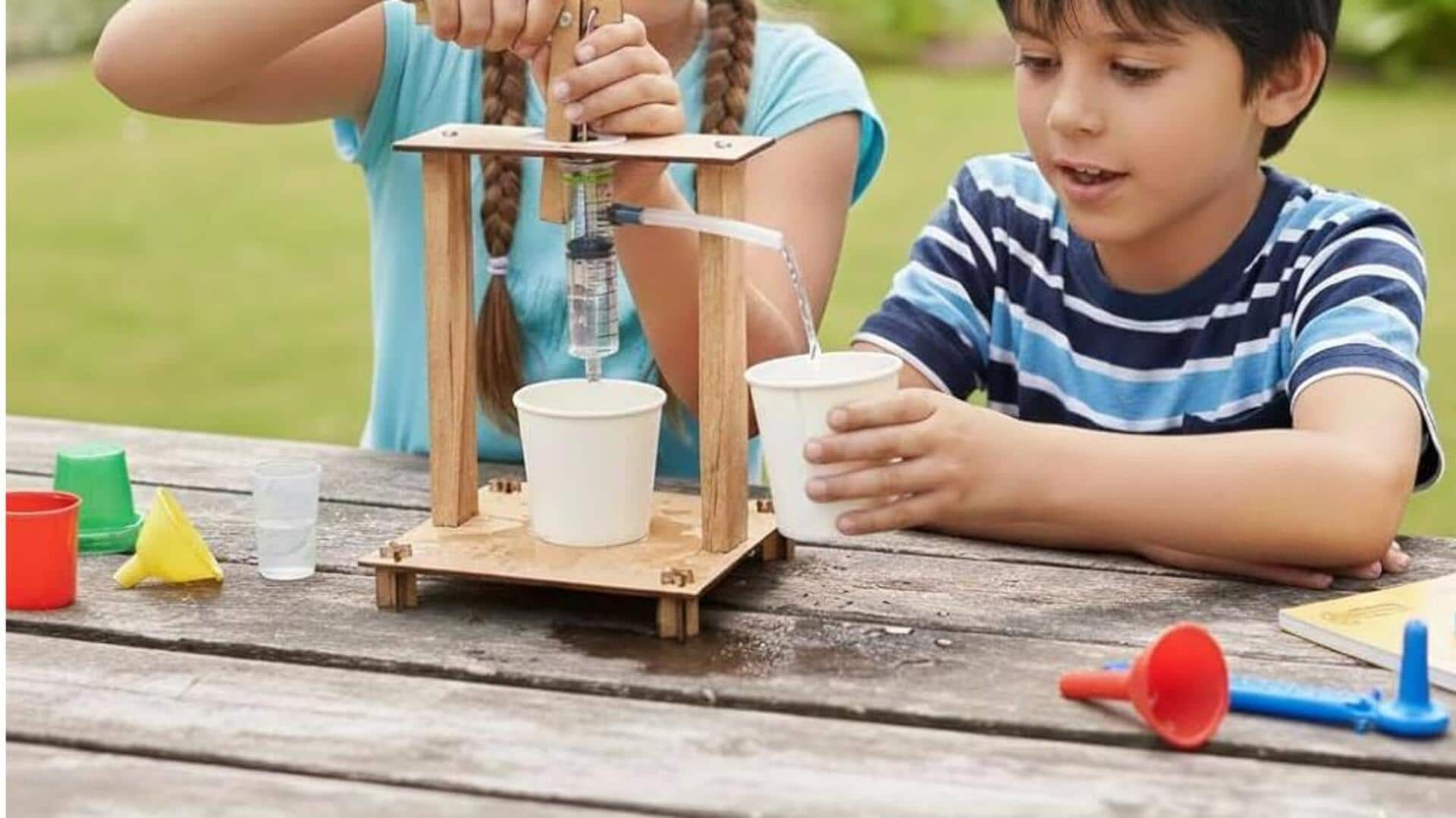
Science models provide an interactive way to understand complex concepts, making them a great tool for boosting creativity in children. By engaging with these models, children can develop critical thinking and problem-solving skills. Here are five science models that have been proven to boost creativity in kids. Each of these models provides a unique way to learn and explore, making science fun and engaging.
#1
The water cycle model
The water cycle model is a great way to teach kids about the continuous movement of water on Earth.
By visualizing processes like evaporation, condensation, and precipitation, kids can understand how water travels through different states.
This model encourages curiosity as children ask questions about each stage of the cycle. It also promotes creativity as they think of ways to demonstrate these processes through experiments or art projects.
#2
Solar system model
A solar system model gives kids a chance to explore planets and other celestial bodies in our solar system.
By creating or interacting with this model, kids learn about distances between planets, their sizes, and their unique characteristics.
This exploration fosters imagination as children envision what life could be on other planets or design their own planetary systems.
#3
Plant growth model
The plant growth model demonstrates how plants develop from seeds into full-grown plants.
By observing this process, children learn about the importance of sunlight, water, and soil nutrients for plant health.
This model inspires creativity as kids experiment with different variables affecting growth or design their own experiments to test hypotheses related to plant development.
#4
Human Body Model
A human body model provides an insight into how our organs work together to keep us healthy.
By exploring this model, kids gain an understanding of anatomy and physiology while developing empathy by learning how different systems affect well-being.
This knowledge encourages creative thinking when designing solutions for health-related problems or imagining new ways to improve human health.
#5
Ecosystem model
An ecosystem model illustrates how living organisms interact within their environment. It highlights the balance between producers, consumers, and decomposers in nature's cycles.
Children who engage with this model develop an appreciation for biodiversity. They also think creatively about conservation strategies.
These strategies can protect ecosystems from human impact.