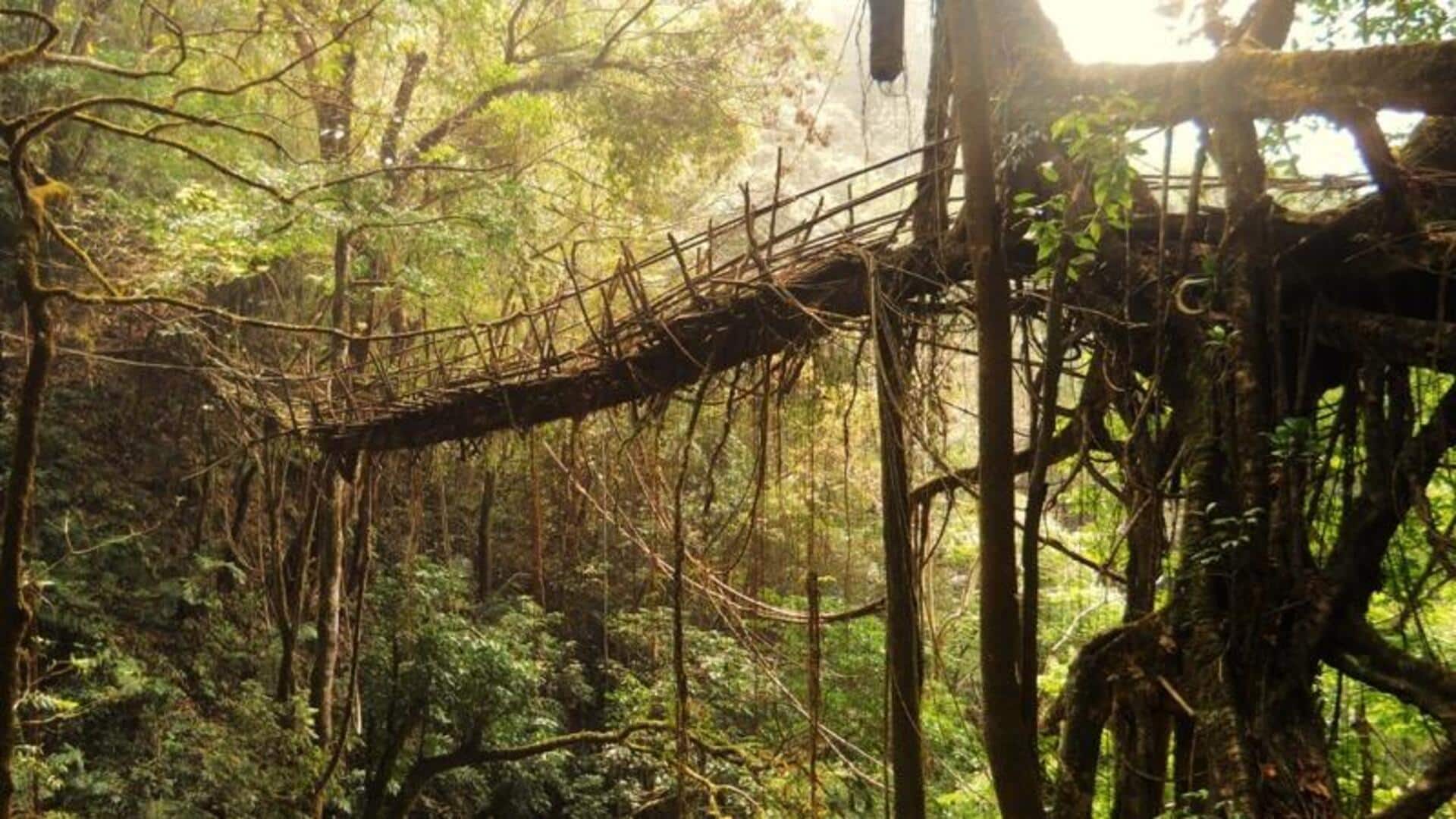
Meghalaya's living root bridge ranked 2nd most beautiful bridge globally
What's the story
A marvel of nature and indigenous engineering, Meghalaya's Double Decker Living Root Bridge has been ranked as the second most beautiful bridge in the world by British magazine Time Out. The unique structure, located in Nongriat village near Cherrapunji, is made entirely from the living roots of rubber fig trees. It was grown over decades by the Khasi tribe, making it a one-of-a-kind bioengineered wonder.
Design details
Criteria for ranking
The ranking was based on three main criteria: unique architectural design, integration with the surrounding landscape, and international media visibility.
The list celebrates structures that combine construction brilliance with aesthetic value, transforming them into tourism icons for their respective countries.
Unlike conventional bridges made from steel or concrete, the Double Decker Living Root Bridge is a product of nature's ingenuity.
It continues to grow and adapt over time, making it a symbol of sustainability and resilience in architecture.
Construction process
How the unique structure was built
The bridge is made from the aerial roots of the Ficus elastica (rubber fig) tree.
The Khasi tribe developed this technique out of necessity, as conventional wooden bridges repeatedly collapsed during Meghalaya's intense monsoon seasons.
Over 180 years ago, Khasi elders began placing young rubber tree roots through hollowed areca nut palm trunks or bamboo scaffolding, carefully directing them across streams.
Over decades, these roots thickened and intertwined naturally to form sturdy pedestrian crossings.
Unique feature
Why is it called 'living root bridge?'
The Nongriat bridge is unique as it is the only known double-decker living root bridge in the world.
This was a solution to the problem of rising river levels during monsoon seasons, which had previously submerged the original bridge.
Instead of abandoning it, the community grew a second tier above the first one, resulting in a two-storeyed, interlaced root structure that can withstand powerful currents.
Accessibility
How to reach the bridge?
Reaching the Double Decker Living Root Bridge isn't easy. Visitors have to descend some 3,500 steps from Tyrna village to reach Nongriat.
The trek, which takes a full day round trip, is surrounded by lush rainforest and flowing streams.
Many travelers prefer to stay overnight in Nongriat so they can experience the bridge at a slower pace and enjoy its magical setting of dense greenery and gentle water flow beneath.
Global recognition
A testament to nature's ingenuity
The Double Decker Living Root Bridge is a testament to the partnership between humans and nature.
It grows stronger over time rather than deteriorating, adapting instead of resisting. This harmony is what makes it so globally compelling.
Time Out's recognition places India's living root bridge alongside some of the world's most iconic architectural landmarks, but unlike many entries on the list, this one was not designed by a famous architect or engineered by a multinational firm.