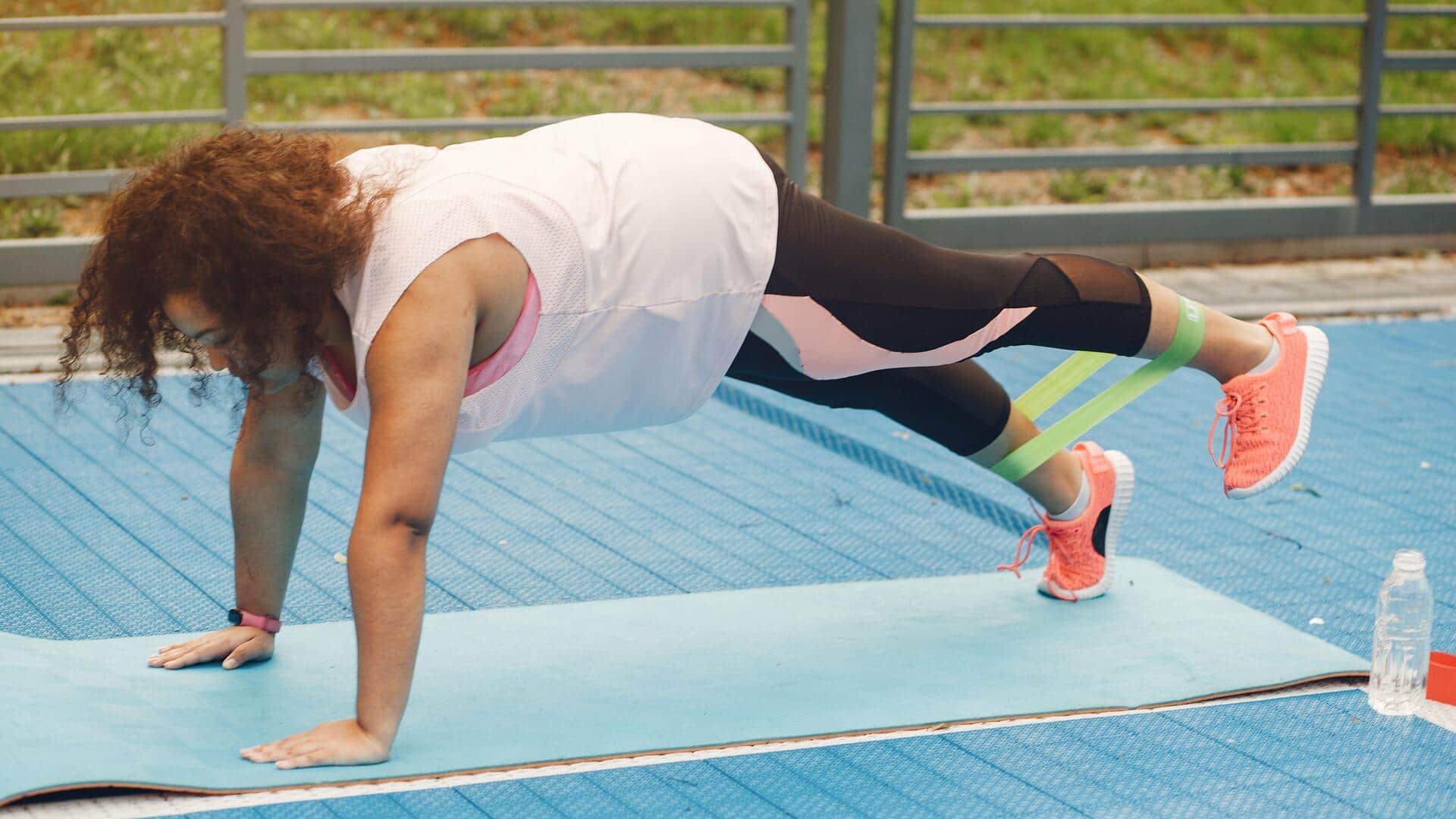
5 plank variations using resistance bands
What's the story
If you are looking to improve your core stability, resistance bands can be a great tool. They add an extra layer of challenge to regular planks, making them more effective. By adding bands, you can target different muscle groups and improve your balance and coordination. Here are five plank variations using resistance bands that can help you with core stability.
Front resistance
Band-resisted front plank
The band-resisted front plank requires you to anchor a resistance band under your feet and hold it with both hands in front of you.
This variation increases the tension on your core muscles as you try to maintain stability against the pulling force of the band.
It engages your abs, obliques, and lower back muscles, giving you a comprehensive core workout.
Side lift
Side plank with band lift
For the side plank with band lift, wrap a resistance band around your top arm and anchor it at the bottom.
As you perform a side plank, lift the banded arm toward the ceiling against its resistance.
This variation targets the obliques and shoulders, while improving lateral stability.
Jumping Jack
Plank jacks with resistance band
Plank jacks with a resistance band add an element of cardio to your core workout.
Place the band around your ankles or feet, and perform plank jacks by jumping your feet in and out while maintaining a plank position.
The added resistance challenges your lower body muscles and enhances overall coordination.
Push-up pull
Plank to push-up with band pull
In plank to push-up with band pull, secure one end of a resistance band under each hand while in a plank position.
As you transition from plank to push-up position, pull one end of the band towards you with each push-up.
This variation engages both upper body and core muscles effectively.
Single leg extension
Single-leg plank with band extension
For single-leg plank with band extension, loop one end of the resistance band around one foot, and anchor it at the other end.
Extend the leg with the band behind you while holding a single-leg plank position.
This variation improves balance and strengthens both legs and core simultaneously.