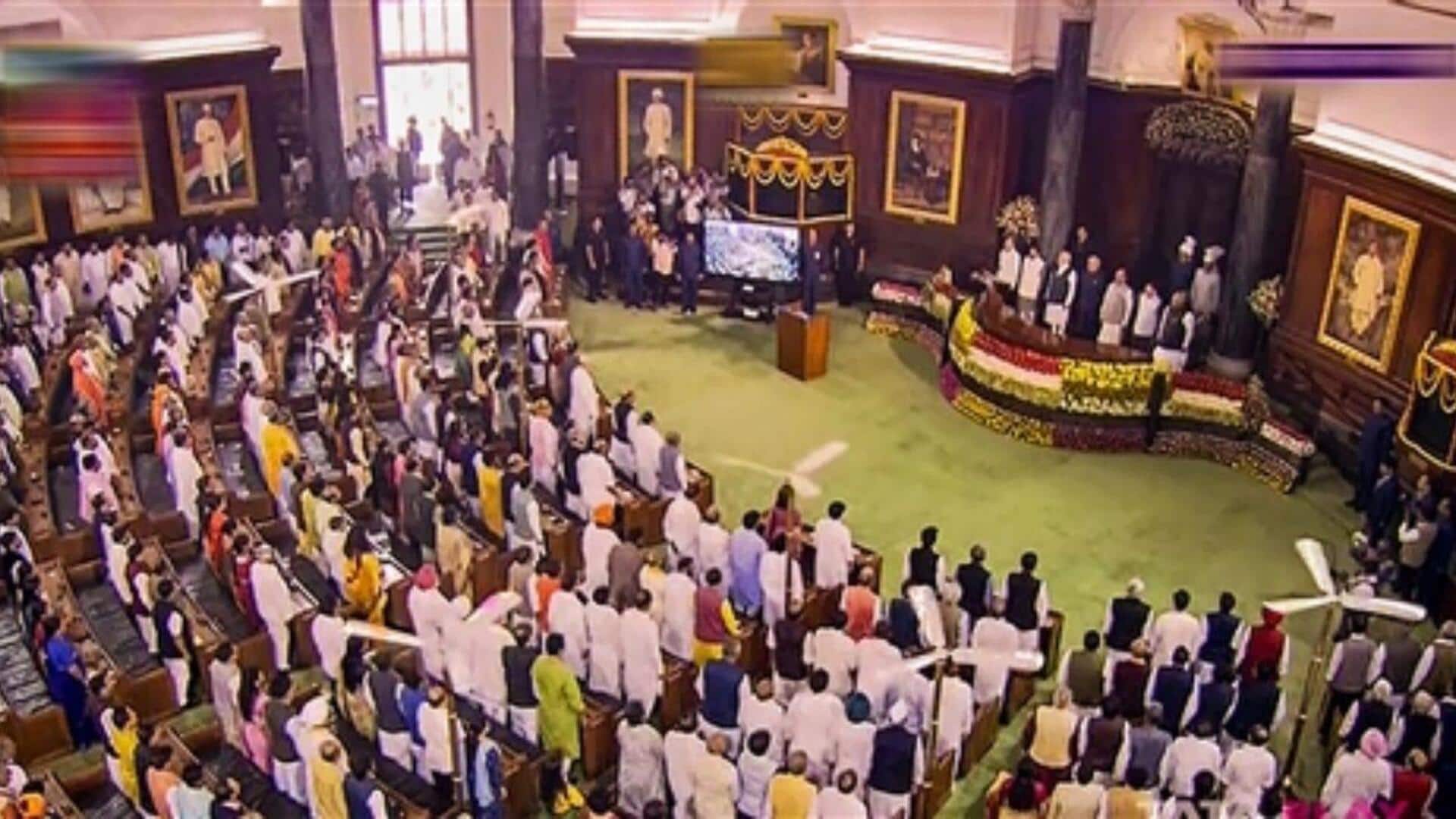
Centre releases FAQs on timing of Women's Reservation Bill
What's the story
The central government has released a set of Frequently Asked Questions (FAQs) regarding the Women's Reservation Bill and other important bills. This comes after the National Democratic Alliance's (NDA) failure to secure 33% reservation for women in the Lok Sabha. The bill required a two-thirds majority, but only 298 members supported it while 230 opposed it.
Legislative strategy
Three key bills introduced in Lok Sabha
On April 16, 2026, the central government introduced three key bills in the Lok Sabha: The Constitution (One Hundred and Thirty-First Amendment) Bill, 2026, The Delimitation Bill, 2026 and The Union Territories Laws (Amendment) Bill, 2026.
These bills were aimed at implementing women's reservation based on delimitation after the post-2026 Census.
Delinking the Act from this condition was necessary to ensure women could benefit from 33% reservation in the upcoming elections.
Seat increase
Number of Lok Sabha seats to increase to 850
The proposed bills would have increased the number of Lok Sabha seats from 550 to 850.
According to the Centre, this was done to ensure fair representation in Parliament as India's population has grown from 54 crore in 1971 to 140 crore now.
The government assured that no changes were proposed to the Delimitation Commission Act, and ongoing state elections would not be affected by these proposals.
Representation impact
More reserved seats for SC, ST
The proposal for a uniform 50% increase in Lok Sabha seats was aimed at maintaining proportional representation across states and Union Territories (UTs).
If implemented, this would have slightly increased the share of southern states from 23.76% to 23.87%.
The delimitation process would also ensure more reserved seats for Scheduled Castes and Scheduled Tribes, strengthening their representation in Parliament.
Reservation framework
Other important points on women's reservation bill
The Centre futher asserted that the Women's Reservation Bill was passed in 2023 to create a legal framework for women's reservation. However, it couldn't be implemented in the 2024 elections due to the need for delimitation.
The government has also started a time-bound program for the caste census with detailed enumeration during the population counting phases.
There is no provision for religious-based reservations; policies are based on social and economic backwardness.