Japan shifted further east after 2011 earthquake, study reveals
What's the story
A new study has uncovered a previously unknown seismic event that caused Japan to move eastward after the 2011 earthquake. The research, led by University of Chicago geophysicist Sunyoung Park, found that nearly all of mainland Japan shifted eastward by about five to six millimeters during the quake. This movement was not immediately linked to the initial earthquake and occurred before any major aftershocks.
Research findings
New type of deep-diving wave event
The study discovered that waves from the 2011 earthquake traveled down to Earth's core and bounced back, displacing four tectonic plates.
This is a new type of deep-diving wave event, which is very unusual due to its broad nature.
The displacement was smaller than typical earthquake movements but covered a larger area, releasing energy equivalent to a 7.5 magnitude earthquake.
Earthquake impact
Tohoku earthquake's impact
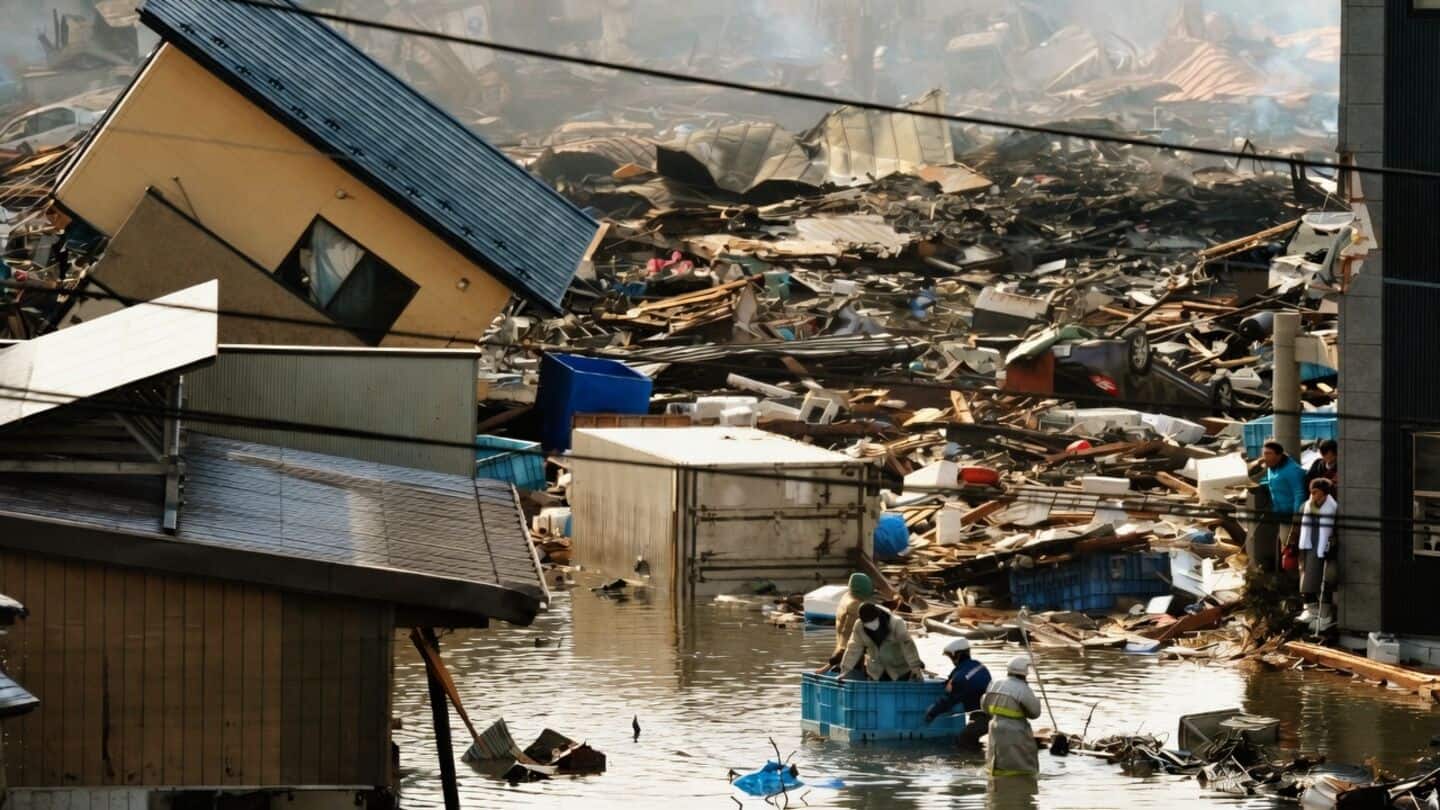
The 2011 earthquake, which struck off the coast of Tohoku, Japan, was the most powerful in the country's history. It triggered a massive tsunami and a nuclear crisis.
The quake killed around 20,000 people.
The study's findings highlight an unknown source of seismic hazard that policymakers should consider when planning for future disasters.
Predictability factor
Anticipating seismic events
Unlike aftershocks, which are unpredictable, this new seismic event could be anticipated as it takes about 15 minutes for the waves to travel to Earth's core and back.
However, since the energy was spread over a large area, it would have caused less damage than a typical magnitude 7.5 earthquake.
The study also considered other explanations for Japan's shift but found them unlikely given their localized impacts.
Research significance
Implications for future research and preparedness
The study's findings have important implications for understanding how large earthquakes can affect fault systems in unexpected ways.
Amanda Thomas, a geophysicist at the University of California, said that this observation gives researchers another piece of the puzzle in understanding fault behavior.
The research could lead to better preparedness for future seismic events by highlighting this newly recognized phenomenon.