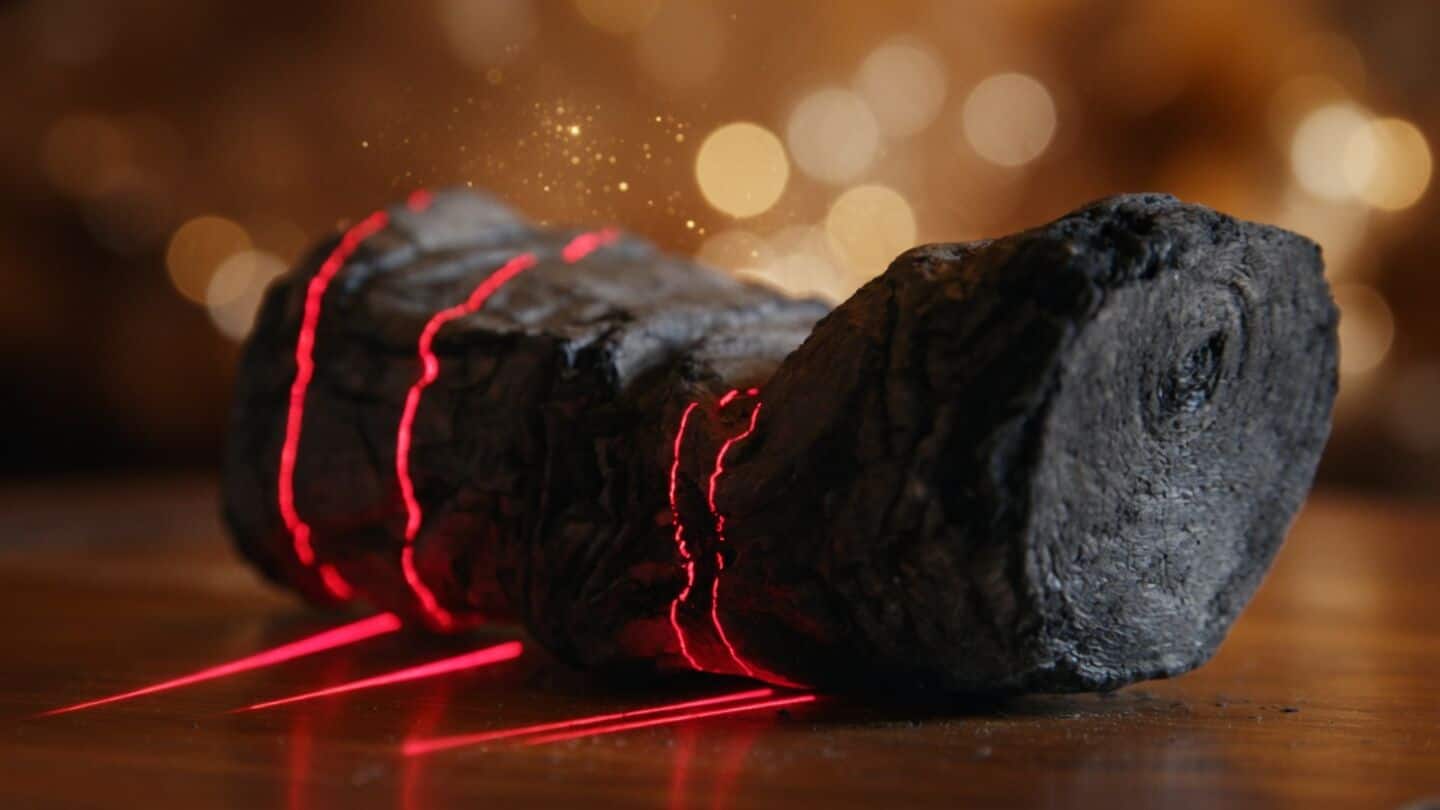
Ancient scroll charred during Vesuvius eruption deciphered using AI
What's the story
A team of researchers has successfully used artificial intelligence (AI) to virtually unroll and partially decipher a papyrus scroll that was burned and carbonized during the Mount Vesuvius eruption nearly 2,000 years ago. The scroll, known as PHerc. 1667, is one of many from the ancient Roman city of Herculaneum, which was buried under volcanic debris in 79 AD.
Historical find
Scrolls were discovered in the 18th century
The collection of scrolls was discovered by an Italian farmer in the 18th century, buried under mud and ash in a villa thought to belong to Julius Caesar's father-in-law.
This is the only large-scale library known to have survived from classical antiquity.
The scrolls were carbonized during the eruption, making them extremely fragile and difficult to unroll without causing damage or destruction.
AI initiative
The Vesuvius Challenge
In 2023, Brent Seales, a computer science professor at the University of Kentucky, and entrepreneurs Nat Friedman and Daniel Gross launched the Vesuvius Challenge.
The initiative invites researchers worldwide to virtually unwrap and decode these ancient texts using advanced AI trained to identify ink on papyrus.
The process begins with CT scans of each coiled-up, warped papyrus before researchers virtually flatten them for exploration.
Breakthrough
Researchers announced their breakthrough in Naples
At a conference in Naples, Italy, the research team announced their historic breakthrough, successfully unrolling one scroll completely and revealing nearly 1.5 meters of text across 20 columns.
Federica Nicolardi from the University of Naples Federico II led a team of papyrologists to create machine learning models and interpret the text from these ancient texts.
"This scroll was deemed completely unreadable when part of it was opened in the 1980s," Nicolardi said.
Textual analysis
The text appears to be a philosophical discussion
The scroll PHerc. 1667 is the only surviving fragment of a once-complete scroll, measuring about eight centimeters in height and two centimeters in diameter.
It was mostly intact when discovered but has been reduced in size due to unrolling attempts over time.
The text appears to be a philosophical discussion on ethics, arts, and human behavior, possibly reflecting Stoic thought.