Astronomers say Milky Way consumed a dwarf galaxy
What's the story
A team of astronomers has discovered a peculiar cluster of stars, which they believe to be the remnants of a dwarf galaxy devoured by the Milky Way some 10 billion years ago. The ancient galaxy, dubbed Loki after the Norse god of mischief, could provide new insights into the early evolution and growth of our home galaxy.
Galactic evolution
The Milky Way's early growth
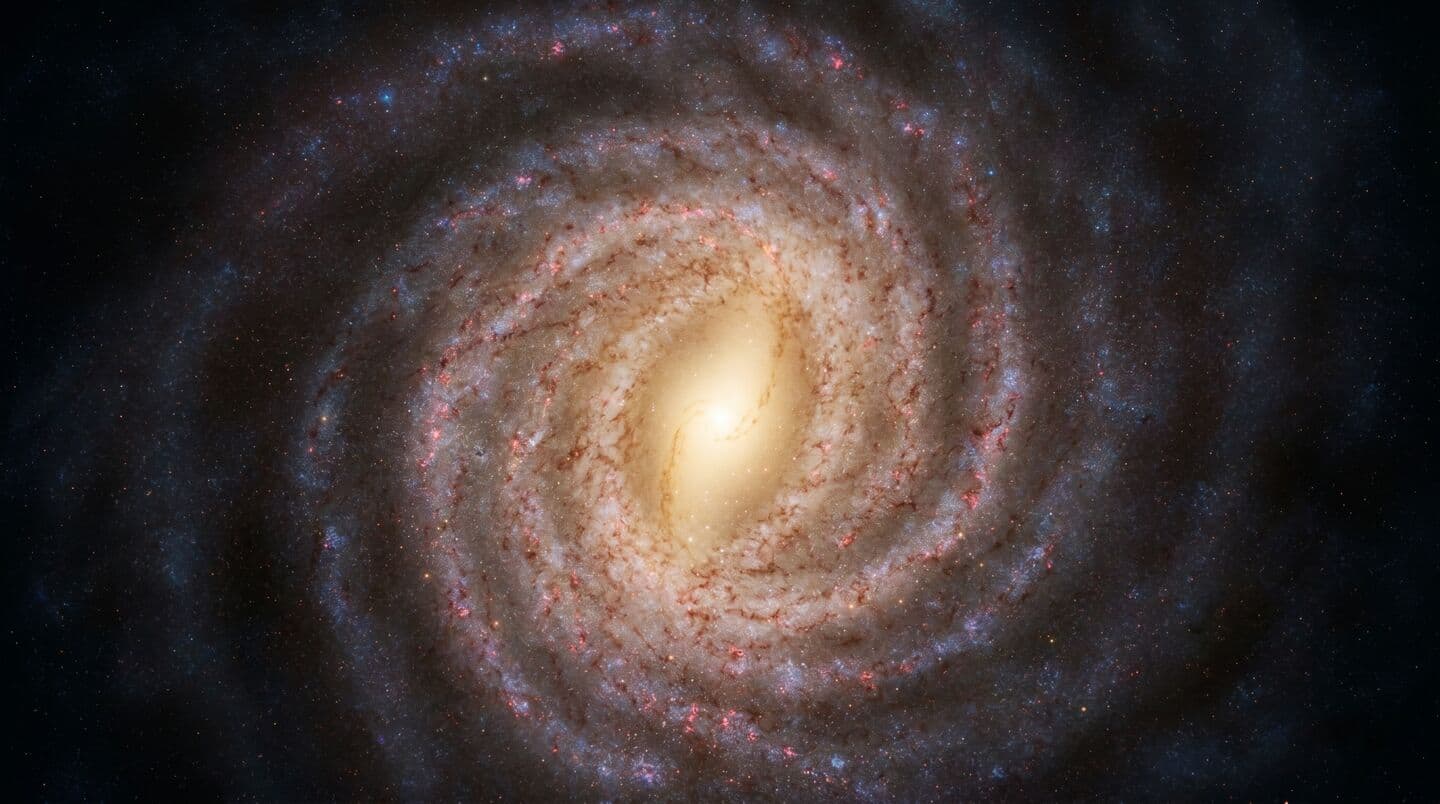
The Milky Way, a massive galaxy spanning some 100,000 light-years and housing between 100 billion and 400 billion stars, wasn't always this big.
It started growing about 12 billion years ago by merging with several dwarf galaxies.
However, the exact size and mass of the early Milky Way remain unclear. This has led scientists to look for traces of these consumed galaxies to better understand its history.
Stellar clues
Discovery of metal-poor stars
A study published in May in the Monthly Notices of the Royal Astronomical Society highlighted a cluster of metal-poor stars unusually close to the galactic disk.
The galactic disk is a massive rotating region that contains most of the Milky Way's stars.
These stars are particularly interesting as they are thought to be remnants from ancient dwarf galaxies that could have been consumed by our galaxy over time.
Stellar analysis
Identifying the ancient dwarf galaxy
Using data from the European Space Agency (ESA)'s Gaia telescope, astronomers identified 20 metal-poor stars surprisingly close to the disk.
These stars are all located some 7,000 light-years from our solar system and have similar chemical compositions.
This suggests they all originated from the same metal-poor dwarf galaxy, possibly Loki.
Cannibalistic growth
Insights from stellar orbits
The stars' orbits also provide clues about the Milky Way's early growth.
Eleven of the stars were found to be in a prograde orbit, moving in the same direction as the galactic disk, while nine were on a retrograde orbit, moving in the opposite direction.
This suggests that these stars could be remnants of a dwarf galaxy consumed by the Milky Way just a few billion years after the Big Bang.
Historical impact
Implications for our understanding of the Milky Way
The discovery of Loki and its remnants could significantly alter our understanding of the Milky Way's history.
"If this is real, it would indicate that we are missing a major part of our Milky Way's formation history," Dr. Alexander Ji wrote in an email.
The study also highlights how detailed chemical element abundances can be used as a fingerprint to identify stars from a now-destroyed satellite galaxy.