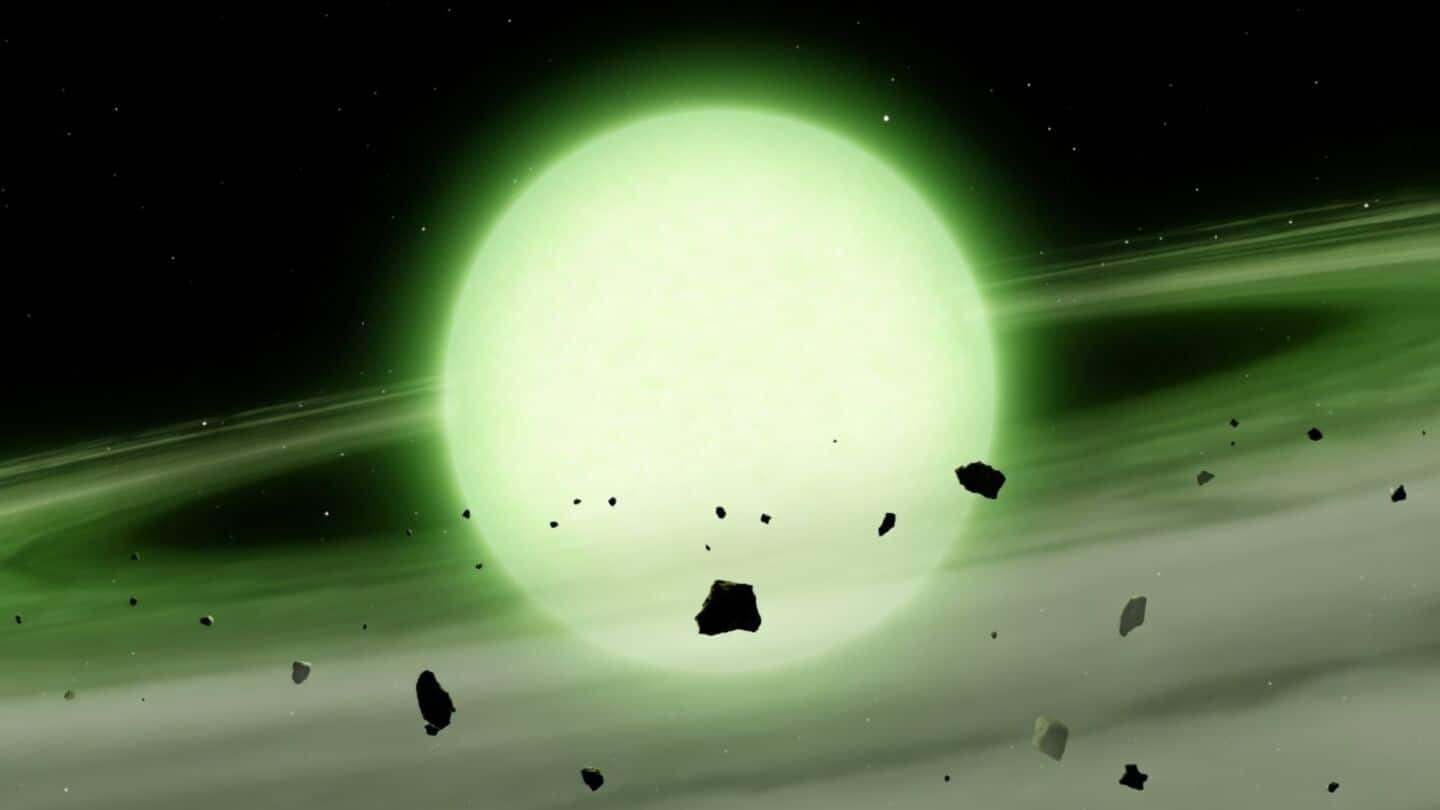
We have found the first green star
What's the story
Astronomers have discovered a star that would appear green to the human eye. The finding was made while studying white dwarf stars, the dense remnants of Sun-like stars that have died. Unlike most stars, white dwarfs can emit an astonishing range of colors. This is because of the unique physics in their outer layers, which can cause significant deviations in their spectrum. These deviations are caused by the interaction between helium in their atmosphere and traces of other elements.
Stellar composition
What do the surface elements of white dwarfs tell us?
Elements like iron, magnesium, and sodium, found on the surface of white dwarfs, could be remnants of a nearby former planetary system or from an asteroid that came too close.
These rocky bits of dust and debris fall onto the white dwarf, mix into its outer layers, and provide clues about the chemistry of planetary material.
Stellar analysis
The study and its findings
The researchers studied 151 known white dwarf stars within 20 parsecs (around 65 light years) of Earth.
Among these, the green star stood out with its composition of calcium, sodium, and lithium.
This unusual combination piqued the interest of astronomers who were not part of the study but were intrigued by why this particular object was accumulating so much material.
Color calculation
How did scientists determine the color of these stars?
Although no white dwarf stars can be seen directly from Earth, their colors were calculated using spectral data.
This is the 'fingerprint' created when starlight is split apart by wavelength, much like a prism splits sunlight into a rainbow.
The study's authors hope this method will help bring these distant space objects closer to home for researchers and the public alike.
Upcoming studies
What is next for researchers?
The study's authors plan to continue their research by analyzing more white dwarf star spectra.
With advancements in scientific techniques, researchers will soon be able to study a new batch of stars even farther away from Earth.
The team hopes that this will lead to an increase in the number of known green white dwarfs, further expanding our understanding of these celestial bodies.