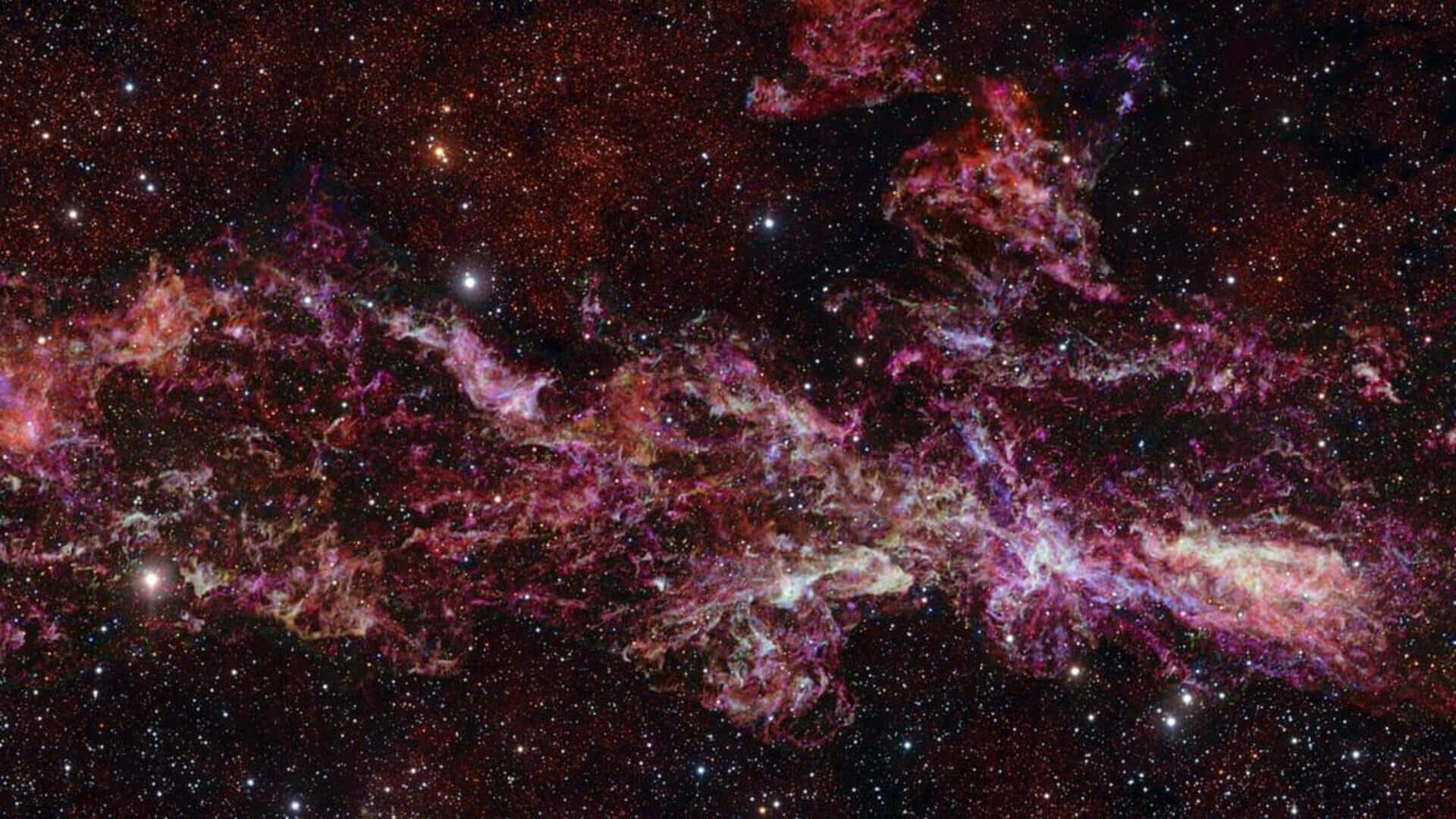
New image reveals Milky Way in stunning detail
What's the story
Astronomers have unveiled the most detailed image of the turbulent heart of our Milky Way galaxy, a stunning web of cosmic gas filaments swirling around its central black hole. The breathtaking new view was created using data from the Atacama Large Millimeter/submillimeter Array (ALMA) observatory in Chile. It reveals the Central Molecular Zone (CMZ), a chaotic region of cold molecular gas that stretches over 650 light-years across and surrounds our galaxy's supermassive black hole.
Stellar nursery
CMZ is a dense region filled with raw material
The CMZ is a dense region filled with the raw material for star formation. For the first time, astronomers have mapped this cold gas across the entire CMZ in unprecedented detail.
"It's a place of extremes, invisible to our eyes, but now revealed in extraordinary detail," said Ashley Barnes from the European Southern Observatory (ESO), who is part of an international research team studying this region.
Research initiative
The observations were made as part of ACES survey
The observations were made as part of the ALMA CMZ Exploration Survey (ACES), led by Steve Longmore from Liverpool John Moores University.
The survey focuses on cold molecular gas, the building block of star formation.
Using ALMA's powerful radio capabilities, scientists detected dozens of molecules in this region including silicon monoxide and more complex organic compounds like methanol, acetone and ethanol.
Cosmic highways
Researchers have revealed a complex network of filaments
The dataset reveals a complex network of filaments channeling gas into dense clumps where stars begin to form.
While star formation processes are well understood in the calmer outskirts of the galaxy, conditions near the galactic center are far more extreme.
The CMZ is home to some of our Milky Way's most massive stars, which burn brightly and briefly before exploding as supernovae or even hypernovae.
Evolutionary insights
CMZ mirrors chaotic environments of early galaxies
Researchers believe the CMZ mirrors the chaotic environments of early galaxies billions of years ago.
By studying star birth in such an intense setting, astronomers hope to refine existing models of how galaxies grow and evolve.
The massive mosaic image was created by stitching together numerous individual observations, covering an area in the sky equivalent to three full Moons placed side by side.
Upcoming studies
Findings have been detailed in 5 papers accepted for publication
The findings have been detailed in five papers accepted for publication in the Monthly Notices of the Royal Astronomical Society, with another currently under review.
With planned upgrades to ALMA and the future Extremely Large Telescope, astronomers say this groundbreaking survey marks only the beginning of deeper explorations into our galaxy's dynamic heart.