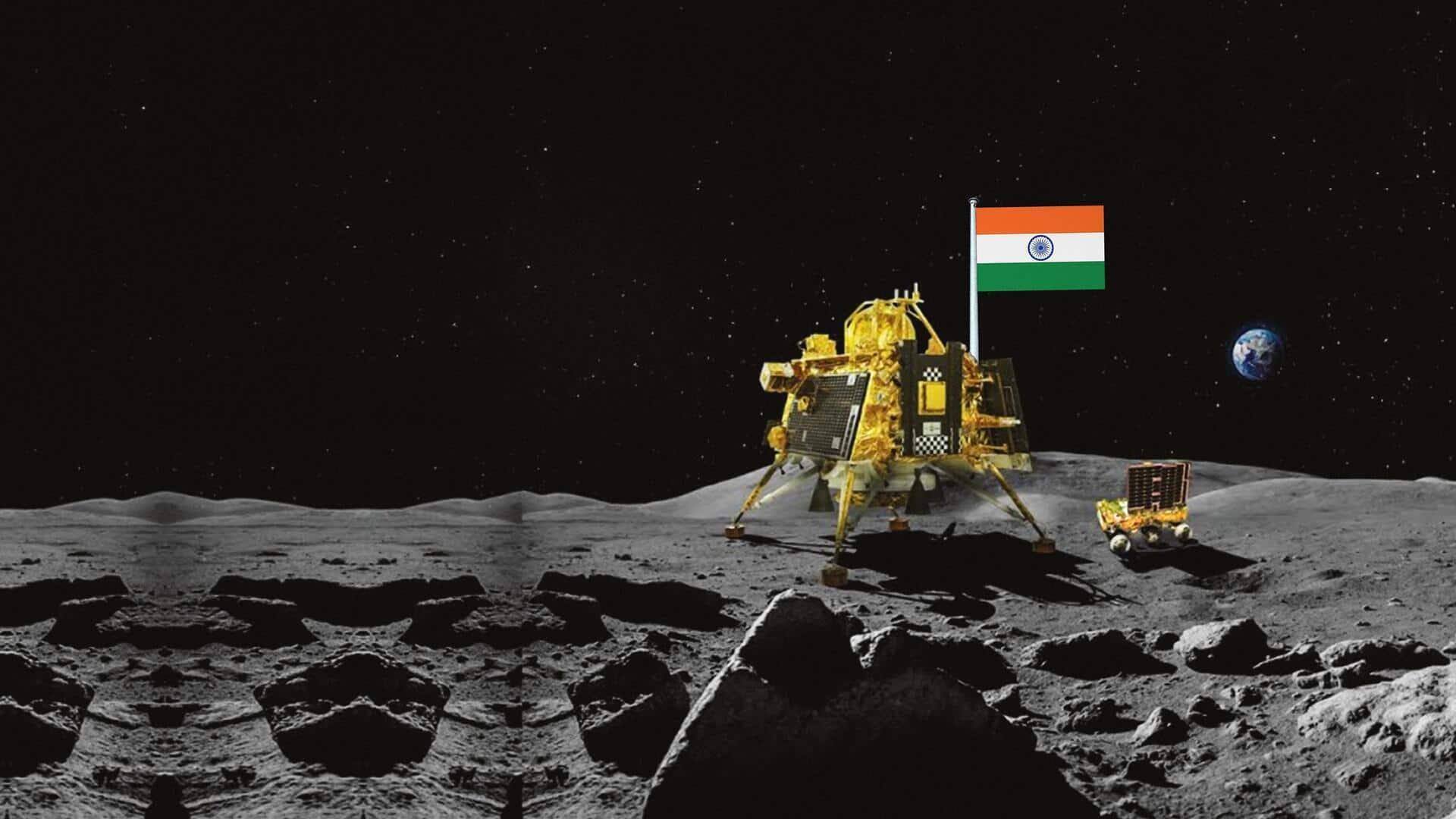
Chandrayaan-2 detects water ice beneath Moon's surface
What's the story
India's Chandrayaan-2 mission has made a major breakthrough in the quest for lunar water. Scientists from the Physical Research Laboratory (PRL) have found strong evidence of subsurface water ice in extremely cold lunar craters. The discovery, published in the journal Npj Space Exploration, is based on radar data collected by Chandrayaan-2's orbiter near the Moon's south pole.
Technological marvel
How researchers studied data from orbiter
The team behind this groundbreaking discovery, including PRL's Rishitosh Sinha, Rajiv Bharti, Kinsuk Acharyya, Sanjay Mishra, Neeraj Srivastava and Anil Bhardwaj.
They studied data from the orbiter's Dual Frequency Synthetic Aperture Radar (DFSAR). This sophisticated instrument can look a few meters below the lunar surface.
The study concentrated on nine "doubly shadowed craters" within larger permanently shadowed craters near the South Pole.
Crater analysis
What are doubly shadowed craters
Unlike regular lunar craters, these areas have been in near-total darkness for billions of years.
Their steep walls block not only sunlight but also reflected heat and scattered radiation.
This makes them some of the coldest places in the Solar System, with temperatures plummeting to nearly -248°C.
Scientists think this extreme cold could help water ice from comets, asteroids or ancient volcanic eruptions survive below the surface.
Ice discovery
Radar signatures consistent with buried water ice deposits
The team found that four of the nine craters studied showed radar signatures strongly consistent with buried water ice deposits.
The strongest evidence came from a crater, F2, within the larger Faustini crater.
According to researchers, this crater showed unusually high circular polarization ratio values and low depolarization signals—patterns indicating that radar waves were probably interacting with subsurface icy material instead of rough rocks.
Methodology advancement
Water ice or rocky terrain?
This discovery is major as scientists have long debated if radar reflections seen at the Moon's poles were due to water ice or rocky terrain.
The new study proposes a refined method to distinguish between the two.
Researchers concluded that a combination of high CPR values and very low degree of polarization provides a reliable indicator of subsurface ice, marking an important step forward in lunar exploration techniques.
Mission implications
Findings could have major impact on future lunar missions
The findings from Chandrayaan-2's orbiter could have a major impact on future lunar missions.
Water on the Moon is viewed as one of the most precious resources for long-term human exploration. Ice can potentially be turned into drinking water, breathable oxygen, and even rocket fuel for deeper space missions.
India's discovery adds vital evidence that the Moon's south pole may hide ancient ice reservoirs in deep natural freezers beneath its surface.