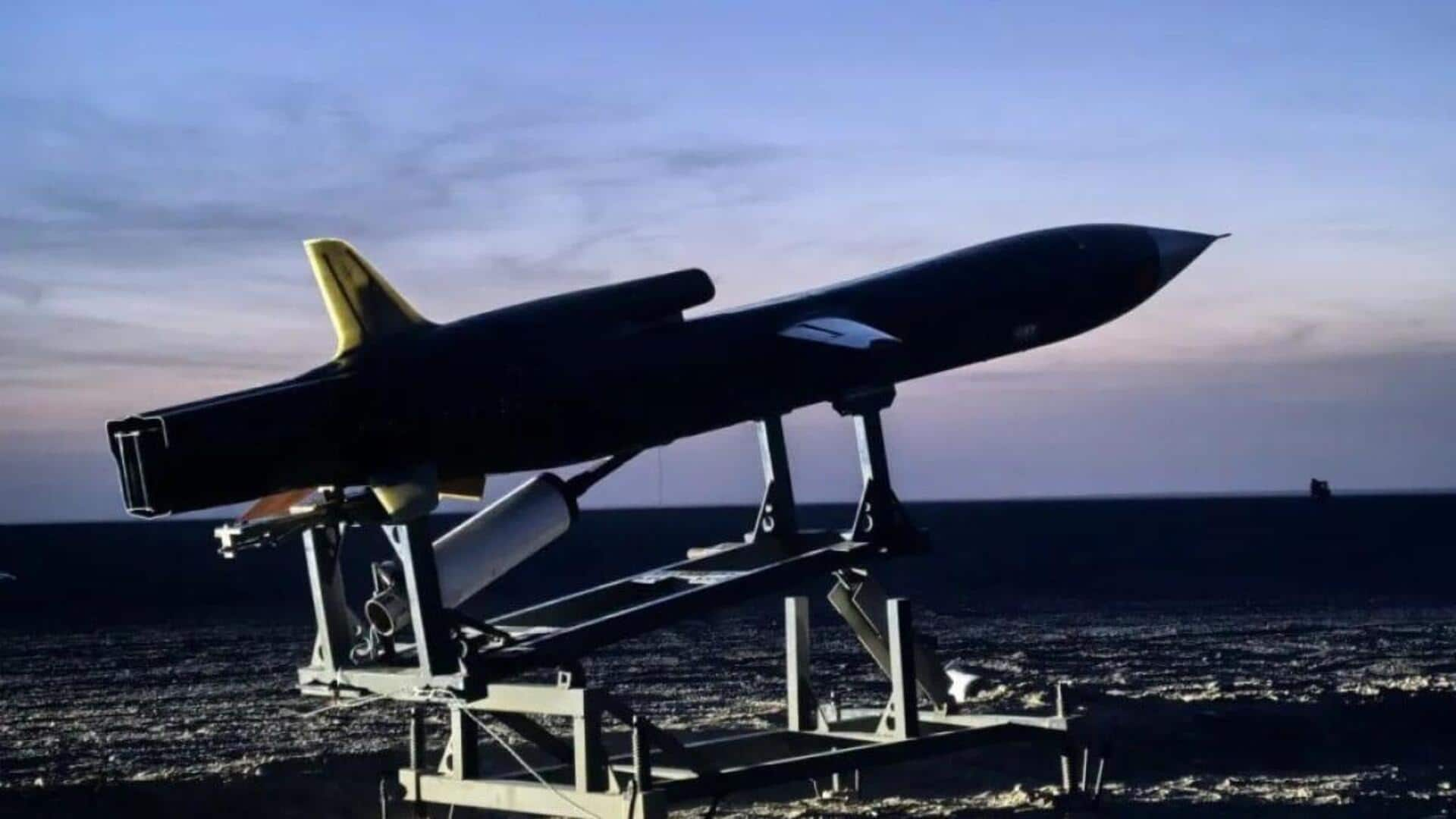
This thrust device might give drones edge over fighter jets
What's the story
A team of Chinese researchers has successfully demonstrated a revolutionary aerodynamic thrust-vectoring system on an unmanned aerial vehicle (UAV). The project, led by Professor Xu Jinglei from Nanjing University of Aeronautics and Astronautics, marks a major milestone in UAV technology. The innovative system replaces heavy mechanical actuators with aerodynamic surfaces that reshape and redirect engine exhaust. This makes the nozzle lighter, simpler, and more reliable while significantly improving maneuverability.
Test flight
First flight with aerodynamic thrust-vectoring nozzle
The new thrust system was first tested on the CK300 high-subsonic UAV, a 3.6m-long drone with a maximum takeoff weight of 140kg.
It can fly as high as 13km and reach speeds of up to Mach 0.9.
The test took place at a desert range in northwest China and was the first time a medium-to-large high-subsonic drone had flown with an aerodynamic thrust-vectoring nozzle, according to the South China Morning Post (SCMP).
Performance boost
Significant boost in maneuverability
The new tail unit of the CK300 drone gave a significant boost in maneuverability and reduced the aircraft's turning radius.
All performance indicators exceeded expectations during the flight trial.
The engineers achieved full thrust-vector control just by swapping out the nozzle, without any major modifications to the drone itself.
This shows how compatible this technology is with existing platforms and how easily it could be integrated into other high-speed UAV designs.
Future implications
Thrust vectoring on aircraft
Modern thrust vectoring systems not only propel an aircraft but also steer it by redirecting engine exhaust to control pitch, yaw, and roll.
This makes high-performance jets far more agile and can even support short takeoffs and landings.
However, these systems are mostly mechanical and used on advanced fighter jets such as the F-22, F-35B, Su-35, and Su-37.
Aerodynamic thrust vectoring aims to overcome such limitations by shaping airflow instead of moving hardware.