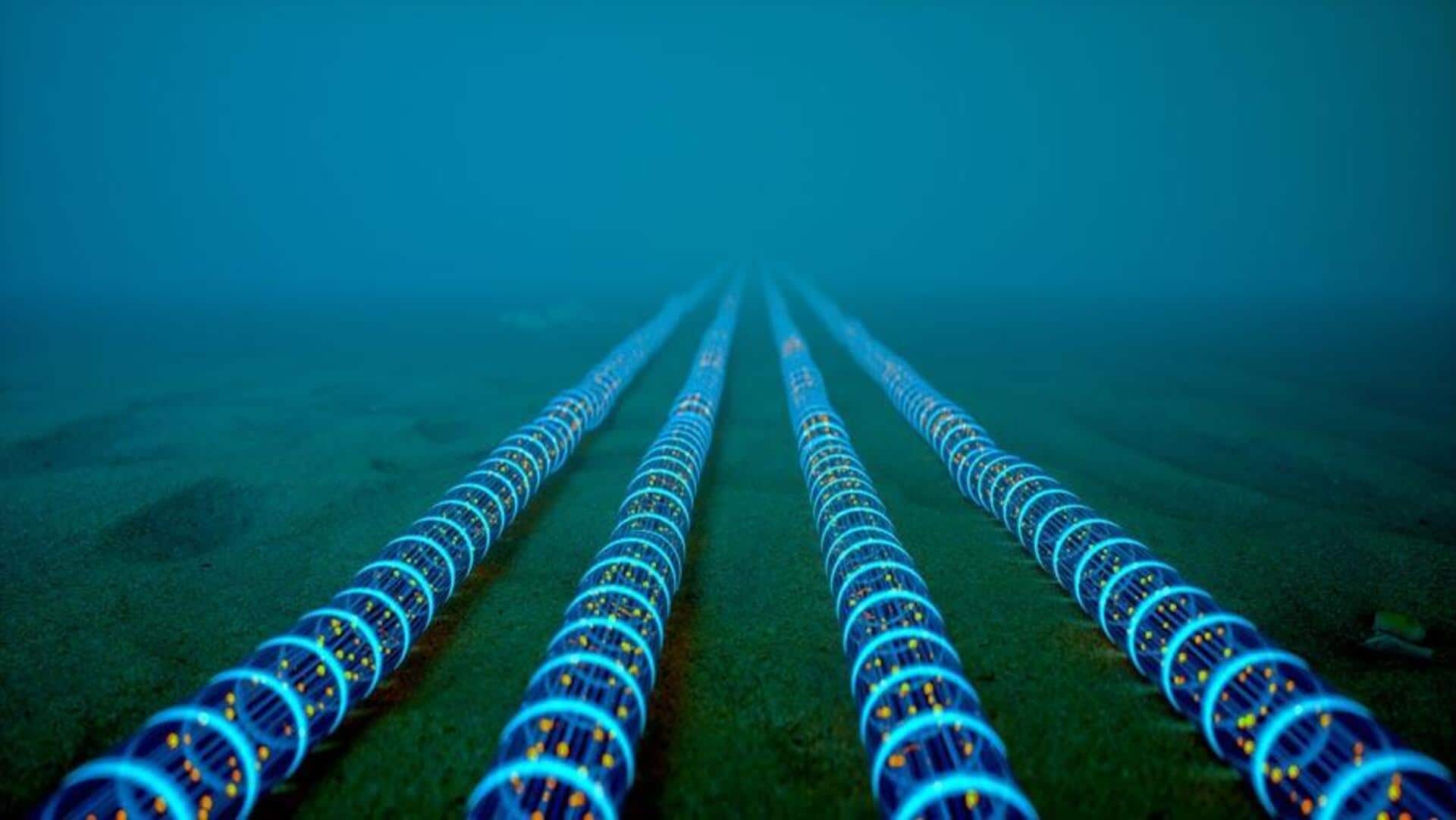
Are submarine cables carrying global data vulnerable to drone attacks?
What's the story
Chinese military researchers have warned that the underwater cables, which are critical to the global digital economy, are increasingly vulnerable to low-cost drone attacks. Shi Guanglei and Shi Haiming from the National Defence University said in an article for Science and Technology Daily that the seabed has long been considered a strategic "blind spot" due to its difficult exploration and high control costs. However, they now see it as a "new arena for great power rivalry."
Emerging risks
Aukus pact shifts dynamics of undersea warfare
Guanglei and Haiming highlighted the Aukus pact between Australia, UK, and the United States as a major factor in this shift.
They said, "The barrier to entry for undersea warfare is lowering."
The researchers noted that previous underwater operations relied heavily on manned submarines, which were expensive and posed significant risks to personnel.
This made it difficult for small and medium countries to conduct underwater military activities.
Technological shift
UUVs now pose no risk to personnel
The researchers also noted that small and medium-sized unmanned undersea vehicles (UUVs) are now "low-cost, easy to deploy in batches, and pose no risk of casualties."
This technological advancement allows countries to seize control of the seabed.
They highlighted that these undersea cables carry 99% of intercontinental data traffic, and play a key role in supporting online services and daily cross-border financial transactions worth an estimated $10 trillion.
Increased vulnerability
Recent incidents of sabotage, disruption
The researchers warned that underwater pipelines and optical cables have become an "easy target," citing incidents like the 2022 sabotage of the Nord Stream pipelines carrying natural gas from Russia to Germany.
They also noted the disruption caused to internet services after cables in the Red Sea were cut last year.
These incidents underscore the growing vulnerability of undersea infrastructure in today's geopolitical landscape.