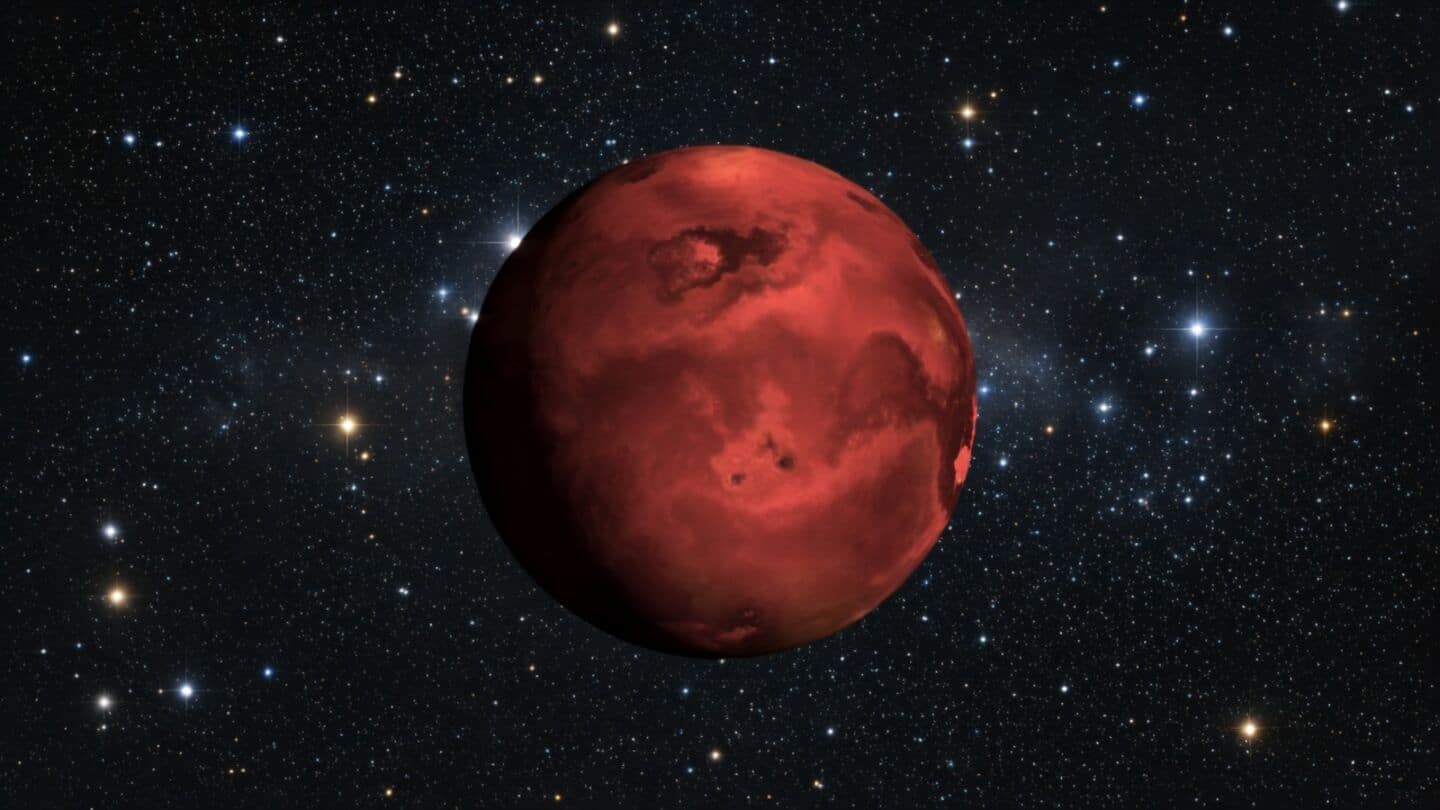
This cold lava planet might resemble our early Earth
What's the story
Astronomers have discovered a new planet, a lava world that is also cold. The newly discovered HD 3167 b is the coldest lava world ever seen with an atmosphere. The rocky super-Earth was found orbiting a star 154 light-years away from our planet. HD 3167 b is a unique addition to the catalog of over 6,300 exoplanets discovered since the first one was confirmed over three decades ago.
Planetary features
Smallest lava world ever discovered
HD 3167 b orbits its star so closely that a single revolution around it (one year) takes just one Earth day. Despite being covered in lava, this super-Earth is also the smallest lava world ever discovered and has somehow retained its atmosphere.
Research methods
James Webb Space Telescope was used to study
The team used the James Webb Space Telescope's MIRI (mid-infrared instrument) to study HD 3167 b.
The instrument allowed them to observe the planet in mid-infrared light, estimate its temperature, and look for signs of an atmosphere.
They observed the planet during a "secondary eclipse," looking for changes in mid-infrared light when it passed behind its star.
Atmospheric analysis
Unusually cool planet with an atmosphere
HD 3167 b is tidally locked, a common trait among lava worlds. This means one side always faces its star while the other remains in perpetual darkness.
If it had no atmosphere, its dayside would be "as hot as theoretically possible," lead author Brandon Park Coy said.
However, they found an unusually cool planet with an atmosphere that "is noticeably cooler than its expected maximum," Coy added.
Temperature regulation
Most lava worlds probably have atmospheres
The researchers concluded that the planet likely has an atmosphere that cools its dayside by reflecting light from its star, and redirecting that heat to the nightside.
This discovery supports a growing consensus among scientists that most lava worlds probably have atmospheres.
The study was published in The Astrophysical Journal Letters, as part of a larger program examining 10 different lava worlds to determine at what temperatures they tend to form atmospheres.