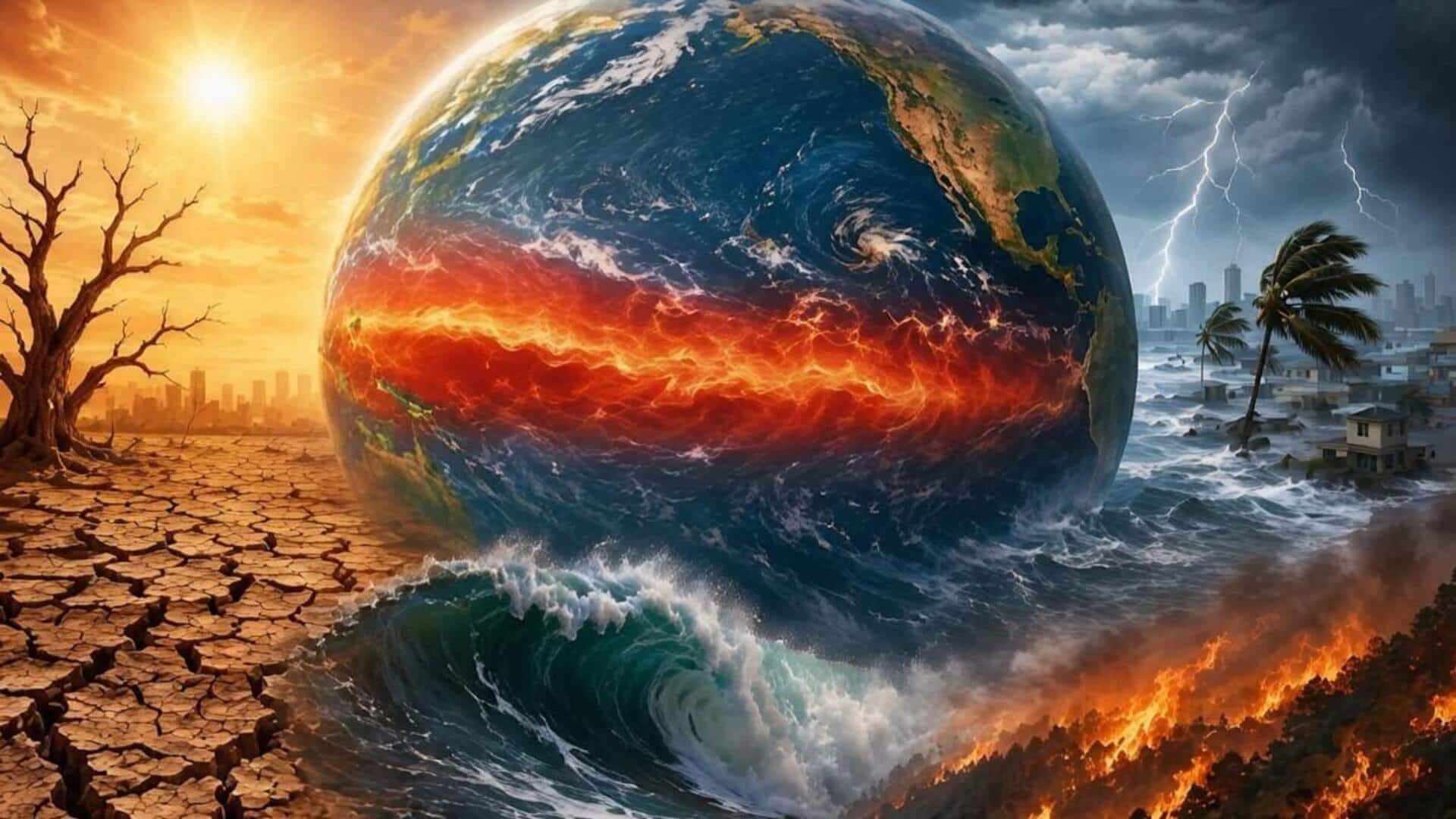
El Nino breaks temperature record in key Pacific zone
What's the story
The Copernicus Climate Change Service has reported an unprecedented rise in sea surface temperatures in a key region of the Pacific Ocean. The area, known as Nino3.4, recorded an "all-time high" of 29.7°C last month. This is higher than the peak temperatures recorded during previous strong El Nino events in 1982-1983, 1997-1998 and 2015-2016.
Climate effects
El Nino raises sea temperatures, triggers extreme weather
El Nino, the warming phase of the naturally occurring El Nino-Southern Oscillation (ENSO), increases sea surface temperatures across the tropical eastern Pacific.
This triggers extreme shifts in rainfall and drought patterns worldwide.
The Copernicus Climate Change Service has warned that while it can't yet confirm if this is the strongest El Nino on record, its intensity is already exceptional considering we are not at its peak yet.
Global confirmation
Japan confirms strongest El Nino on record
Japan's weather agency has confirmed that El Nino conditions have reached their "strongest intensity on record."
The temperatures in the phenomenon's monitoring area are 4°C above normal.
This further highlights the exceptional strength of this particular El Nino event, which is still intensifying and expected to peak later this year.
Temperature records
Global average sea surface temperatures also hit record high
As El Nino intensifies, global average sea surface temperatures have also hit a record high of 21.05°C for September.
This is higher than the previous record of 20.92°C set in September 2023, according to Copernicus.
The world also experienced its second hottest September on record with an average surface air temperature of 16.27°C, 1.63°C above the pre-industrial average (1850-1900).
Climate goals
Crossing Paris Agreement's long-term limit 'only a matter of time'
The United Nations has warned that the long-term 1.5°C target set in the Paris Agreement will be missed within years.
"We are in a new run of months above 1.5C, and with a strong El Nino still intensifying it is likely to last into 2027," said Carlo Buontempo, director of Copernicus.
"Crossing the Paris Agreement's long-term limit is only a matter of time. How far we overshoot, and for how long, is still up to us," he added.