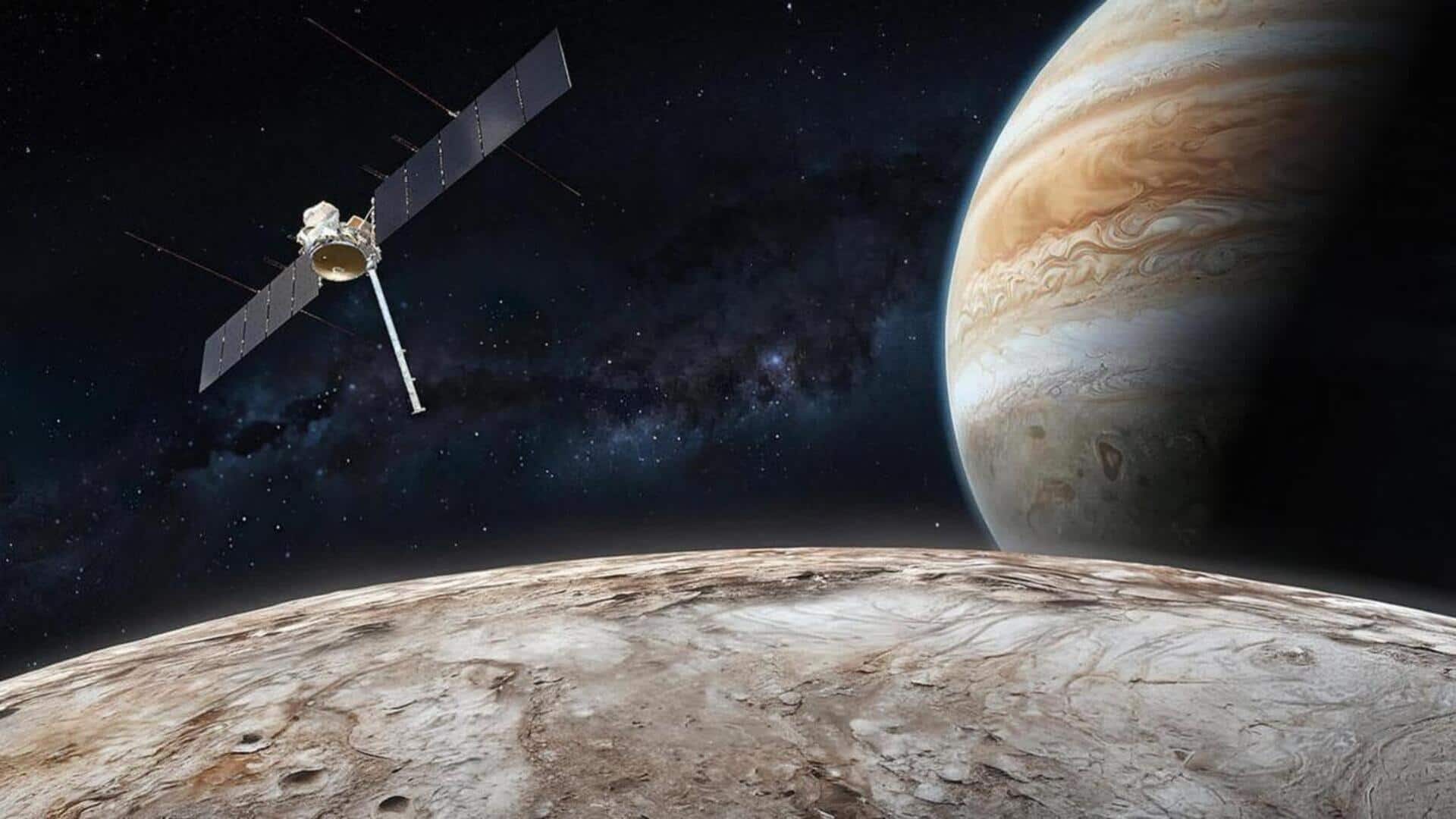
ESA outlines major Moon, Mars and satellite missions for 2026
What's the story
The European Space Agency (ESA) has unveiled an ambitious plan for 2026, featuring a series of groundbreaking space missions. These include lunar flybys, asteroid studies, and Mercury orbit insertion. The year will also see the launch of advanced satellites for Earth observation and global navigation systems. The ESA's 2026 mission calendar highlights key events and scientific milestones aimed at expanding Europe's presence in space.
Mission details
LEO-PNT Celeste Constellation: A leap in satellite technology
The first mission on ESA's list is the LEO-PNT Celeste Constellation, a 10-satellite network to be launched between January and March.
The constellation will support positioning/navigation and complement the Galileo system, providing more accurate global navigation.
It will be used for transportation, emergency services, and scientific applications.
Asteroid study
Hera deep space maneuver: A step toward planetary defense
In February 2026, ESA's Hera mission will perform a deep space maneuver en route to the Didymos binary asteroid system.
The mission aims to study Dimorphos, the smaller moonlet, after NASA's DART impact.
Hera will measure how the asteroid responds to kinetic impacts as part of planetary defense research for Earth's protection.
Human exploration
Artemis II: A historic lunar flyby
The Artemis II mission, scheduled for April 2026, will carry four astronauts on a Moon flyby.
ESA is contributing the European Service Module for life support and propulsion.
This mission will test spacecraft systems for future lunar landings and mark NASA's first crewed mission beyond low Earth orbit since Apollo.
Satellite expansion
Galileo satellite launch: Strengthening Europe's navigation network
Between May and June 2026, two new Galileo satellites will be launched aboard Ariane 6.
This launch will expand Europe's satellite navigation network, improving coverage, redundancy, and reliability for users worldwide.
The satellites will support civil, commercial, and government navigation applications while working together with existing Galileo satellites in orbit.
Climate study
MetOp-SG B1: A new era in weather monitoring
The MetOp Second Generation B1 satellite is scheduled to launch between July and December 2026.
It will monitor Earth's weather, climate, and atmospheric conditions, providing data for forecasts and climate research.
The mission will help track extreme events like storms, floods, and heatwaves while supporting scientists in understanding global climate patterns.
Planetary exploration
BepiColombo: Exploring Mercury's mysteries
In November 2026, the BepiColombo mission will enter Mercury's orbit. It carries two orbiters: ESA's Mercury Planetary Orbiter and JAXA's Magnetospheric Orbiter.
The spacecraft will study Mercury's surface, magnetic field, and exosphere.
This mission provides insights into planet formation and solar system evolution, marking a major milestone for inner Solar System exploration.
Exoplanet study
PLATO mission: Unraveling the secrets of exoplanets
In December 2026, ESA's PLATO mission will be launched to study exoplanets.
It will detect rocky planets in habitable zones around distant stars and measure star properties and planet densities.
The data from PLATO could reveal solar system analogs beyond our own, helping scientists understand planet formation and habitability.