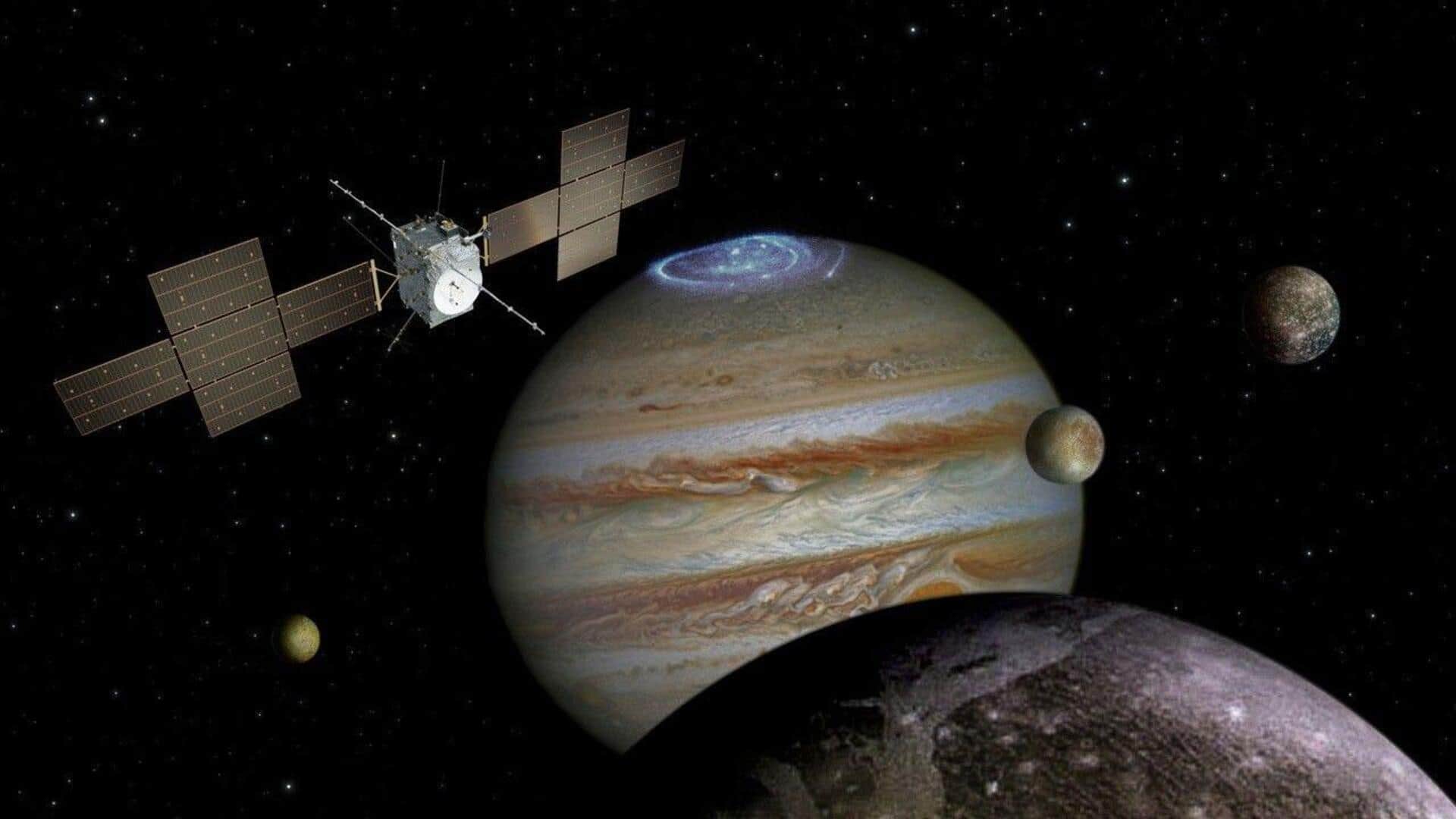
Jupiter-bound spacecraft receives a 12,606km/h speed boost from Earth
What's the story
The European Space Agency's (ESA) Jupiter Icy Moons Explorer (JUICE) spacecraft has successfully completed its third gravity assist flyby. The maneuver was performed yesterday, when JUICE came within 8,640km of Earth's surface. The close encounter provided the probe with a much-needed speed boost and trajectory adjustment for its ongoing journey to Jupiter and its moons.
Mission strategy
JUICE has used gravity assist flybys to save fuel
Launched in April 2023, JUICE has strategically used gravity assist flybys to adjust its speed and trajectory. This is the third such maneuver in its mission.
The first was a lunar-Earth flyby in August 2024, followed by another one using Venus's gravity in August 2025.
These maneuvers are essential as they save fuel that would otherwise be needed to reach Jupiter at high speeds and slow down for orbital insertion later on.
Operational challenges
Earth flyby was less complex than lunar-Earth maneuver
The Earth flyby was a complex operation, requiring careful planning and continuous monitoring.
However, it was simpler than the 2024 lunar-Earth flyby that set JUICE up for this encounter.
"This is great news for science, because it means we will be able to turn JUICE in all different directions to point its science instruments at different parts of Earth and the moon," said Claire Vallat, Juice Project Scientist, in a statement.
Mission progress
Flyby adjusted JUICE's trajectory by some 20 degrees
The latest flyby has adjusted JUICE's trajectory by some 20 degrees and boosted its speed by about 12,606km/h (3.5km/s).
The spacecraft was above the Indian Ocean at its closest approach to Earth around 7:45am EDT (5:15pm IST).
This strategic maneuver ensures that JUICE will have enough fuel to enter Jupiter's orbit in 2031 and later hop into an orbit around Ganymede, one of Jupiter's moons, in 2034.