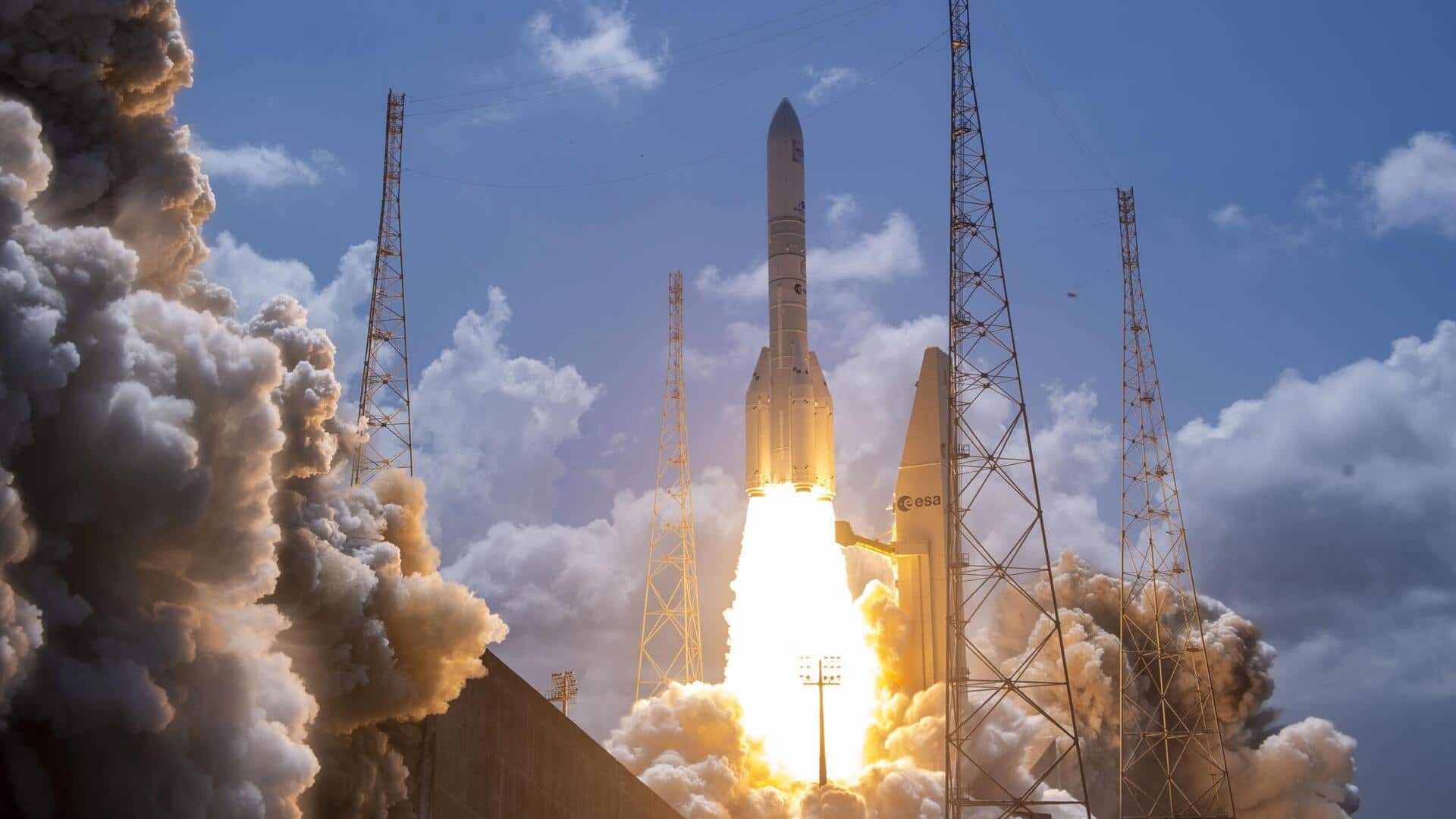
Europe cancels upgrades for Ariane 6, its main space rocket
What's the story
The European Space Agency (ESA) has decided to cancel the "Block 3" upgrades for its Ariane 6 rocket. The decision was first reported by European Spaceflight on Thursday. The Block 3 upgrade was supposed to include a lightweight ICARUS upper stage made of carbon-composite structures.
Mission implications
Implications for ESA's science missions
The cancellation of the Block 3 upgrade could affect several ESA missions, including one planned for Saturn's icy moon Enceladus.
The decision raises questions about the future of the Ariane 6 program.
So far, Ariane 6 has provided reliable access to orbit for Europe's most important satellites, especially after Russia's invasion of Ukraine forced Europe to stop using Russian rockets.
Cost concerns
Concerns over launch costs
Despite its success, the future of Ariane 6 is marred by high launch costs.
The European ministers who fund the rocket's development are reportedly hesitant about these upgrades, which could indicate their growing impatience with the rocket's cost.
Although France-based Arianespace has not publicly disclosed the cost of an Ariane 6 launch, it is estimated to be between €80 million and €100 million.
Subsidy details
Europe is likely losing money on each private mission
Despite having several European customers and including Amazon, a major US corporation, which has contracted 18 launches for its Amazon Leo constellation, Europe is likely losing money on each private mission.
The ESA's director general, Josef Aschbacher, has confirmed that based on nine flights a year, the involved European governments will have to subsidize each launch with between €32 million and €38 million.
This means taxpayers have contributed over €100 million into each launch before Arianespace receives anything from customers.
Launch expansion
Plans for increased Ariane 6 launches
Despite these challenges, Europe hopes to fly the Ariane 6 rocket nine or 10 times a year.
There are also talks of increasing the number of Ariane 6 rockets in light of the growing global demand for launches and limited capacity.
Aschbacher said Europe is on track to achieve its target of 10 launches next year but is also considering scenarios for increasing this capacity further.