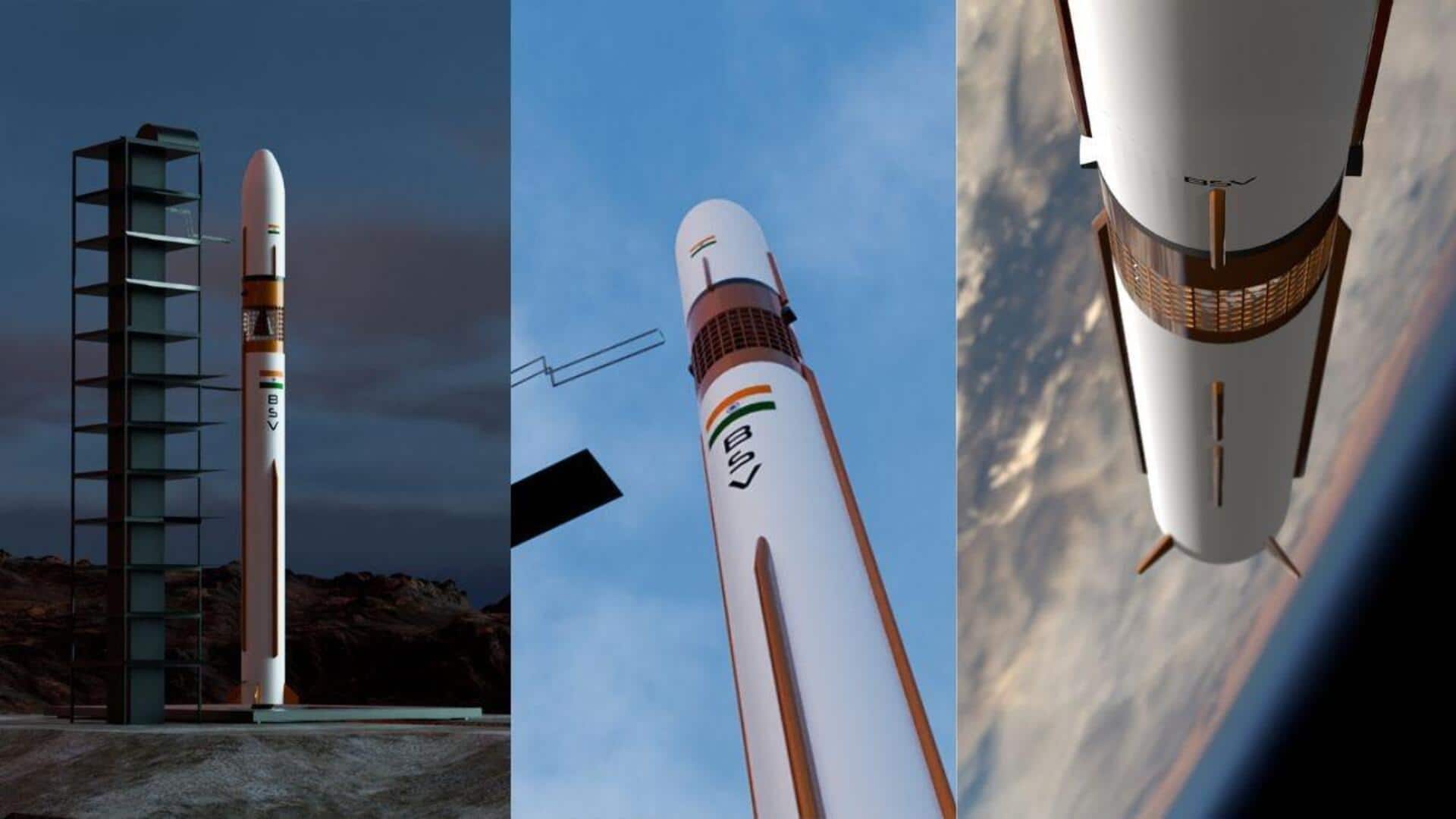
Meet Agasthya-1: Ex-ISRO scientists building rocket targeting 24-hour launch readiness
What's the story
Surat-based Bharath Space Vehicle (BSV), a start-up founded by former Indian Space Research Organization (ISRO) scientists, is working on a new rocket called Agasthya-1. The 28-meter long liquid-fueled rocket will be able to carry satellites weighing up to 500kg into orbit. The team at BSV has over 70 years of combined experience at ISRO and is now developing one of India's most promising private rocket programs.
Rocket specifications
Two-stage rocket to target small-satellites
Agasthya-1 is a two-stage expendable rocket with two LOX/RP-1 engines, or liquid oxygen and kerosene engines. It is designed to provide reliable and affordable access to space.
The small-lift vehicle targets the small-satellite market, capable of delivering 500kg payloads into a Sun-Synchronous Polar Orbit (SSPO) and 800kg into a low-inclination low-Earth orbit (LEO) at an altitude of around 400km.
Fuel choice
BSV adopts 'fly-what-you-test' philosophy
Unlike most Indian small-satellite rockets, including ISRO's own SSLV (Small Satellite Launch Vehicle), which use solid propellants, BSV has opted for a liquid bipropellant engine. This allows them to fully test it before launch.
The "fly-what-you-test" philosophy of BSV enables hot-fire acceptance tests of both the first and second stage engines on ground, significantly reducing chances of inflight failure.
Launch preparedness
Liquid engines enable 24-hour launch readiness
The liquid engines also allow BSV to be launch-ready within 24 hours of notice, a growing requirement for defense and disaster-response satellite operators.
The founding team includes Dr. N. Vedachalam, former Director of ISRO's Liquid Propulsion Systems Centre (LPSC), who led the development of the cryogenic upper stage for Geosynchronous Launch Vehicle (GSLV).
He continues to consult for ISRO, DRDO, and Ministry of Defense.
Information
BSV proposes Kodinar west-coast launch complex
BSV has proposed a launch complex near Kodinar in Gujarat's Gir Somnath district. The coastal location offers open sea access and favorable launch corridors for specialized satellite trajectories. If approved, this would be India's first west-coast orbital launch option, reducing reliance on a single spaceport.