This cosmic particle might have come from 'Shadow Blaster' galaxy
What's the story
A team of astronomers believes to have traced the origin of a ghostly cosmic particle to a star-forming galaxy dubbed "Shadow Blaster." The discovery, published in Nature Astronomy, marks a significant milestone in unraveling the enigma of neutrinos. These elusive particles are abundant throughout the universe but are notoriously difficult to trace due to their lack of electric charge and minimal mass.
Particle characteristics
Neutrinos are known as ghost particles
Neutrinos, often referred to as ghost particles, are created by supernovae, stellar nuclear reactions, and the decay of heavy particles.
"They rarely interact with matter, which is why they can travel across the universe almost undisturbed," said Dr. Yuji Urata, a researcher at Taiwan-based MITOS Science Co.
He added that even when high-energy neutrinos are detected by observatories like Antarctica's IceCube Neutrino Observatory, their precise location in the sky often has a much larger uncertainty region than a galaxy's size.
Discovery details
IceCube detected a high-energy neutrino in 2021
In 2021, IceCube detected a high-energy neutrino named IC 210922A, which appeared to originate from the Eridanus constellation.
However, follow-up observations across different wavelengths of light failed to reveal any associated astronomical events.
Days after this alert was released, Urata and his team observed a star-forming galaxy called JCMT0402-0424 with the East Asian Observatory's James Clerk Maxwell Telescope and Submillimeter Array in Hawaii.
This galaxy was later dubbed "Shadow Blaster" due to its dust-filled nature that makes it nearly invisible.
Cosmic magnification
Shadow Blaster was behind a gravitational lens
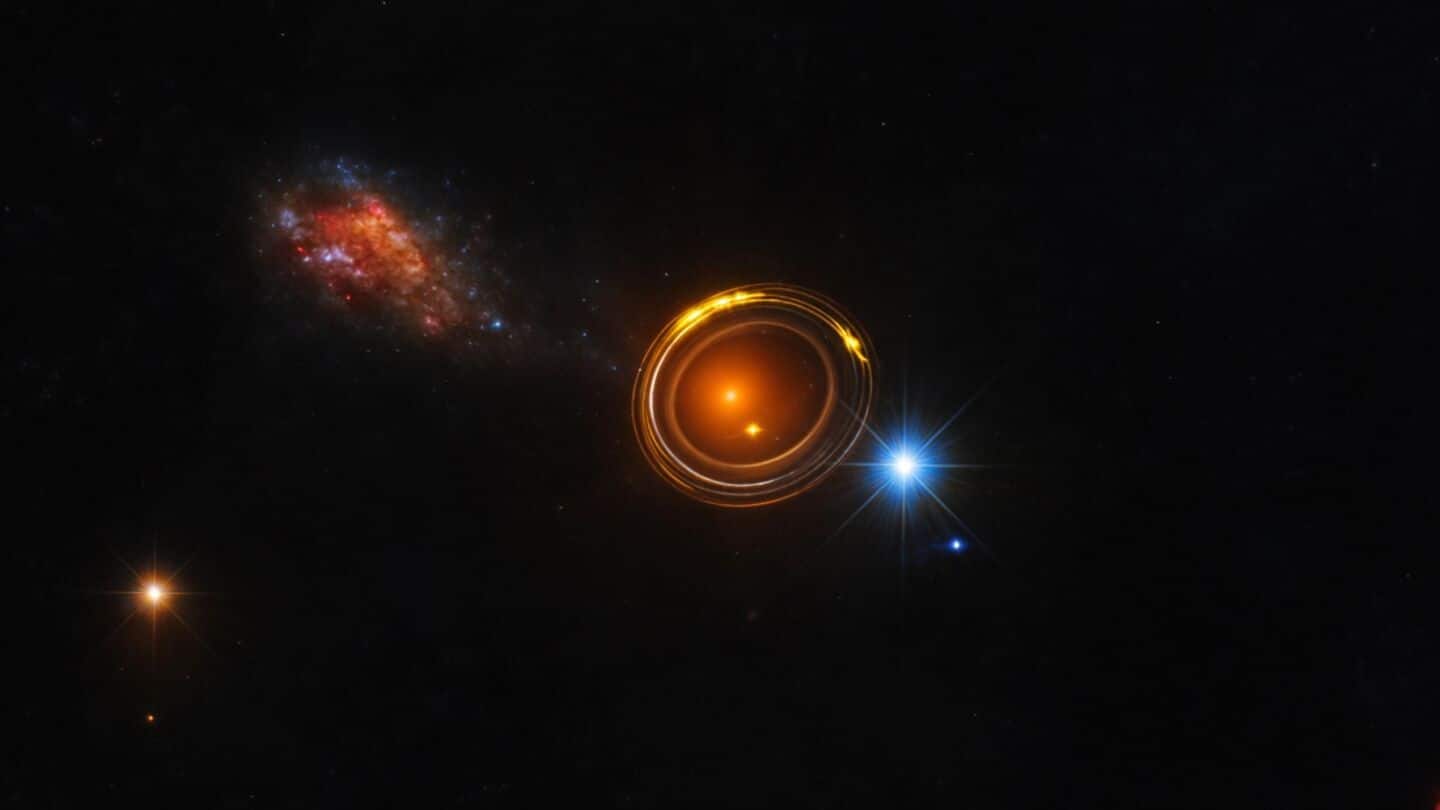
Further observations with Chile's Atacama Large Millimeter/submillimeter Array revealed that Shadow Blaster was behind a gravitational lens.
This phenomenon occurs when a large foreground galaxy magnifies a distant one behind it, acting like a cosmic magnifying glass.
"This lensing effect magnified the galaxy and allowed us to study a hidden, compact star-forming region that would otherwise have been much harder to detect," Urata said.
Neutrino source
Shadow Blaster could be a major source of high-energy neutrinos
Urata suggested that star-forming galaxies like Shadow Blaster could be a major source of high-energy neutrinos.
"Our analysis suggests that this population could contribute up to roughly 20% of the observed diffuse neutrino background measured by IceCube," he said.
However, further research is needed to confirm if these galaxies are indeed sources of high-energy neutrinos and what conditions within them contribute to their creation.