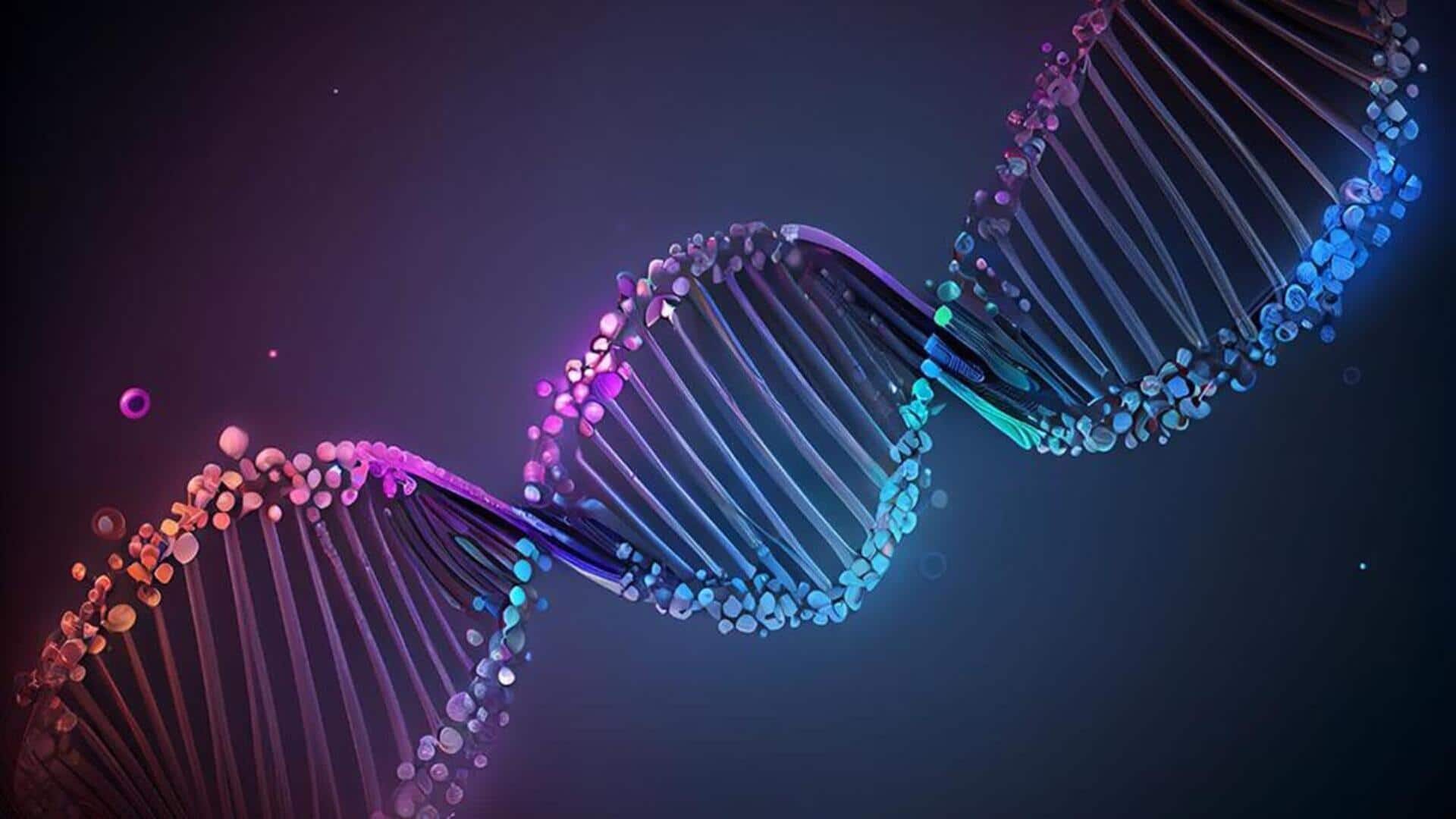
Google creates AI map of 9B possible human DNA changes
What's the story
Google DeepMind has launched a revolutionary AI platform, AlphaGenome Atlas, which could revolutionize our understanding of the human genome. The groundbreaking tool promises to speed up scientific research and open doors to new disease treatments. The Atlas offers a "predictive map of every possible DNA letter change in the human genome," according to blog post published on Tuesday.
Tool features
Atlas decodes the human genome
The human genome is made up of about three billion letter pairs, or four chemical "letters" (A, C, G, and T).
These letters contain instructions for life processes like gene activation.
However, changes to individual letters can be harmless or contribute to diseases.
The Atlas predicts how each of the nine billion possible single-letter substitutions could affect the body at a molecular level.
Research aid
Variant Impact Score to help researchers focus on mutations
To help researchers focus on the most important mutations, Google is also introducing a Variant Impact Score (AVI). This tool uses Google's other models to predict the effects of DNA changes.
"Now, researchers can rapidly rank variants and interpret their molecular effects at the same time," said Google's blog post.
The project builds on AlphaGenome, an AI model DeepMind launched last year to help scientists identify genetic disease drivers.
Expanded reach
Atlas trained on public databases of human and mouse genomes
Atlas goes beyond AlphaGenome's capabilities by extending predictions across the entire genome, including regions that don't directly code for proteins but control gene behavior.
The underlying model was trained on public databases of human and mouse genomes to learn patterns between DNA changes and biological processes.
This resulted in a massive dataset of roughly 1 petabyte in size, which Google is now making available for noncommercial use through its website.