Scientists recreate cosmic dust in a lab for 1st time
What's the story
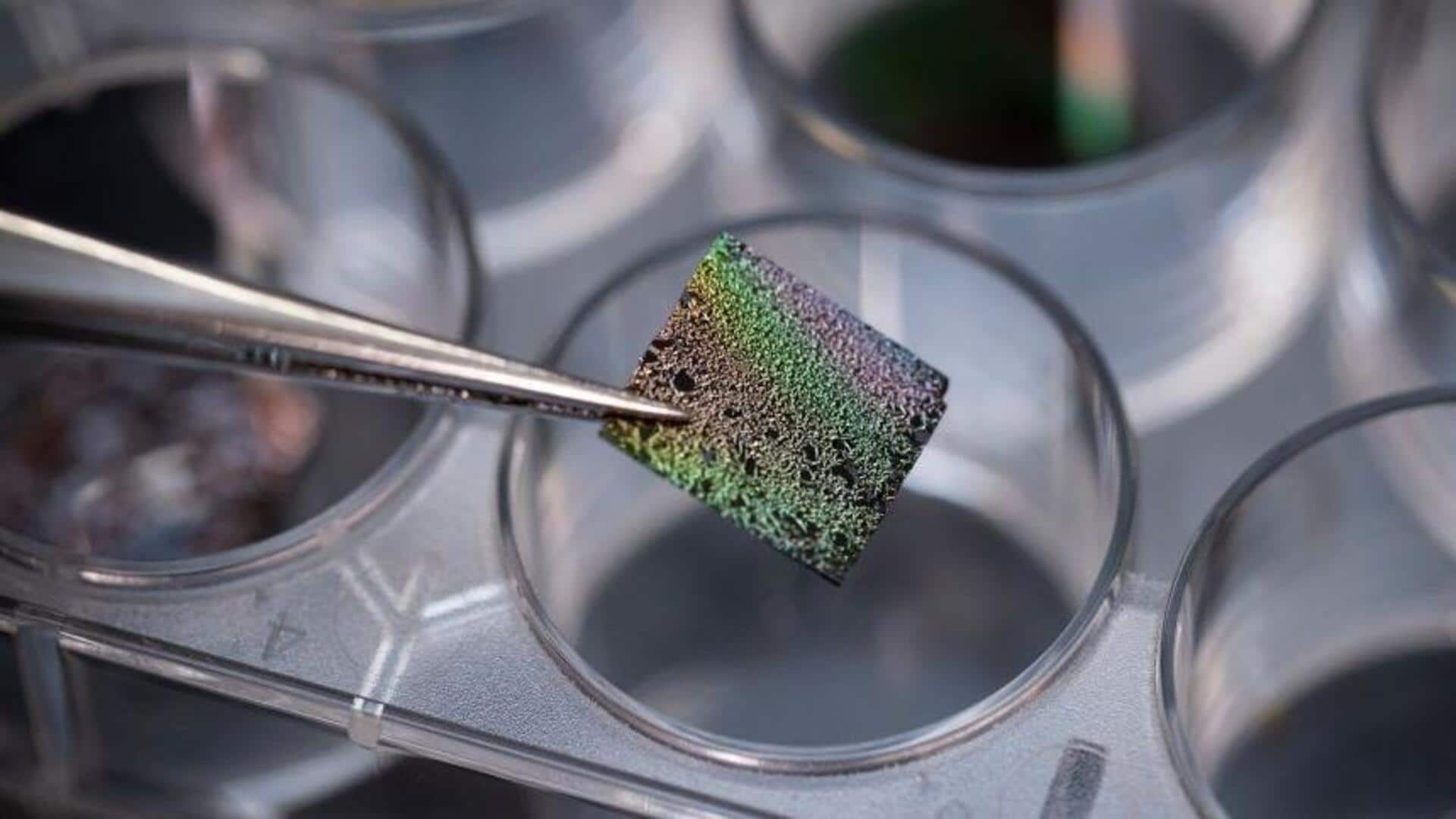
In a groundbreaking experiment, Linda Losurdo, a PhD student at the University of Sydney, has successfully recreated cosmic dust in a laboratory setting. Using simple gases and electricity, she mimicked conditions typically found near stars and supernovas to produce this tiny amount of cosmic dust. This work could provide new insights into the origins of life on Earth.
Dust significance
What is cosmic dust and why is it important?
Cosmic dust is an integral part of the universe, contributing to star formation and catalyzing organic molecules that form life's building blocks.
It is abundant in interstellar space, the vast expanse between stars, and found in comets and asteroids.
However, studying it on Earth is challenging as most space-borne particles and rocks burn up in our atmosphere. The few that survive as meteorites are often hard to find and collect.
Research implications
How does this research help us understand life's origins?
Losurdo's lab-made cosmic dust could be a valuable tool for scientists trying to understand how life began on Earth.
She said, "When we're looking at big questions like the origins of life, we have to look at where the building blocks started from."
This research could help answer whether amino acids were formed on Earth or originated in space.
Creation method
How did they create the cosmic dust?
To create the cosmic dust, Losurdo and her co-author David McKenzie, a professor of materials physics at the University of Sydney, used nitrogen, carbon dioxide and acetylene.
They pumped air out of a glass tube and introduced these gases before applying 10,000 volts of electricity for an hour.
This created a type of plasma called "glow discharge," resulting in a few milligrams of "dusty nanoparticles."
Dust analysis
How did they analyze the dust?
The lab-created cosmic dust was deposited on a silicon wafer for analysis. This process aimed to recreate space-like conditions as closely as possible.
The artificial dust created this way is similar to pristine cosmic dust right after its formation.
Once it becomes a catalyst for organic molecules or gets embedded in comets and meteorites before reaching Earth, the dust undergoes multiple chemical processes.
Research expansion
Future of research and its potential impact
The next step in this research is to change the conditions under which the cosmic dust is made, creating a database of different types.
Losurdo hopes that one day their dust will be even closer to the real thing and can be matched to specific objects like meteorites.
This study bridges an important gap between telescopic observations and laboratory analysis, offering a good starting point to test current models of how organic matter evolves in space.