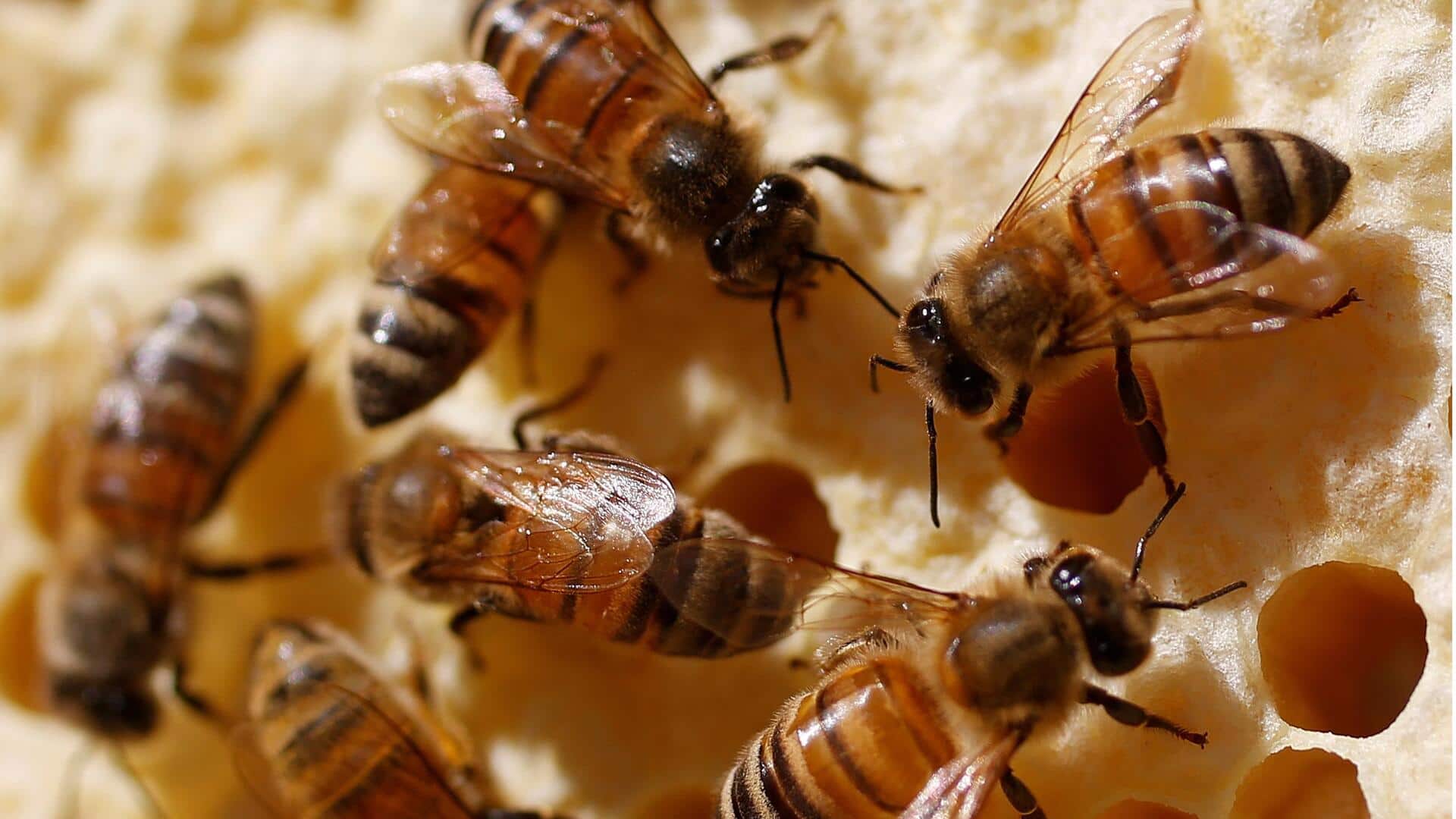
Honeybees are pushing out wild pollinators in race for nectar
What's the story
A recent study by researchers at Anglia Ruskin University has revealed that honeybees are aggressively competing with wild pollinators for resources. The research found that in areas with high concentrations of honeybees, there were fewer wild pollinators like bumblebees and hoverflies. The study observed these interactions over two years in Cambridgeshire, documenting 300 instances across five groups: honeybees, bumblebees, solitary bees, hoverflies, and "other" flower-visiting species.
Competitive behavior
Honeybees most likely to win competitive interactions
The study found that honeybees were most likely to win competitive interactions, pushing out rivals to collect more pollen and nectar.
They were also actively avoided by other flower visitors in 28.4% of encounters on bramble and 35.6% on ivy.
In cases where a honeybee won a competitive interaction, it either displaced other flower visitors or chased them away in about 20% of instances.
Resistance
Ivy bee was only pollinator that could hold its own
The only pollinator that could hold its own against honeybees was the ivy bee, which mainly feeds on the nectar of ivy flowers.
The study also found that higher temperatures led to more competitive interactions, probably because nectar was drying up and plants were going into heat stress.
Given that mean summer temperatures are predicted to rise by up to 4 degree Celsius in the UK by 2080, such competition is likely to become more frequent.