ISRO conducts successful parachute test for Gaganyaan mission
What's the story
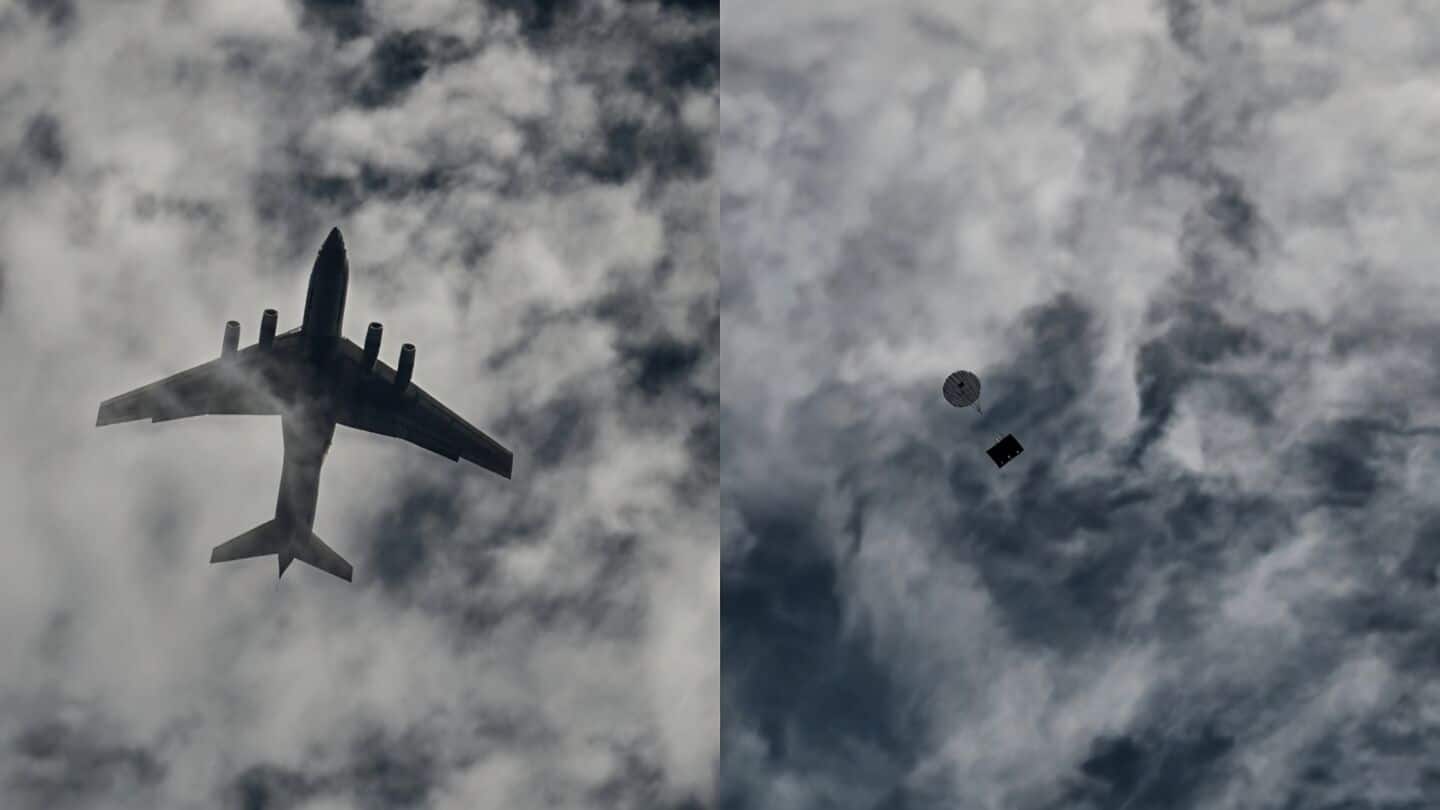
The Indian Space Research Organisation (ISRO) has successfully conducted a major test of the main parachutes for the crew module of its Gaganyaan program. The test was conducted at the Aerial Delivery Research and Development Establishment (ADRDE) drop zone in Madhya Pradesh's Sheopur district on Tuesday. The aim was to assess the structural integrity and design margins of the main parachute under maximum expected load conditions during India's first uncrewed Gaganyaan mission.
Test execution
Test involved dropping a simulated assembly of single main parachute
The test involved dropping a simulated assembly of a single main parachute and dummy mass from an altitude of 2.5km using an Indian Air Force (IAF) IL-76 aircraft.
A drogue parachute was deployed after release, which is known to stabilize the crew module and slow it down significantly.
The main parachute was then deployed, bringing the payload down to a safe terminal speed.
Milestone achievement
Fifth in series of IMAT tests
The latest test is the fifth in a series of integrated main parachute airdrop tests (IMAT) to validate this critical system for the Gaganyaan mission.
"The successful completion of IMAT-05 provides necessary confidence in the performance and reliability of the main parachute system for the first uncrewed Gaganyaan mission (G1)," ISRO said.
The deceleration system of the Gaganyaan crew module consists of 10 parachutes across four types, ensuring a safe splashdown in water.
Mission progress
Gaganyaan mission to mark India's 1st human spaceflight
The Gaganyaan mission is a major leap in India's space exploration efforts. It aims to send Indian astronauts into space aboard an indigenously developed spacecraft.
The successful parachute test is just one of the many qualification and validation tests ISRO has been conducting across various mission systems for this historic project.