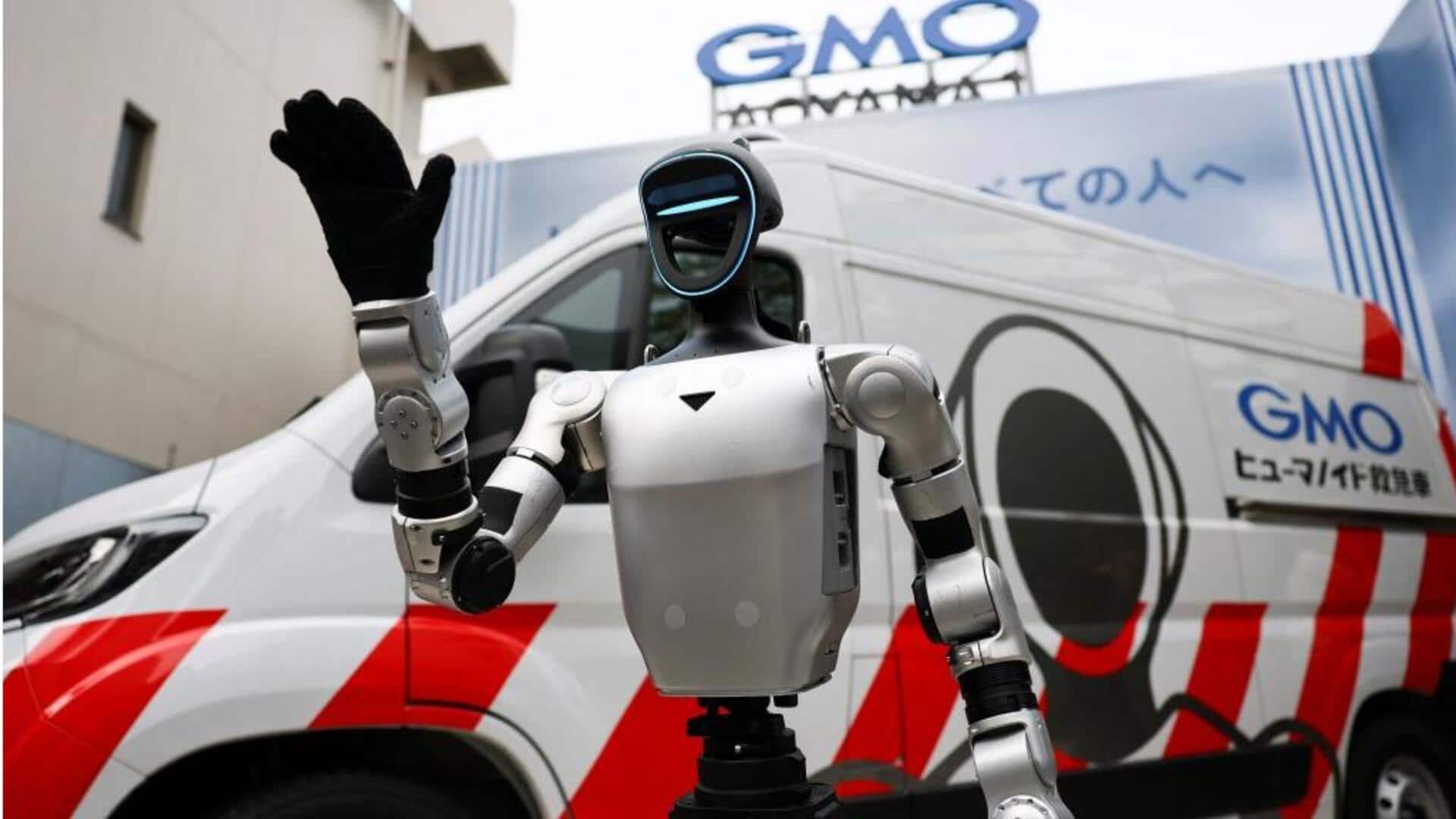
Tokyo now has an 'ambulance' for humanoid robots
What's the story
Japan has unveiled a unique kind of emergency vehicle, an "ambulance" for humanoid robots. The innovative service has been developed by GMO Internet Group through GMO Air. The vehicle will carry engineers, repair equipment, spare parts and even a replacement humanoid to robots that break down at work sites. It aims to minimize the downtime of humanoid robots deployed at commercial locations.
Operational details
It acts as a mobile robotics workshop
The vehicle acts as a mobile robotics workshop. When a humanoid robot malfunctions, engineers can take the vehicle to the site with diagnostic tools and replacement parts.
They can inspect and repair the machine on-site without removing it from operation.
If immediate repairs aren't possible, they can bring in a spare humanoid robot to take over while the damaged one is taken for servicing.
Human involvement
It's not an autonomous machine
Despite its futuristic appearance, the "robot ambulance" isn't an autonomous machine. The vehicle is driven and staffed by human engineers who carry computers, tools, parts, and robots needed for maintenance. This makes it more like roadside assistance for humanoid machines than a robotic ambulance.
Need for support
The need for such a vehicle
Humanoid robots are increasingly being developed for real-world tasks in factories, warehouses, hotels and other commercial environments.
However, more robots in the field also mean more potential breakdowns.
A damaged robot sent back to a service center could remain unavailable for days.
A mobile repair team can instead bring technicians and parts directly to the machine, reducing downtime significantly.
Infrastructure development
Infrastructure development around humanoid robotics
The robot ambulance represents a major step in the infrastructure development around humanoid robotics.
These machines will need more than just artificial intelligence and advanced hardware to operate at scale. They will also require maintenance, spare parts, diagnostics and rapid replacement systems.
GMO currently has one such vehicle based at its Tokyo headquarters but could expand its fleet if demand increases.