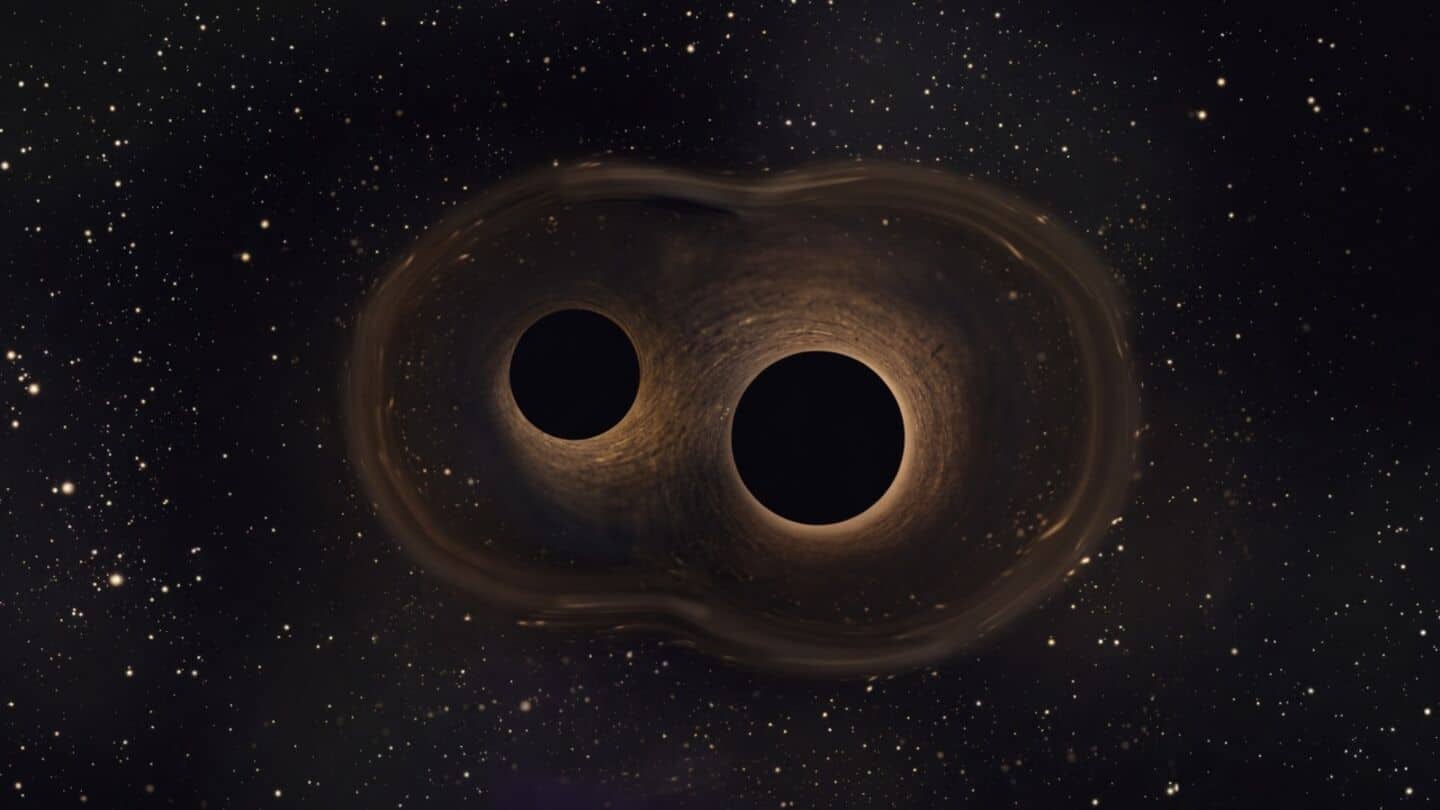
This camera can help us find more merging black holes
What's the story
Scientists at the Laser Interferometer Gravitational-Wave Observatory (LIGO) have found a solution to a persistent engineering problem using an off-the-shelf camera. The team, led by Jonathan Richardson from the University of California, has used commercially available thermal imaging cameras and computer models to correct small heat-induced distortions in the observatory's mirrors. This elusive flaw currently limits how far into deep space LIGO can look for cosmic collisions like merging black holes.
Enhanced reach
New technique doesn't require new technology development
Richardson said the new technique doesn't require any new technology development, which is almost unheard of for solving a LIGO instrumentation problem.
Once integrated into LIGO's next upgrade, the fix could extend the observatory's reach by about 33 million light-years.
This may seem small against the vastness of the universe, but it opens up an exponentially larger window of space due to three-dimensional expansion.
Detection process
How LIGO detects gravitational waves
LIGO detects gravitational waves using two L-shaped detectors in Washington and Louisiana.
Each facility has a laser beam that travels down two 4km-long tunnels, reflecting off mirrors at each end.
When a gravitational wave passes through Earth, it slightly stretches one tunnel and squeezes the other.
This microscopic shift alters the laser beams ever so slightly, producing a tiny flicker of light that alerts scientists to a distant cosmic event.
Sensitivity issues
Why is heating a problem for LIGO?
Despite being among the purest optical components ever built, LIGO's mirrors still absorb a tiny fraction of intense laser light.
The energy from this absorbed light turns into heat, warping the mirror's surface by just a few nanometers.
This distortion is enough to alter the laser beam and reduce the observatory's overall sensitivity.
To counteract these distortions, targeted heat can be applied to the back of the mirrors with exact precision using infrared thermal images and existing computer models.