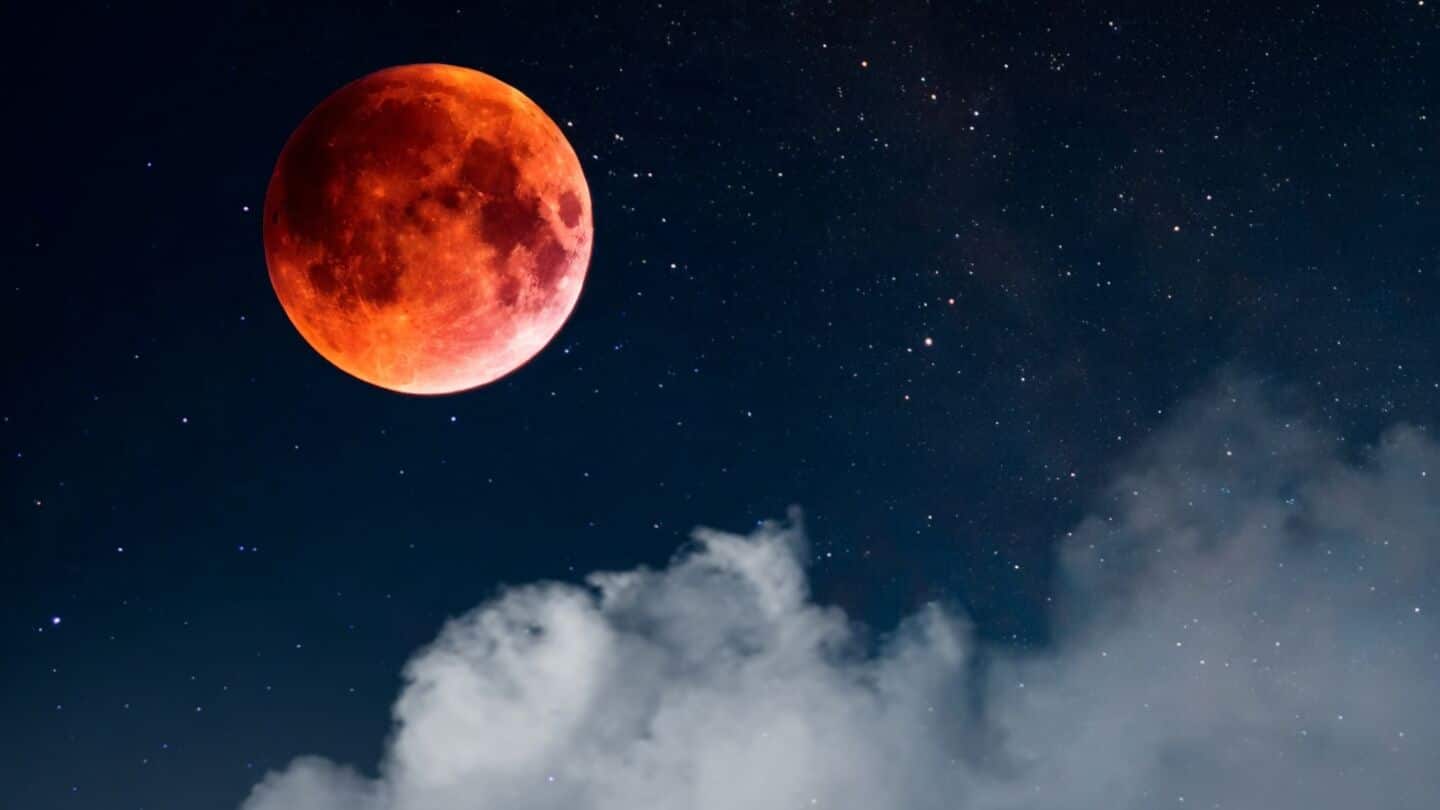
Lunar eclipse on August 28: How to watch 'Blood Moon'
What's the story
A partial lunar eclipse, popularly known as a 'Blood Moon,' will grace the skies on the night of August 27-28. The event will see Earth positioned between Sun and Moon, casting a shadow that will give the lunar surface its characteristic red-orange hue. However, this celestial spectacle won't be visible from India due to daytime conditions and the Moon's position below the horizon.
Eclipse timings
Timing in the UK
In the UK, the penumbral phase will start at 2:23am BST on August 28. However, this early stage is hard to observe with naked eyes.
The partial eclipse will be visible from around 4:12am peaking at around 5:12am.
By around 5:00am, the Moon will be close to the western horizon.
US viewing
Viewing in the US
In the US, the eclipse will be visible during the evening of August 27 and into the early hours of August 28.
The partial phase will start at around 10:33pm ET, with maximum eclipse occurring at around 12:12am-12:13am. This timing varies across Central, Mountain and Pacific time zones.
Large parts of North and South America will get a good view of this celestial event.
Eclipse effect
Why does Moon turn red during a lunar eclipse?
During the deepest part of the eclipse, Earth's shadow will cover most of the Moon's surface.
This will give it a dark red, copper or rusty color due to some sunlight being filtered and bent by Earth's atmosphere.
The red and orange wavelengths aren't scattered as much as blue wavelengths are, allowing some reddish light to reach the lunar surface.
Observation advice
How to watch safely?
Unlike a solar eclipse, a lunar eclipse can be viewed safely with the naked eye. No special protective glasses are required.
However, binoculars or a small telescope could provide a closer look at the Moon's changing color and Earth's shadow moving across its surface.