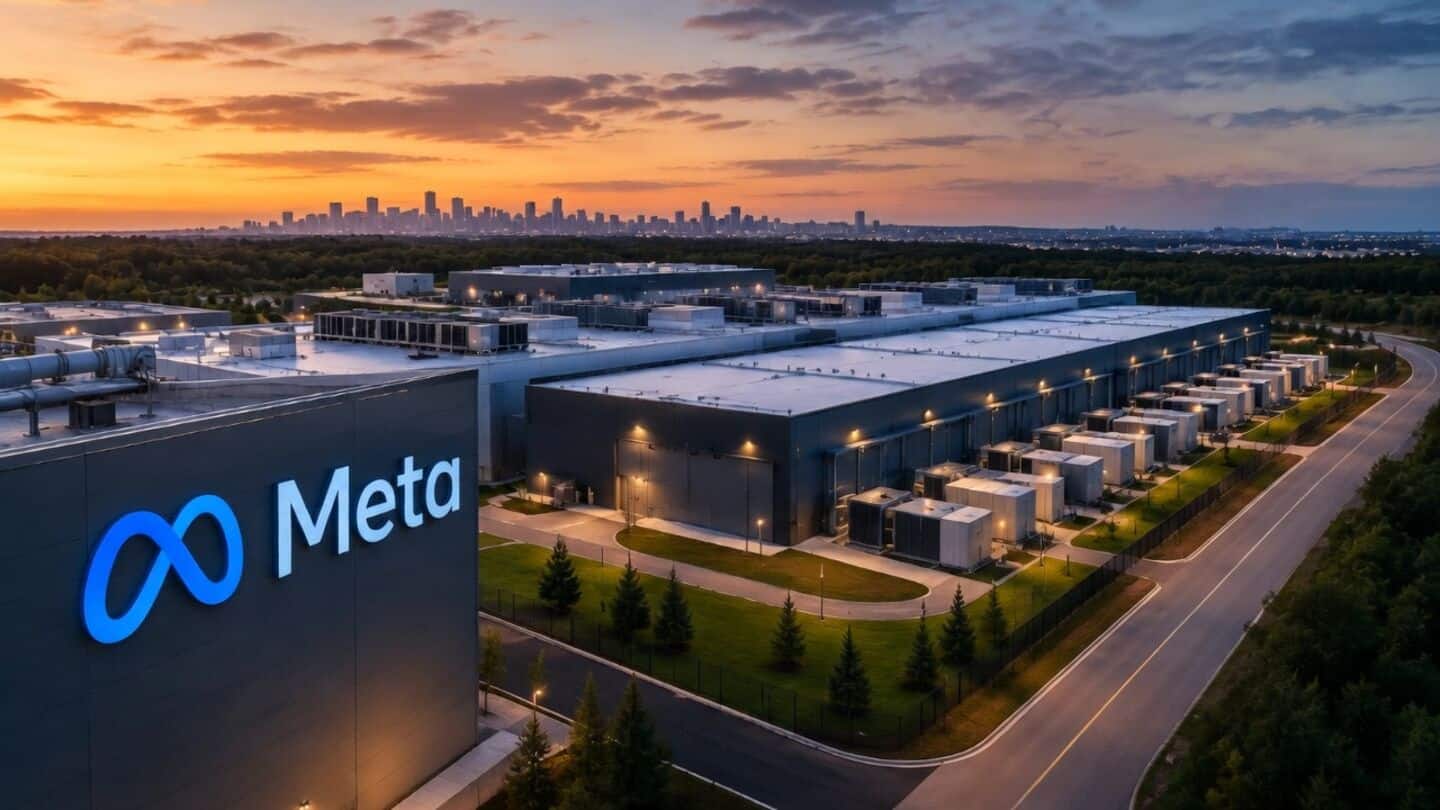
Meta's data center may use electricity equal to 800,000 homes
What's the story
Meta has announced plans to build a massive new data center in Alberta, Canada. The facility will cost C$13 billion (approximately $9.17 billion) and will be Meta's first data center in the country and its 33rd globally. The project comes as part of the company's ongoing investment in artificial intelligence (AI) infrastructure.
Growth prospects
Initial capacity of 1GW
The new data center will be located in Sturgeon County and will have an initial capacity of 1 gigawatt (GW). This can be expanded to 1.8GW as the demand for AI computing grows.
The facility is expected to consume as much electricity as nearly 800,000 homes, highlighting the power requirements of the AI boom.
Strategic location
Why Alberta?
Meta's decision to build a data center in Alberta was influenced by several factors.
The province has abundant natural gas supplies, lower energy costs than many regions, and a colder climate that helps reduce cooling expenses for large server farms.
Alberta has also been actively trying to attract investments from major tech companies with several more large-scale data center proposals under review.
Sustainability efforts
Power plant to be built
To support the massive power requirement of the new data center, Meta plans to invest in new power generation and upgrades to the electricity grid.
The company has partnered with Pembina Pipeline, an Alberta-based company that is building a natural gas-fired power plant in Sturgeon County.
The plant will eventually provide electricity to the data center under a long-term agreement.
Eco-friendly initiatives
Renewable energy investments
Meta has said that it will offset the electricity used by the site through investments in clean and renewable energy.
The company also plans to use a closed-loop liquid cooling system at the facility, which recycles cooling liquid and reduces overall water consumption.
According to Meta, the total water use at this site will be less than that of a typical golf course.