Microsoft's quantum chip claims under scrutiny
What's the story
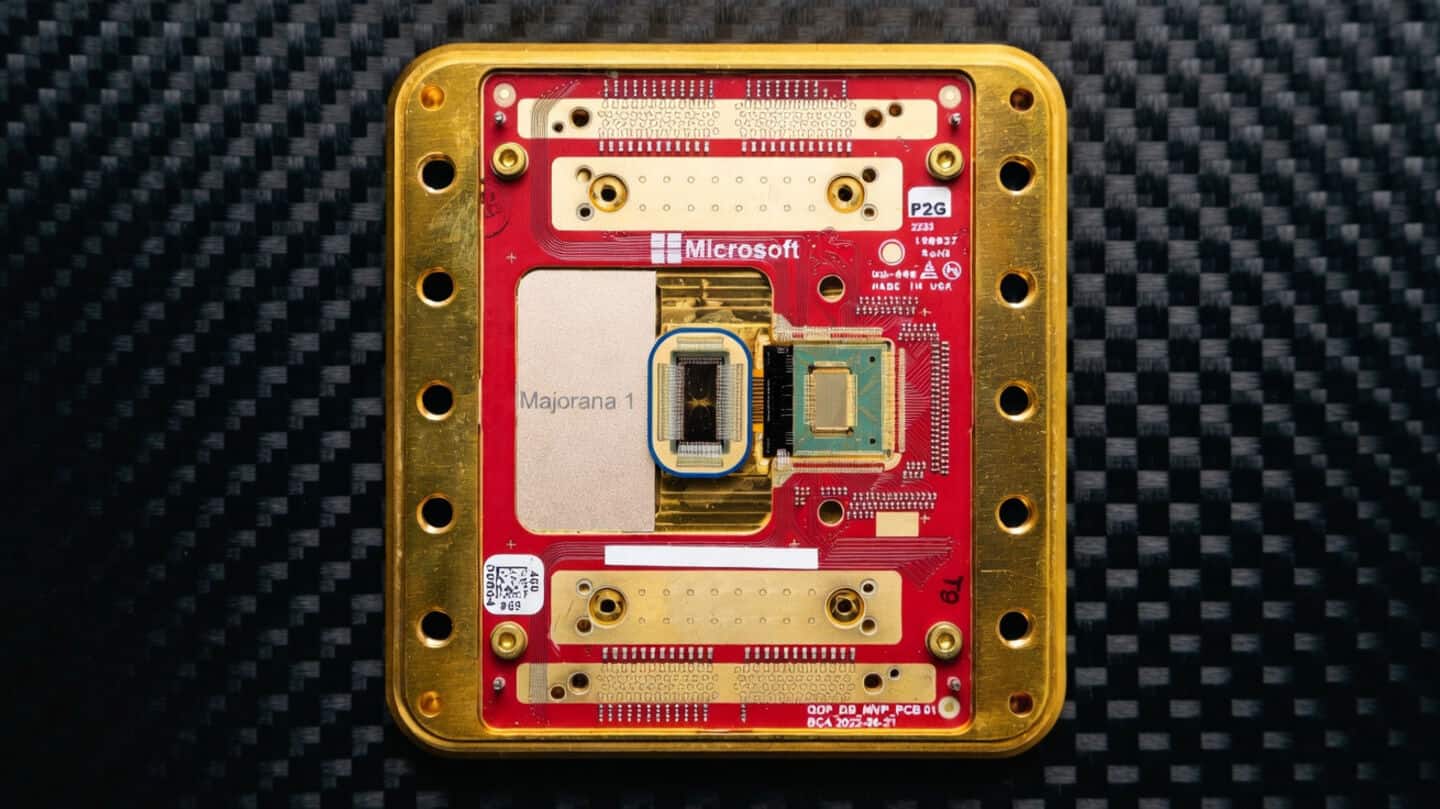
A peer-reviewed critique published in Nature has questioned Microsoft's claims about its Majorana 1 quantum computing chip. The tech giant had unveiled the chip in February 2025, touting it as a major leap forward with a novel technology called a topological qubit. However, Henry Legg, a physicist at the University of St Andrews, reanalyzed Microsoft's data and argued that they did not conclusively demonstrate a working topological qubit.
Quantum aspirations
What are topological qubits
Microsoft's design for its quantum computing chip is unique in the industry.
It consists of a thin wire, made of indium arsenide semiconductor, stuck to a superconductor.
The company wants to encode information in the properties of the Majorana particle, which is theoretically predicted to compute with fewer errors than other materials when formed into topological qubits.
However, Legg has questioned whether Microsoft has actually created a Majorana particle, saying they haven't convincingly shown that they have it.
Data dispute
Microsoft rebuts Legg's claims
In his critique, Legg suggested that what Microsoft claims as a signature of the Majorana particle could actually be from quantum dots, which are electron-containing structures.
He also accused Microsoft of cherry-picking its data.
However, the tech giant's team published a rebuttal in Nature, disputing Legg's interpretation of their data and claiming his critique "does not constitute a substantial scientific challenge to our findings."
Future prospects
Microsoft announces Majorana 2 chip
Despite the criticism, Microsoft remains committed to its roadmap.
The company announced a new chip, Majorana 2, on June 2. It features what they claimed was the next generation of their topological qubits.
Legg has expressed concerns over this characterization in a non-peer-reviewed manuscript.
He said nothing in it resolves the fundamental issues that many scientists have with Microsoft's previous claims about its quantum computing technology.