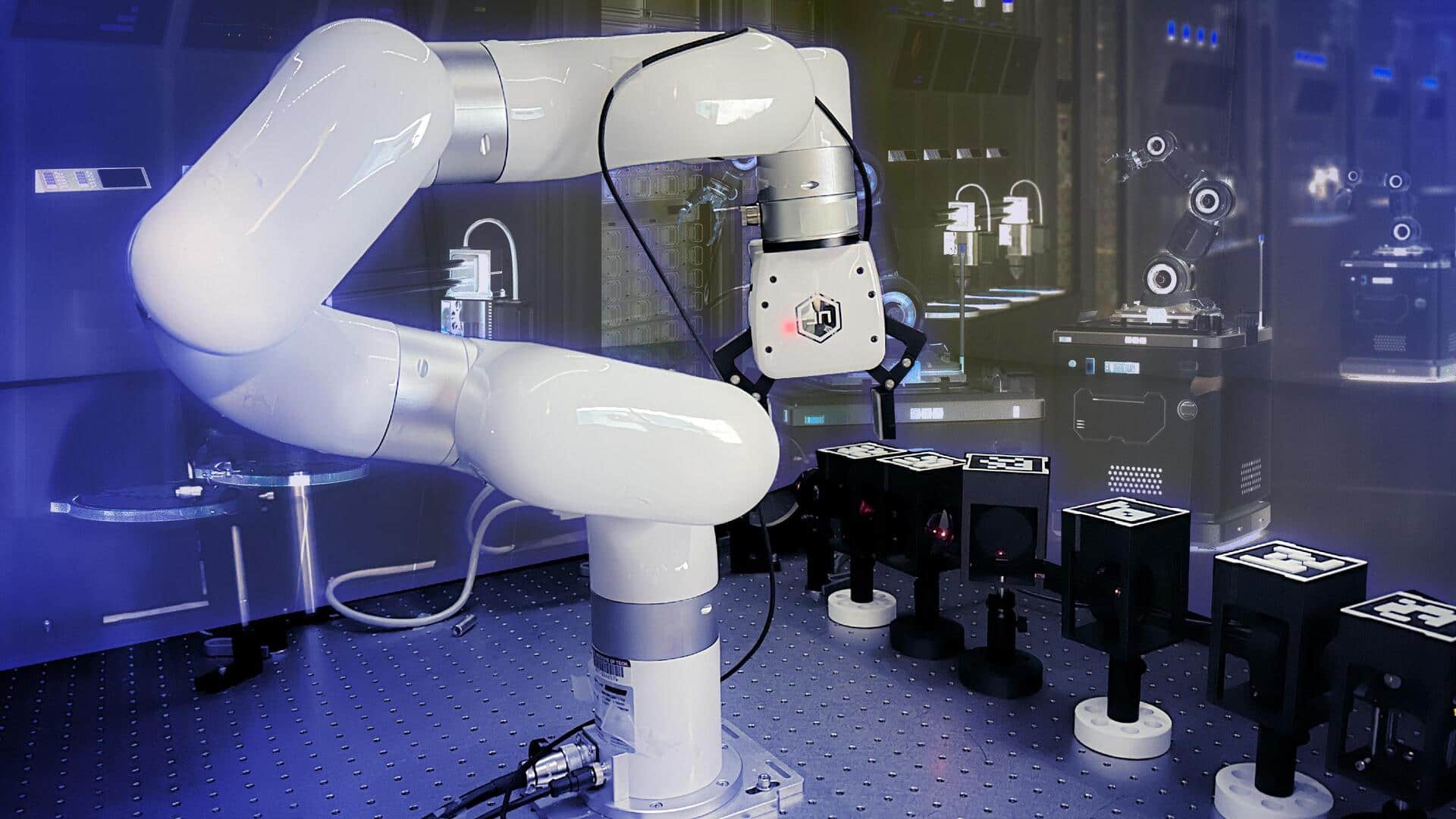
MIT's new robotic lab runs experiments on its own
What's the story
Researchers at the Massachusetts Institute of Technology (MIT) have created a robotic laboratory capable of independently building, aligning, and running optics experiments. The system can manipulate lenses and mirrors with high precision and even correct an experiment when its alignment is disturbed. The technology could eventually allow scientists to conduct remote experiments with robotic systems automatically preparing different setups.
First test
Assembling a laser cavity
The MIT team demonstrated the system by asking it to build a laser cavity, which uses mirrors and a crystal to amplify light.
The robot performed some 50 separate maneuvers in about 30 minutes to assemble the setup and then aligned the optical components to produce a working laser beam.
This was its successful test of building an optics experiment from scratch.
Self-repair
Restoring laser intensity
The robot's capabilities aren't just limited to assembling an experiment.
When the researchers deliberately disturbed the optical setup by moving its components, the system detected the change and adjusted them to restore laser intensity.
This is a major breakthrough as precision optics experiments can be disrupted by small movements, vibrations, and temperature changes.
Design details
Robotic arm and 3D-printed holders
The system features a seven-jointed robotic arm that can position components with micron-scale precision.
The optical components are placed in specially designed 3D-printed holders, each carrying a QR code containing information about the component.
A wireless motorized tool allows the robot to make fine adjustments to these optical components.
Future prospects
Journey toward fully automated science
The MIT team's approach is designed to make the laboratory reconfigurable.
Once one experiment is complete, the robot can dismantle the setup and use the same components to construct another one.
This could eventually lead to 24-hour robotic science, with scientists potentially sending experimental instructions remotely while the robotic system carries out physical work.