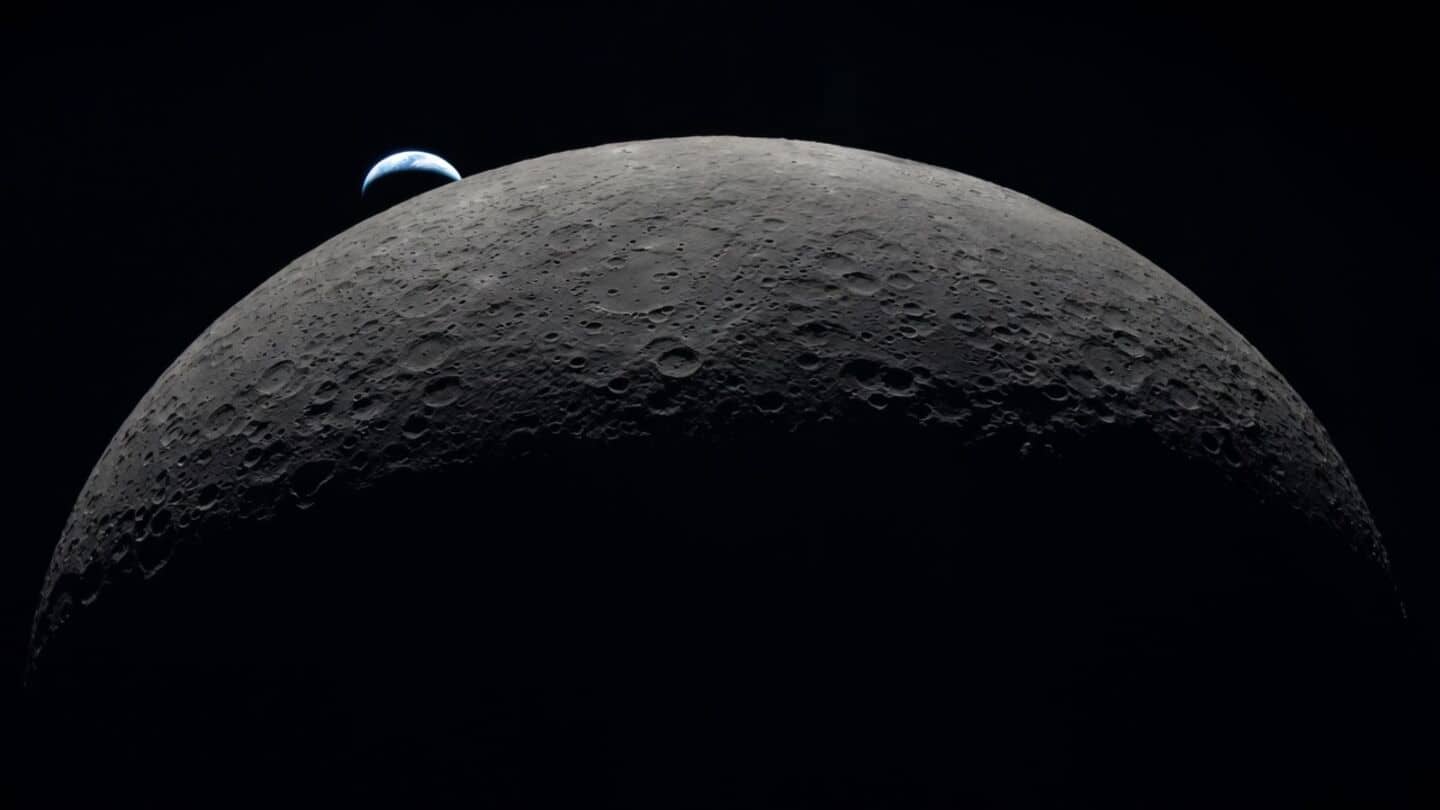
Did the Moon form in just 5 hours?
What's the story
A recent study has suggested that Earth's Moon could have formed within five hours of a massive collision between our planet and a Mars-sized protoplanet. The groundbreaking theory comes from advanced simulations that consider the internal temperature of early protoplanets, and how it influenced their geological characteristics and subsequent collisions. The findings were published in The Astrophysical Journal Letters.
Impact analysis
Giant impact hypothesis and its significance
The leading theory of the Moon's formation, known as the giant impact hypothesis, was thanks in particular to work done by planetary scientist Robin Canup.
It suggests that a Mars-sized body called Theia collided with Earth at just the right angle to eject debris into orbit around proto-Earth. This debris eventually coalesced to form the Moon.
The new study builds on this theory by factoring in how temperature variations could have influenced material strength and collision outcomes.
Simulation insights
How temperature variations could influence collisions
Led by Adeene Denton from the Southwest Research Institute, the team conducted detailed simulations of the Earth-Theia collision.
They found that warmer bodies are weaker than their colder counterparts.
This means that the internal heat from planetary formation could have affected material strength and influenced how debris was ejected into orbit around Earth, ultimately shaping the Moon's formation process.
Possibilities
Two scenarios for the Moon's formation
The simulations revealed two possible scenarios for the Moon's formation.
One theory suggests that a ring of debris lingered around Earth, allowing the Moon to gradually accrete.
The other scenario, first proposed by NASA-led simulations in 2022, posits that the Moon formed from this debris within hours.
Denton's models lend support to this rapid formation hypothesis, suggesting a warmer Theia could have led to a quick Moon formation while obliterating itself in the process.
Formation implications
Rapid Moon formation timeline
Denton's simulations showed that if Earth and Theia were hot enough before the collision, it could have destroyed Theia and created a massive disk of debris that formed the Moon within five hours.
This rapid formation timeline might help scientists better constrain when the Moon-forming event occurred.
However, these variations can't be fully explained by current models, including Denton's.