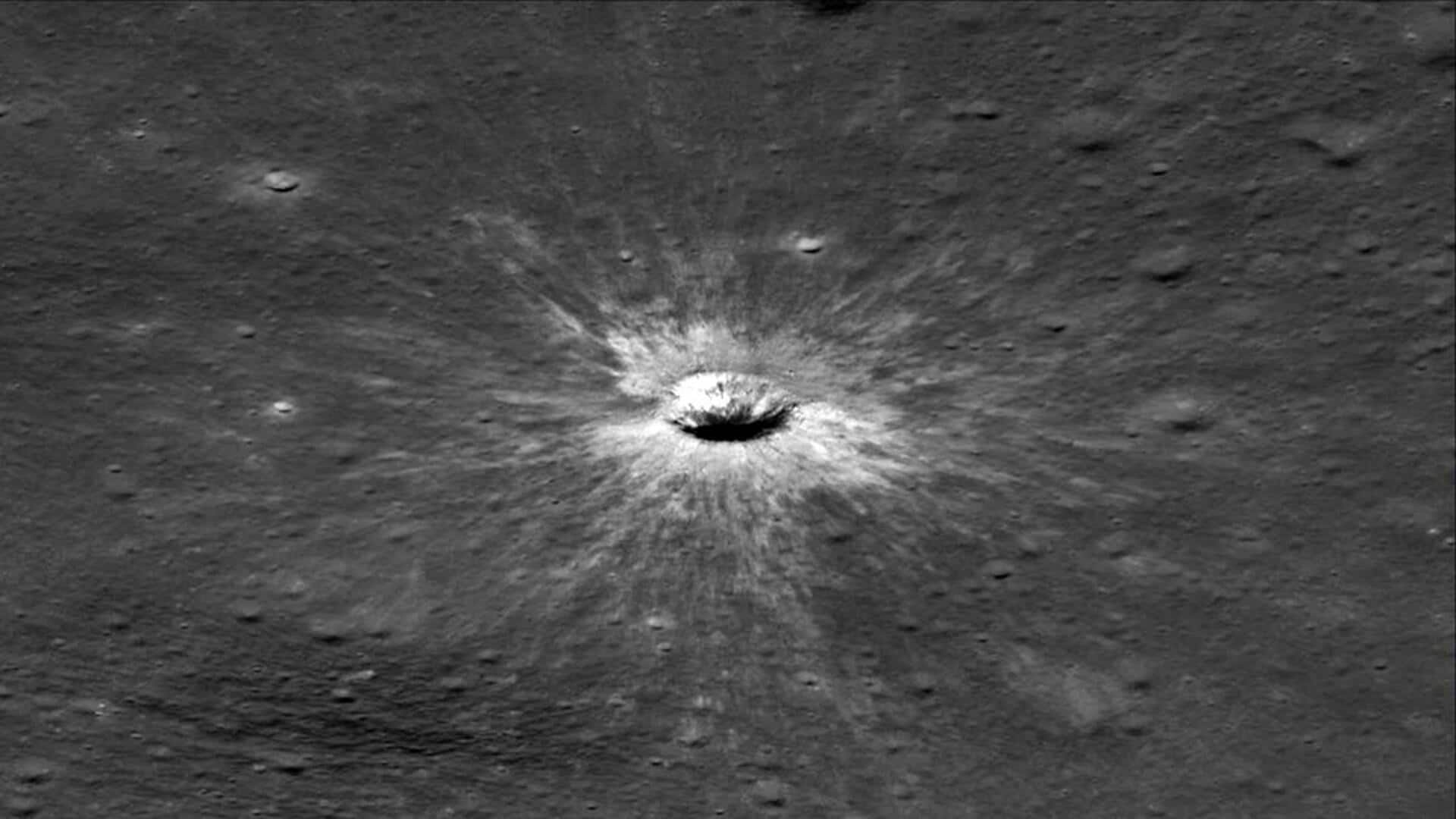
NASA finds Moon crater 3 times bigger than previous record
What's the story
NASA has confirmed the formation of a massive crater on the Moon, caused by a powerful impact two years ago. The steep-sided hole is about 222m wide and 43m deep, making it the largest known impact crater created in recent history. The impact was caused by a fragment of an asteroid or comet. It escaped real-time detection by Earth- and space-based telescopes but was later confirmed in early 2026 after detailed images were captured by NASA's Lunar Reconnaissance Orbiter.
Impact assessment
Named after late Thomas McGetchin
The crater is named after late Thomas McGetchin, a former director of Houston's Lunar and Planetary Institute.
"This event constitutes a statistically rare, effectively once-in-a-lifetime observation," the scientists wrote in one of two studies published in journal Science Advances.
The impact was so large that it is estimated to happen only once every 132 years.
Lunar transformation
Three times bigger than previous record-holder
The newly discovered crater is three times bigger than the previous record-holder found by the LRO a decade ago.
The impact churned the lunar surface for over 100km, with dust and rocky soil being ejected at a higher angle than expected.
Mark Robinson, chief scientist for LRO's cameras at Intuitive Machines, said this was an important finding as NASA plans to build an astronaut base on the Moon.
Regolith gardening
LRO has discovered many craters since its launch in 2009
A separate study found a 7km-wide cold spot around the new crater, indicating a loosening of the Moon's top soil.
David Paige from UCLA compared this to gardening, saying, "We're now thinking of impacts as a way to garden the regolith - churning the sediments and putting stuff above that's usually below the surface."
The LRO has discovered many craters since its launch in 2009, showing that material ejected by these impacts overturns Moon's topsoil every 80,000 years.