NASA's James Webb telescope discovers earliest galaxy ever seen
What's the story
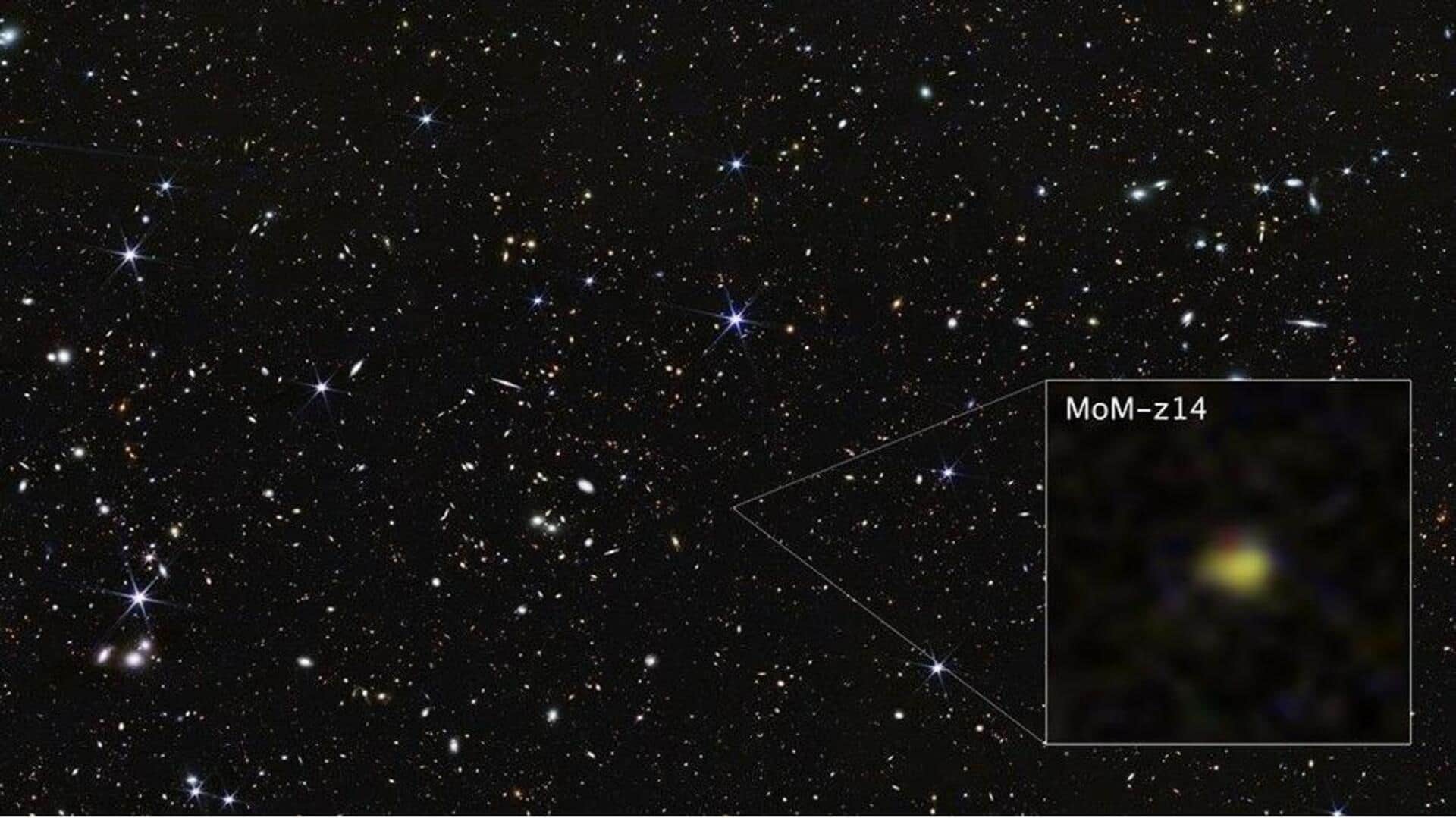
NASA's James Webb Space Telescope (JWST) has made another groundbreaking discovery by spotting the earliest galaxy ever seen. The galaxy, dubbed MoM-z14, existed just 280 million years after the Big Bang. "Meet our current record holder for farthest galaxy ever seen (so far!!) MoM-z14 may look like a little yellow smudge here, but it's our first view of a galaxy that existed just 280 million years after the big bang!" NASA Webb Telescope wrote in a post on X.
Theoretical implications
MoM-z14's discovery challenges existing theories
The discovery of MoM-z14 adds to a growing number of unexpectedly bright galaxies in the early universe. JWST has detected 100 times more galaxies than theoretical studies predicted before its launch. This finding has led scientists to question the historical timeline of our universe and how it differs from today's cosmos. "We can estimate the distance of galaxies from images, but it's really important to follow up and confirm with more detailed spectroscopy," said Pascal Oesch from University of Geneva.
Unusual features
MoM-z14's unique characteristics and nitrogen enrichment
MoM-z14 displays some unusual characteristics, including high amounts of nitrogen. This is also seen in some JWST observations of early galaxies. Rohan Naidu from MIT's Kavli Institute for Astrophysics and Space Research said, "We are seeing some of the same features, like this unusual nitrogen enrichment." NASA suggests that the early universe's dense environment may have led to supermassive stars producing more nitrogen than any stars seen in today's universe.
Reionization timeline
MoM-z14's role in understanding the early universe
MoM-z14 also shows signs of clearing the dense hydrogen fog around it in the early universe. The JWST was built to define this clearing period when early stars produced high-energy light to break through the dense hydrogen gas of the early universe and begin traveling through space. "Galaxy MoM-z14 provides another clue for mapping out the timeline of reionization," NASA said, adding that this work wasn't possible until JWST revealed this era of our cosmos.