New rock formation findings could prove Noah's Ark was real
What's the story
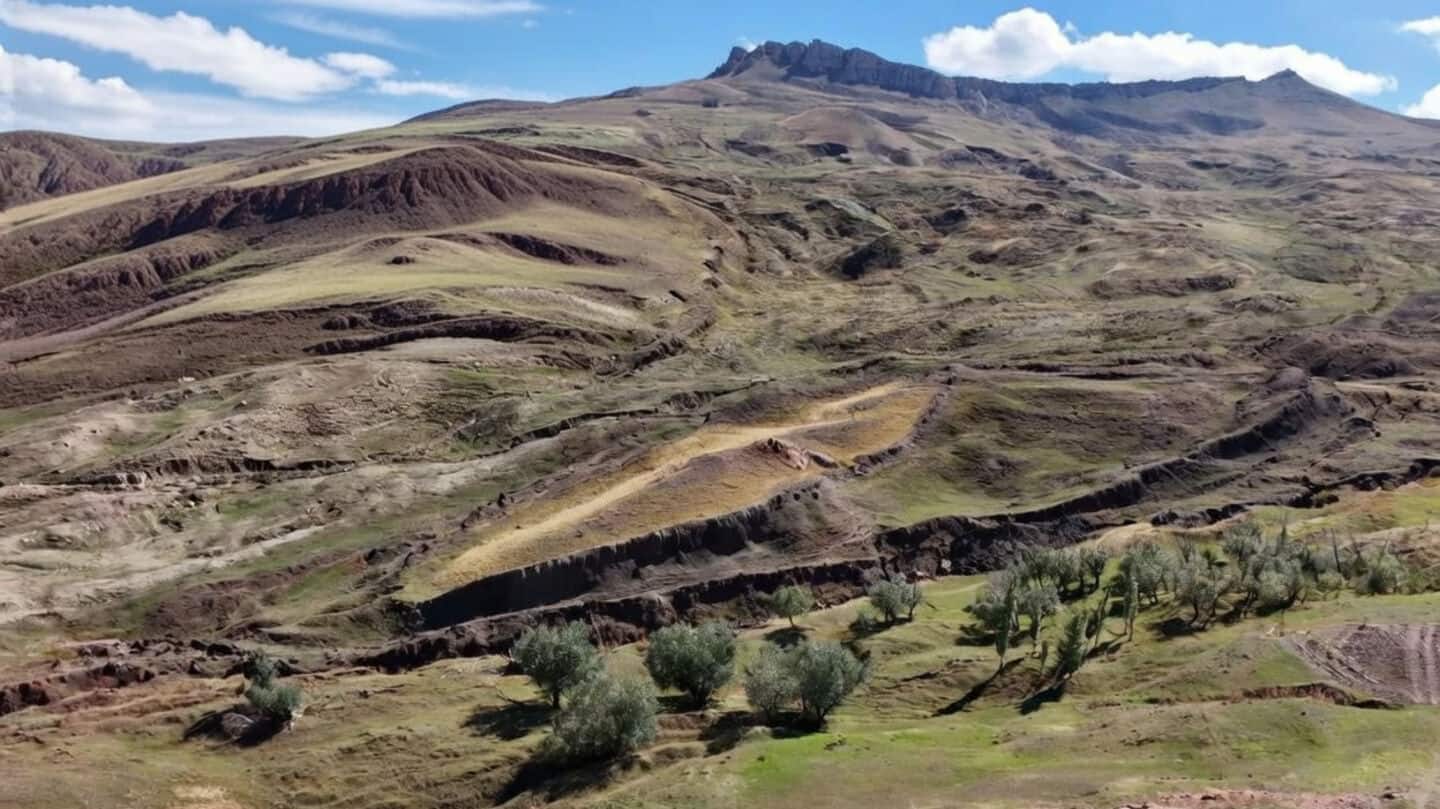
A researcher has made new discoveries about a mysterious rock formation on Turkey's Mount Ararat, which could lend credence to the biblical tale of Noah's Ark and the Great Flood. Andrew Jones, from Noah's Ark Scans, revealed that ground-penetrating radar scans and soil samples from the site match the dimensions of Noah's Ark. The site, first discovered in 1959, is believed to be the resting place of Noah's Ark.
GB
Scans revealed tunnels running down middle of 'boat'
He told GB News that ground-penetrating radar scans and soil samples from the site have revealed a series of corridors beneath the surface that match the dimensions of Noah's Ark.
The scans revealed tunnels running down the middle of the "boat" and along its inner edge, leading to a central cavity that Jones calls an "atrium.
"God told Noah to bring the animals in....And so these animals would have stayed there, plus Noah and his family," Jones told the outlet.
Geological findings
Tunnels inside the formation follow a pattern
Jones explained that these tunnels are not random but follow a pattern.
He said, "GPR is just a way to look below the soil using radar."
He said another geophysical technique, IRT, also revealed a ship-shaped hull buried deep in the ground.
Soil samples taken from inside and outside this formation in 2024 showed distinct differences: three times more organic matter and 38% more potassium were found inside.
Geological evidence
Fossil remains found around the site
"What that shows is that the soil is unique. And the grass, in the fall, it has a yellower color just inside," he said.
Fossil remains found around the site, located about 6,500 feet above sea level, could indicate that this area was once underwater.
Ancient coral and seashells were discovered by researchers, suggesting a prehistoric ocean.
However, Jones also considered tectonic activity as a possible explanation for the rock formation's elevation.
Future exploration
Robotic device to explore the tunnels
To further investigate these findings, Jones and his team are planning to use a robotic remote-controlled device to explore the tunnels.
He said, "We have a team that is designing a robotic, remote-controlled device that could go down inside the holes and explore the tunnels."
This could provide more insight into whether this rock formation is indeed evidence of Noah's Ark or something else entirely.