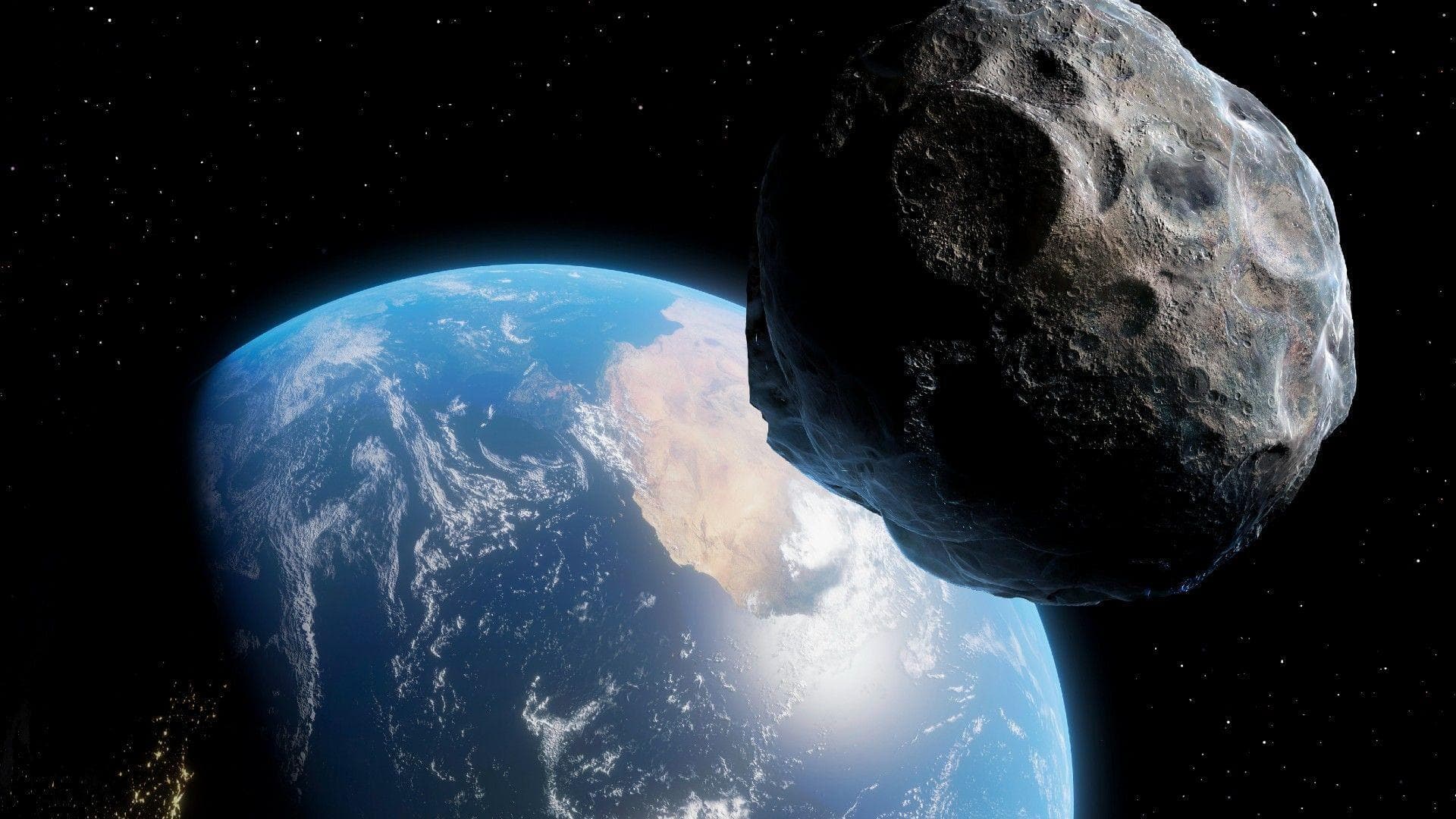
This asteroid crater might be linked to a mass-extinction event
What's the story
An ancient asteroid crater, hidden beneath the town of Ames in Oklahoma, has been found to be nearly 100 million years younger than previously thought. The discovery links it to one of Earth's five mass extinction events. The crater, which is about 16km in diameter and buried under 2.7km of sedimentary rock, was first detected through seismic readings in 1991.
Age revelation
Initial dating of the crater
The initial age estimate for the crater was based on a tooth discovered in a rock at the impact site.
The tooth belonged to an ancient eel-like creature called a conodont, which lived during the Ordovician period.
However, Elizabeth Catlos from the University of Texas at Austin led a team that dated the crater to be 370 million years old, placing it in the Late Devonian mass extinction period.
Crater dating
Newer dating techniques
The new age estimate for the Ames crater comes from zircon crystals. These silicate minerals can be dated by analyzing their uranium and lead content.
The impact that created the Ames crater would have formed new zircons, which were imaged using cathodoluminescence and electron backscatter diffraction techniques at NASA's Johnson Space Center.
Both methods consistently pointed to a younger signal, supporting Catlos's team's findings.
Formation impact
Impact may have contributed to mass extinction
The formation of the Ames crater likely jumbled the fossil conodont teeth found at the site.
While this impact alone may not have caused a mass extinction, it could have contributed to one.
Other possible causes for this extinction include reduced oxygen levels, super-volcanism, or a nearby supernova explosion.
At the time of the impact 370 million years ago, Oklahoma was under a shallow sea where sedimentary rock now covers the crater.
Resource extraction
Oil and gas extraction
The impact that created the Ames crater also fractured the Earth's crust beneath it, allowing oil and natural gas to seep up.
Wells have struck oil three kilometers down inside the crater, producing 17.4 million barrels of oil and a volume of 79.5 billion cubic feet (2.25 billion cubic meters) of natural gas since 1991.
This highlights how geological events can influence resource availability over millions of years.