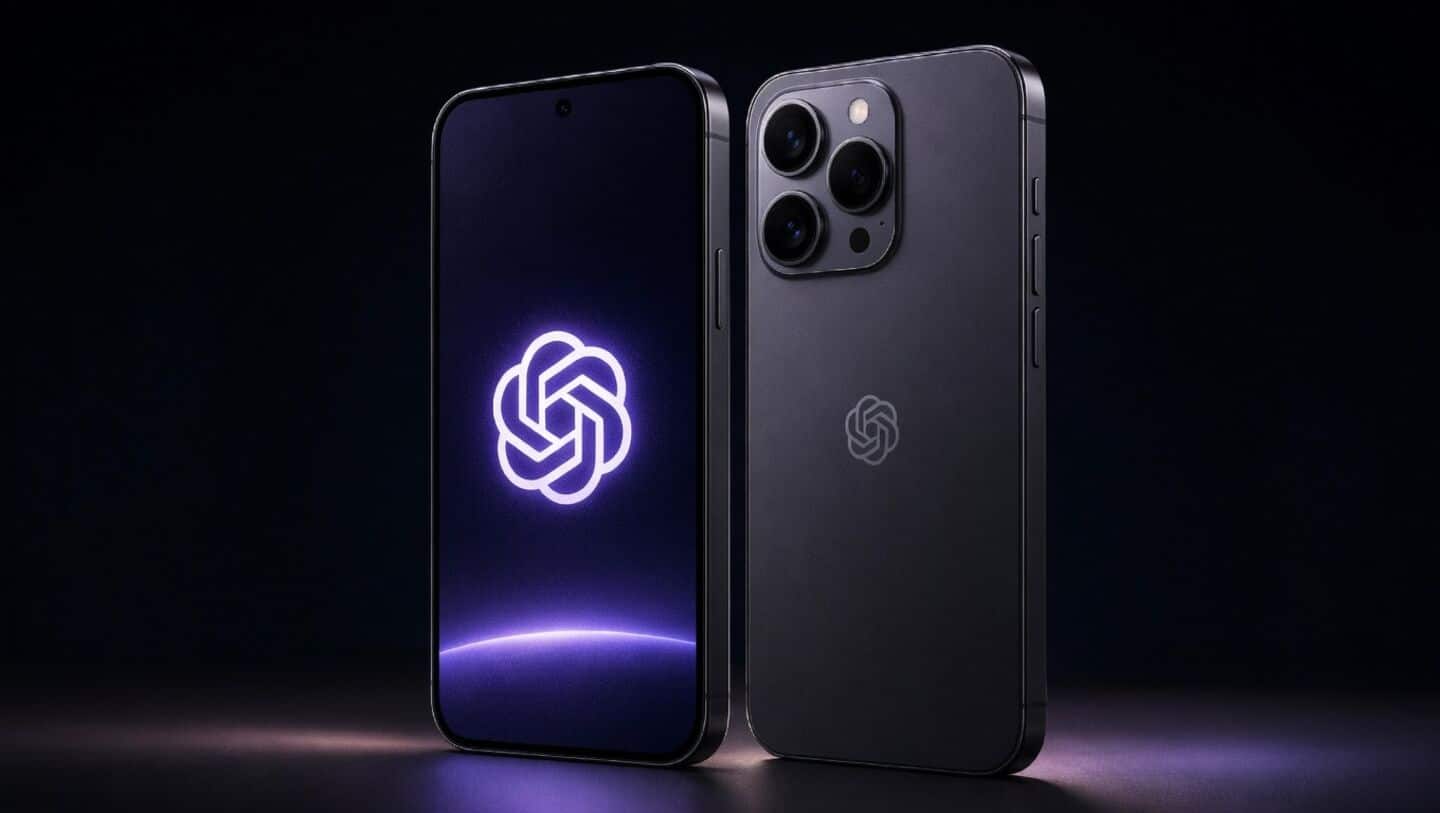
OpenAI's smartphone may replace apps with AI agents
What's the story
OpenAI, the artificial intelligence (AI) giant, is said to be working on an AI-first smartphone. The company is collaborating with MediaTek and Qualcomm for the development of smartphone processors. Analyst Ming-Chi Kuo revealed this in an X post. The move indicates OpenAI's growing interest in hardware as it aims to create devices optimized for AI-native experiences instead of traditional app-based usage.
Innovative concept
Redefining user interaction
OpenAI's smartphone is said to be based on the idea of an AI agent-led device. This means instead of using multiple apps, users would rely on AI for task completion.
The shift would change how people perceive smartphones—not as a collection of apps but as systems designed to fulfill user intent.
In this model, AI becomes the main interface, redefining user interaction patterns.
Market entry
Why smartphones?
Kuo highlighted several reasons for OpenAI's push into smartphones.
By controlling both the OS and hardware, the company could provide a fully integrated AI agent experience.
Also, smartphones uniquely capture real-time user state, making them ideal for contextual AI inference.
Plus, they are likely to remain the largest-scale device category in the near future.
Together these factors make smartphones an important platform for deploying advanced AI systems at scale.
Differentiation strategy
OpenAI's strategy
Despite its lack of experience in the smartphone sector, OpenAI is banking on its strong consumer brand, years of user data, and advanced AI models.
The company plans to leverage existing supply chains while focusing on differentiation through AI.
On the business model front, it could bundle subscriptions with hardware and create a new ecosystem involving developers.
This could change how software is distributed and monetized on mobile devices.
Workload distribution
Hybrid AI approach
Kuo hinted that the envisioned device would use a tightly integrated mix of on-device and cloud-based AI.
The smartphone would have to continuously understand user context, making power efficiency, memory hierarchy management, and small-model execution key considerations in processor design.
More complex or compute-intensive tasks would be handled in the cloud, ensuring performance without compromising battery life.
This hybrid approach highlights the importance of distributing AI workloads across local and remote systems.
Partnership details
Role of MediaTek and Qualcomm
MediaTek and Qualcomm have been roped in as processor co-development partners for OpenAI's smartphone. Their expertise in mobile chip design will be leveraged for this project.
Specifications and supplier decisions are expected to be finalized by late 2026 or early 2027.
For MediaTek and Qualcomm, the long-term opportunity is huge as replacement cycles driven by AI-centric devices could emerge as a major growth driver in the global high-end smartphone segment.