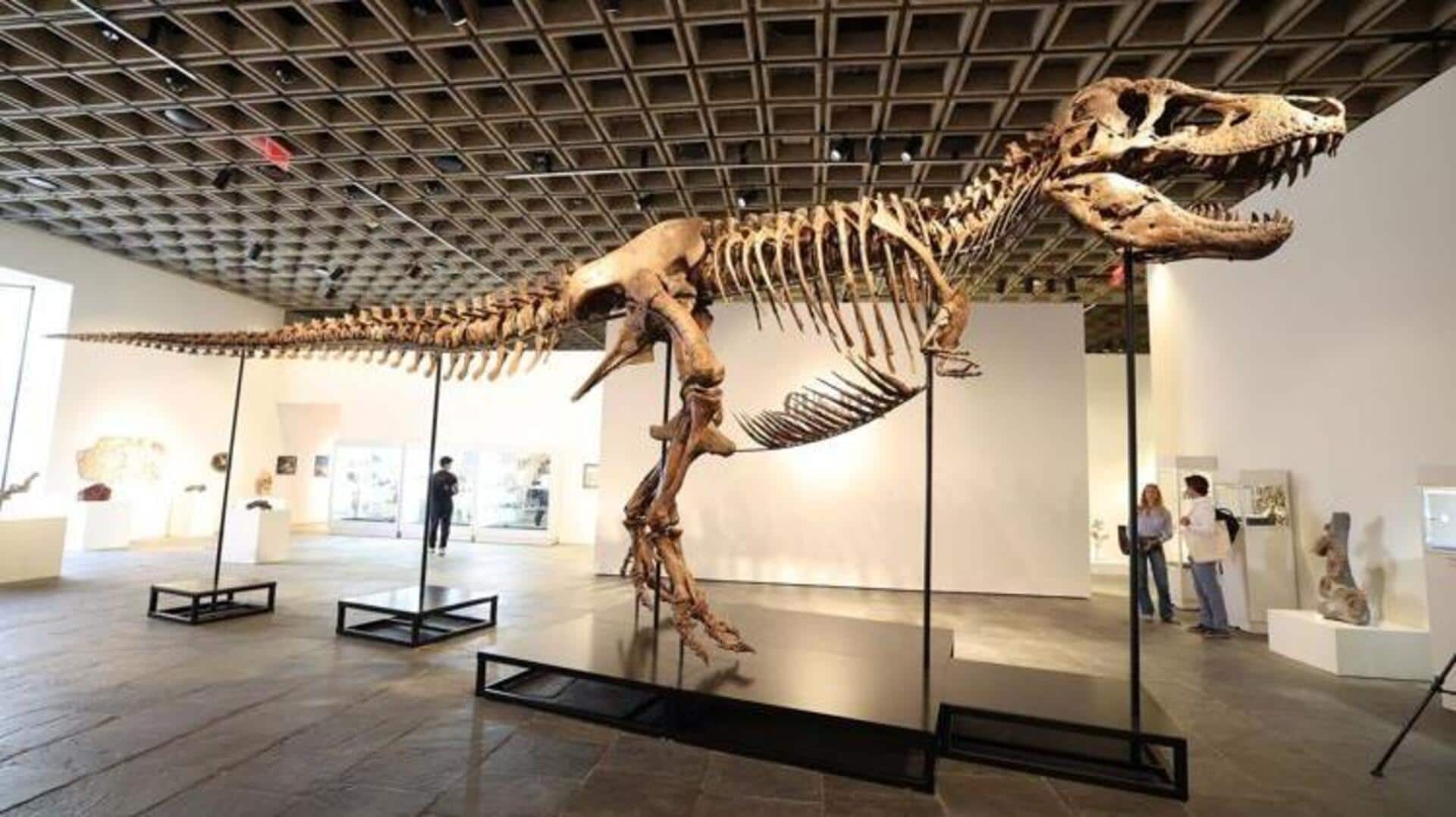
Rare T. rex fossil goes under the hammer for $50M
What's the story
A rare Tyrannosaurus rex fossil, nicknamed Gus, has sold for a staggering $50.1 million at Sotheby's in New York City. The skeleton is one of the largest and most complete T. rexes ever discovered, with an estimated age of 67 million years. It was excavated on a ranch in Harding County, South Dakota, by Theropoda Expeditions between 2021 and 2023.
Fossil details
Gus is 1 of the largest T. rexes ever found
The skeleton of Gus is 38 feet long and 12.5 feet tall, making it one of the largest T. rexes ever found.
It consists of 183 fossil bone elements, making it about 61% complete by bone count or 75% to 80% complete by mass.
The specimen has an exceptionally preserved skull with all six dentitions and includes rarely found components such as a wishbone, a complete pelvis, and both feet.
Auction process
The sale of Gus exceeded its estimate
The fossil was excavated over three seasons, from 2021 to 2023, and then underwent three more years of lab work for cleaning and mounting the bones.
The pre-sale estimate for Gus was between $20 million and $30 million. It sold well above the estimate to a phone bidder.
The winning bid was placed over the phone, with Sotheby's describing Gus as "an outstanding exhibition-ready mounted skeleton."
Scientific debate
Paleontologists are disappointed
The sale of Gus has sparked a scientific debate over the potential impact on paleontological research due to private ownership.
Paleontologists generally believe that once a fossil is in private hands, it is lost to science.
This is because scientific journals only publish research conducted on specimens held in publicly accessible collections; if a fossil is privately owned, studies can't be reliably reproduced, an important standard for verifying scientific findings.
Specimen uniqueness
Features that made Gus interesting to buyers
Gus has many features that made it interesting both to scientists and prospective buyers.
The skull has about 82% of the original bones represented, and the skeleton includes rarely found components such as the wishbone, a complete pelvis, and both feet.
Sotheby's said only one other specimen is known to have two well-represented feet.
Gus reportedly also shows bite marks and evidence of fractures that the dinosaur survived.