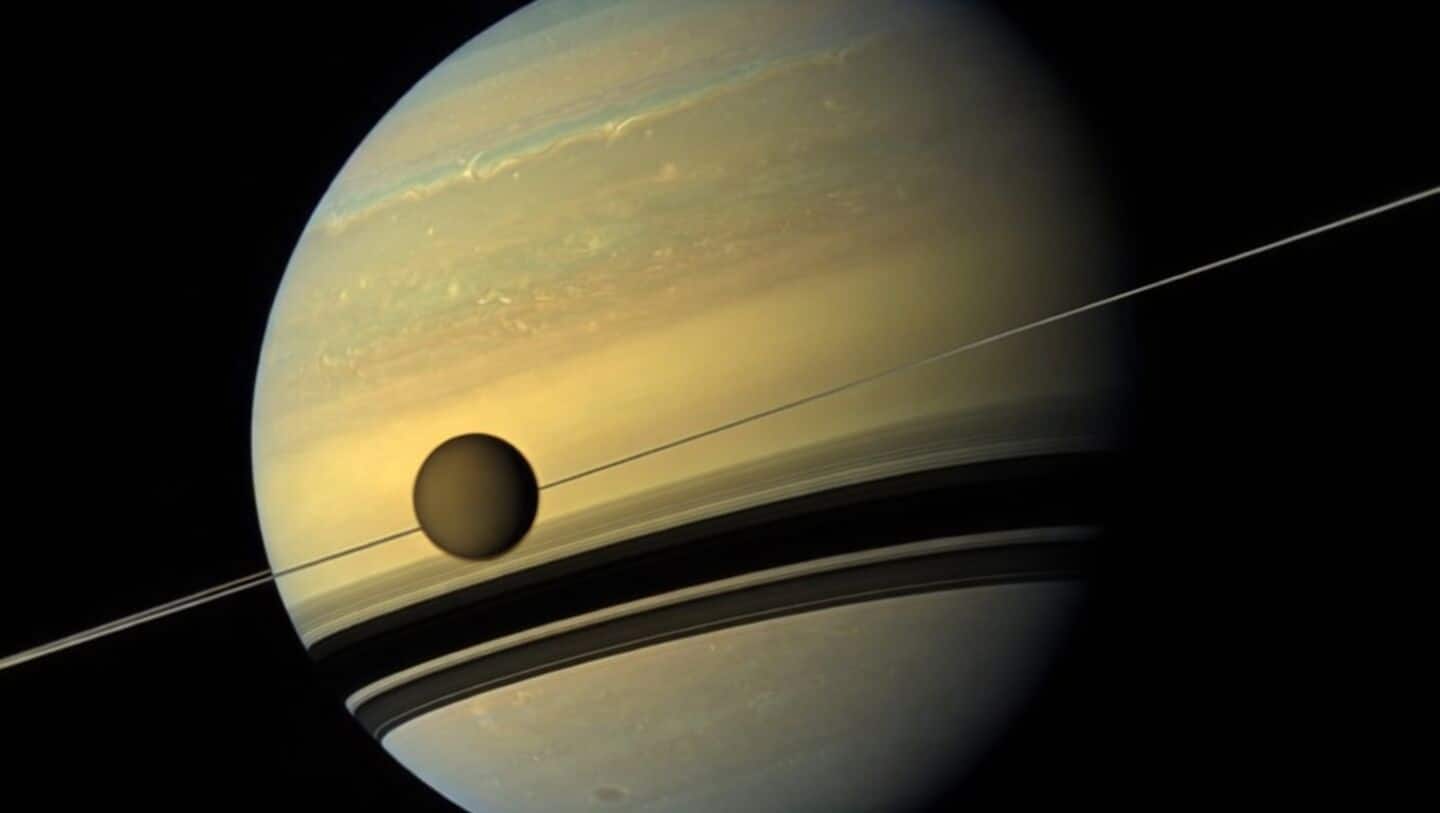
Saturn's iconic rings may be debris from ancient moon crash
What's the story
A new study has revealed that Saturn's largest moon, Titan, may have undergone significant changes due to a collision with another moon about 500 million years ago. The research was published on ArXiv and accepted by The Planetary Science Journal. Lead author Matija Cuk from the SETI Institute in California, proposed this theory after analyzing data collected by Cassini spacecraft between 2004 and 2017.
Impact analysis
Collision could explain Hyperion's formation
Cuk's theory suggests that an extra moon collided with Titan, becoming part of it. This collision could also explain Hyperion's formation, one of Saturn's largest non-spherical moons.
Hyperion is much smaller than Titan, at about 5% of its diameter.
The researchers speculate that Hyperion could be a remnant from the Titan-lost moon collision or formed later from debris around Titan's orbit.
Tilt theory
Ancient collision may have influenced Saturn's tilt
The study also found evidence of an ancient collision influencing Saturn's tilt.
Saturn rotates at an angle of 26.7 degrees compared to its orbit around the Sun.
Earlier, astronomers thought that gravitational disturbances from Neptune's orbit caused Saturn's tilt over time.
However, Cassini data showed these planets aren't exactly in sync, hinting at a missing element in this cosmic puzzle.
Resonance explanation
Lost moon theory
In 2022, astronomers proposed that a lost moon named Chrysalis could explain Saturn's current tilt. It orbited the planet for billions of years, contributing to its resonance with Neptune.
But around 160 million years ago, it came too close to Saturn and was torn apart in an event that created the planet's rings and shifted its tilt.
The new study refines this idea by suggesting a collision between predecessors of Titan and Hyperion instead.
Tilt explanation
Implications for Hyperion
The lost moon's gravity and mass kept Saturn and Neptune in sync, with its disappearance explaining their current slight misalignment.
If the collision also created Hyperion in its current form, it would explain why its orbit is locked with Titan's.
However, it remains unclear whether Hyperion is a fragment of Titan's precursor or of the lost moon that merged with it.
Ring formation
How this ancient collision could explain Saturn's rings
The study also suggests that Saturn's rings could have formed hundreds of millions of years after the collision event.
Titan's expanding orbit interacted with some of Saturn's inner moons, disturbing them to the point of making them collide. Some of the resulting debris survived as the planet's rings.
This theory is supported by a February study suggesting Titan's surface is as young as 300 million years based on a lack of impact craters.