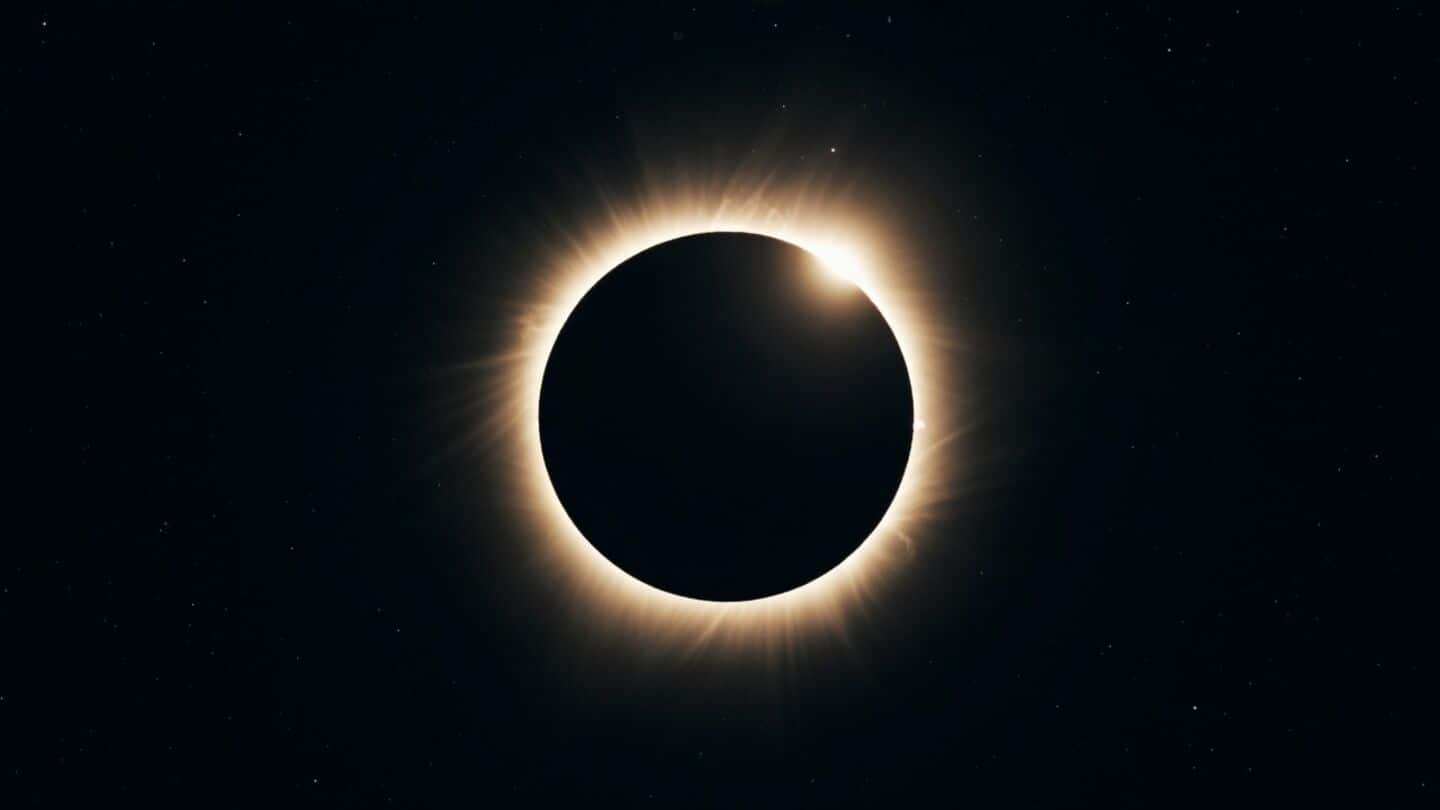
Shadow bands likely during upcoming total solar-eclipse: What are they?
What's the story
As the world gears up for a total solar eclipse on August 12, scientists are preparing to study a strange phenomenon known as shadow bands. These elusive light patterns appear just before and after totality, when the Moon completely obscures the Sun's light. The bands consist of long dark lines with white spaces in between, racing across surfaces like ground or buildings.
Historical accounts
Shadow bands have been described for centuries
The phenomenon of shadow bands has been described by solar eclipse watchers for centuries.
David Turnshek, a professor of physics and astronomy at the University of Pittsburgh, first saw these bands as a teenager during a total eclipse in 1970.
He recalled noticing "bands of light were sweeping across the ground" just before the total eclipse.
Research hurdles
Shadow bands are difficult to capture on camera or video
While shadow bands are easily visible to the naked eye, capturing them on camera or video is a different story. The subtle contrast makes it difficult to photograph these phenomena.
Turnshek's research has mainly focused on galaxy formation and quasars, but his curiosity about shadow bands remains.
Despite two competing theories explaining their origin, no definitive explanation has been found yet.
Unexpected findings
Research into shadow bands found a sustained signal
In 2017, Turnshek and a team of University of Pittsburgh undergraduates tested the leading theory that turbulence in Earth's atmosphere causes shadow bands.
They placed light detectors on the ground and a high-altitude balloon to collect data on light patterns before and after totality.
Surprisingly, they found a sustained signal at both high altitude and on the ground, suggesting that turbulence might not be the only explanation for shadow bands.
Alternative theory
Data from the 2017 eclipse suggested another explanation
The 2017 eclipse data hinted at another explanation for shadow bands, called diffraction-interference.
This phenomenon occurs when light waves encounter an obstacle, like the curved edge of the Moon during an eclipse.
Turnshek and his team were unable to replicate their findings during the April 8, 2024, total solar eclipse due to cloud cover in Texas.
Future prospects
Turnshek plans to travel to Spain for the event
The upcoming total solar eclipse will give scientists another chance to study shadow bands.
The path of totality will pass through northern Russia, eastern Greenland, western Iceland, northern Spain, and northeast Portugal.
Turnshek plans to travel to Leon, Spain, for the event but won't be able to replicate his previous experiments due to logistical complexities.
He hopes to detect and capture video of shadow bands using ground-based equipment he deployed in Texas in 2024.