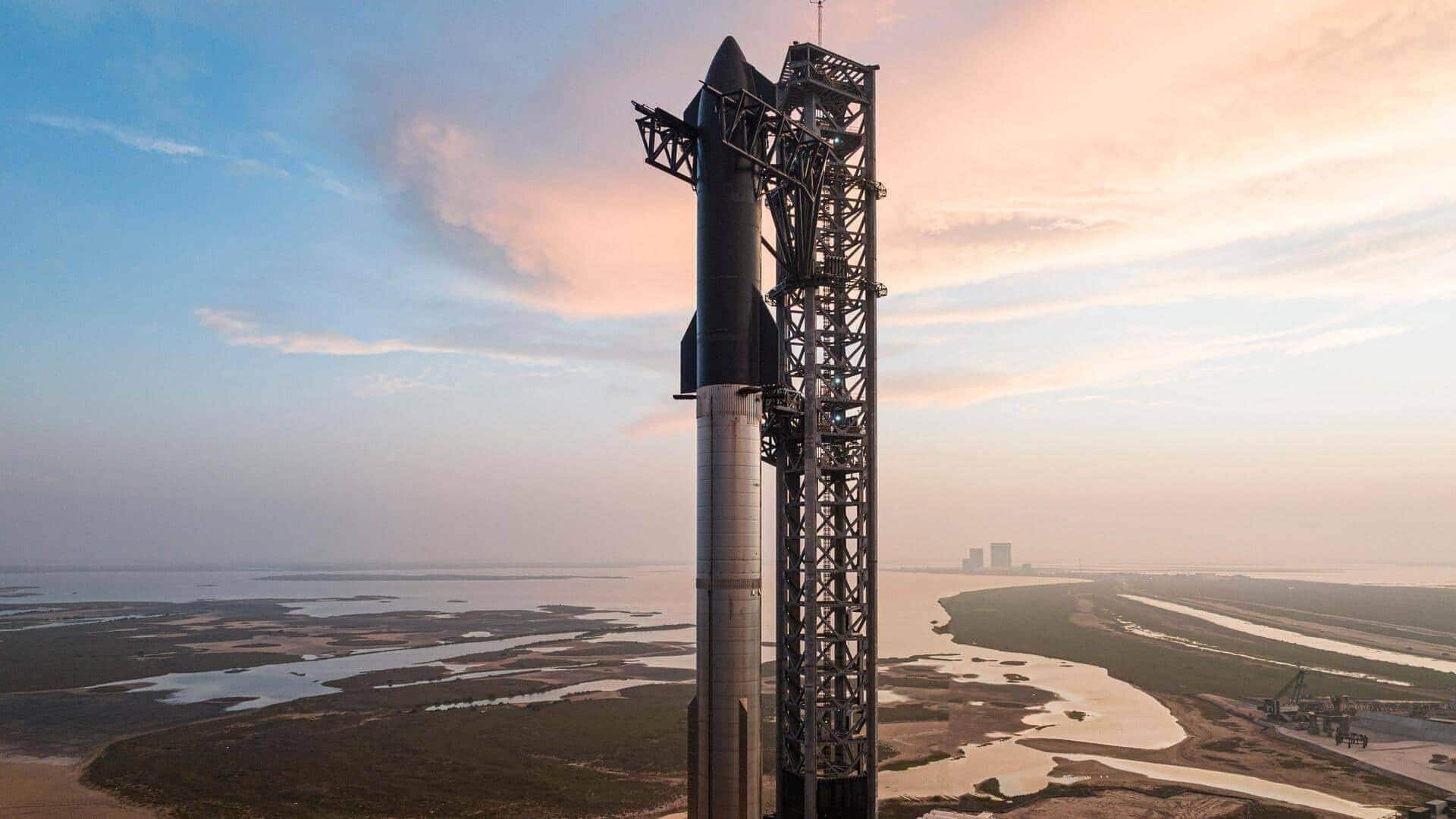
SpaceX aborts Starship launch after engine ignition failure
What's the story
SpaceX has postponed the test flight of its Starship rocket and Super Heavy booster. The decision was made at the company's South Texas spaceport after a countdown abort during the Super Heavy booster engine ignition sequence. Elon Musk, CEO of SpaceX, confirmed on social media platform X that some engines failed to ignite, leading to an automatic launch abort.
Launch schedule
Starship may not launch during next available window
Musk hinted that the company might not be able to launch during the next available window on Friday evening.
He said, "Some of the engines didn't start, triggering an automatic launch abort."
The team is now offloading propellant from the rocket's tanks and hopes to make another attempt in a few days.
Technical adjustments
SpaceX will replace 2 Raptor engines on Super Heavy booster
Musk also said that ground teams at Starbase will replace two Raptor engines on the Super Heavy booster.
The Super Heavy booster is powered by 33 methane-fueled Raptor engines, each generating over half a million pounds of thrust.
These engines are designed to ignite in a staggered sequence after activation of the launch pad's water-cooled flame diverter, which protects the facility from extreme heat and vibrations during liftoff.
Engine modifications
Test flight is 13th full-scale Starship launch
This test flight is the 13th full-scale Starship launch and the second to use the Raptor 3 engine on SpaceX's upgraded Starship Version 3 rocket.
The company has made several changes to address engine problems encountered in Flight 12 two months ago.
One of these changes is modifying the engine start-up sequence on the Super Heavy booster during its flip maneuver after separating from the Starship upper stage a few minutes after liftoff.
Future goals
Flight will pave way for SpaceX's orbital flight
SpaceX hopes to achieve a controlled splashdown in the Gulf of Mexico with Flight 13, allowing future reusable Super Heavy boosters to return to the launch site.
This was already demonstrated with Starship V2 but not with Starship V3.
A successful test flight with the next Starship would pave the way for SpaceX's orbital flight, bringing it closer to using Starship for Moon missions under NASA's Artemis lunar lander program.