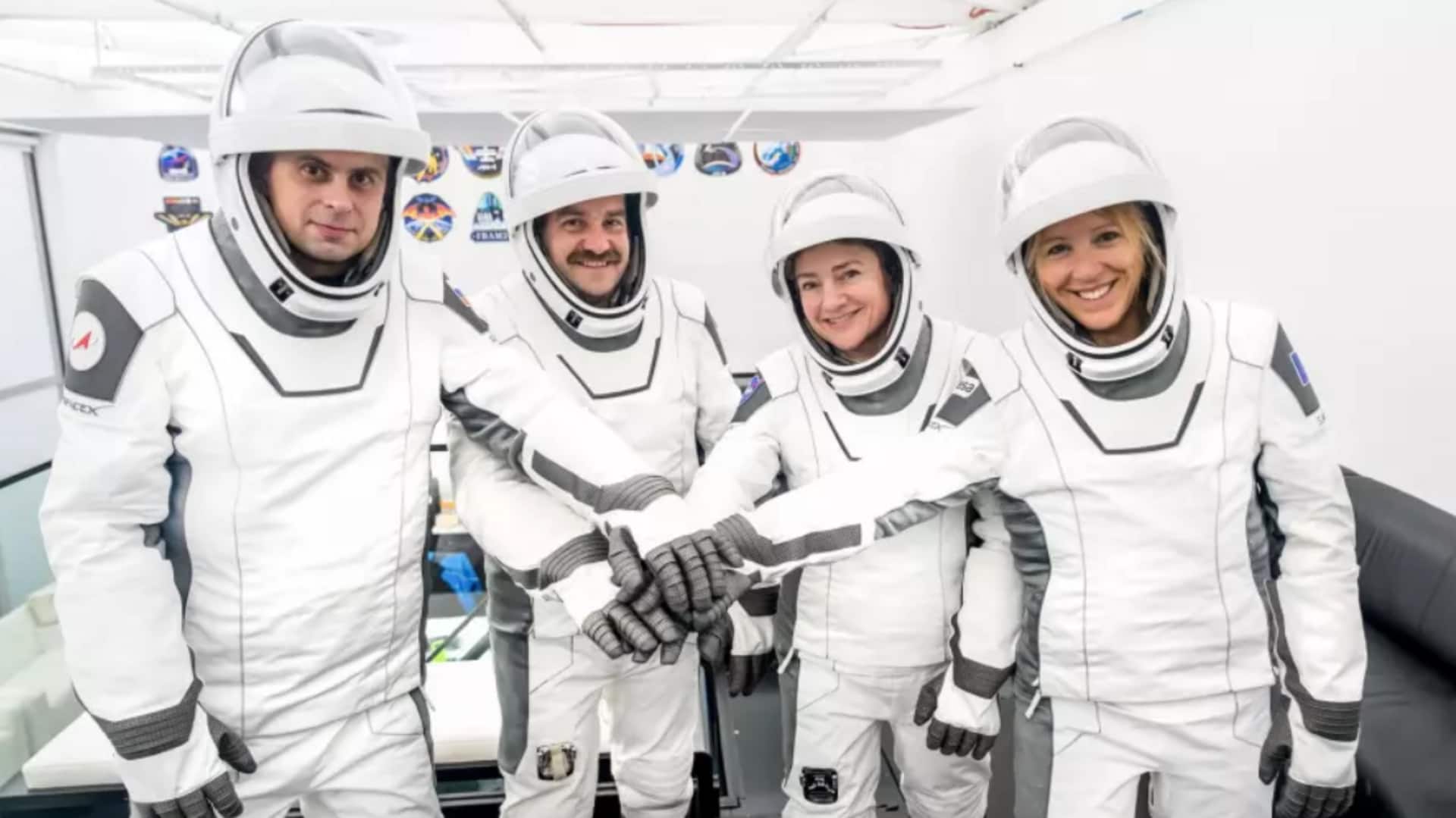
NASA's Crew-12 astronauts on their way to space station
What's the story
SpaceX has successfully launched NASA's Crew-12 mission to the International Space Station (ISS). The Falcon 9 rocket lifted off from Space Launch Complex 40 at Cape Canaveral Space Force Station, Florida, at 3:45pm IST on February 13. The spacecraft is carrying four astronauts for an eight-month stay aboard the ISS. As per the latest details, the Dragon capsule has successfully separated from Falcon 9's second stage.
Twitter Post
Take a look at the official confirmation
Dragon has separated from Falcon 9’s second stage pic.twitter.com/9yvLEVSfSW
— SpaceX (@SpaceX) February 13, 2026
Astronaut profiles
Meet the Crew-12 team
The Crew-12 mission is being led by Commander Jessica Meir, with Pilot Jack Hathaway assisting flight operations.
The team also includes Mission Specialists Sophie Adenot and Andrey Fedyaev.
Adenot, who is representing the European Space Agency (ESA) astronaut corps, is the first from her class to fly on this mission.
Expedition details
Joining Expedition 74 on the ISS
The Crew-12 mission is headed to join Expedition 74 on the ISS. The station crew recently saw unexpected changes when Crew-11 returned early after a medical evacuation.
The new arrivals will restore staffing levels and ensure research continuity.
This program reflects the partnership between NASA and SpaceX, with docking expected about 28 hours after liftoff.
Research focus
Crew will conduct over 200 experiments aboard the ISS
Once aboard the ISS, the crew will begin work on over 200 experiments. A key focus is biological investigations, including the Venous Flow study that examines clot formation.
The goal is to understand microgravity effects and guide astronaut health strategies.
The mission also includes tests of manual piloting skills for future Moon landings and studies into astronaut vision changes during prolonged missions.
Launch broadcast
SpaceX and NASA offered live streams of the launch
Space enthusiasts were able to witness the events through live streams provided by NASA and SpaceX.
The coverage started hours before the scheduled liftoff, including crew suit-up moments.
SpaceX also offered high-definition views with cameras tracking ascent and booster descent.
This allowed people around the world to witness this historic moment in real-time.