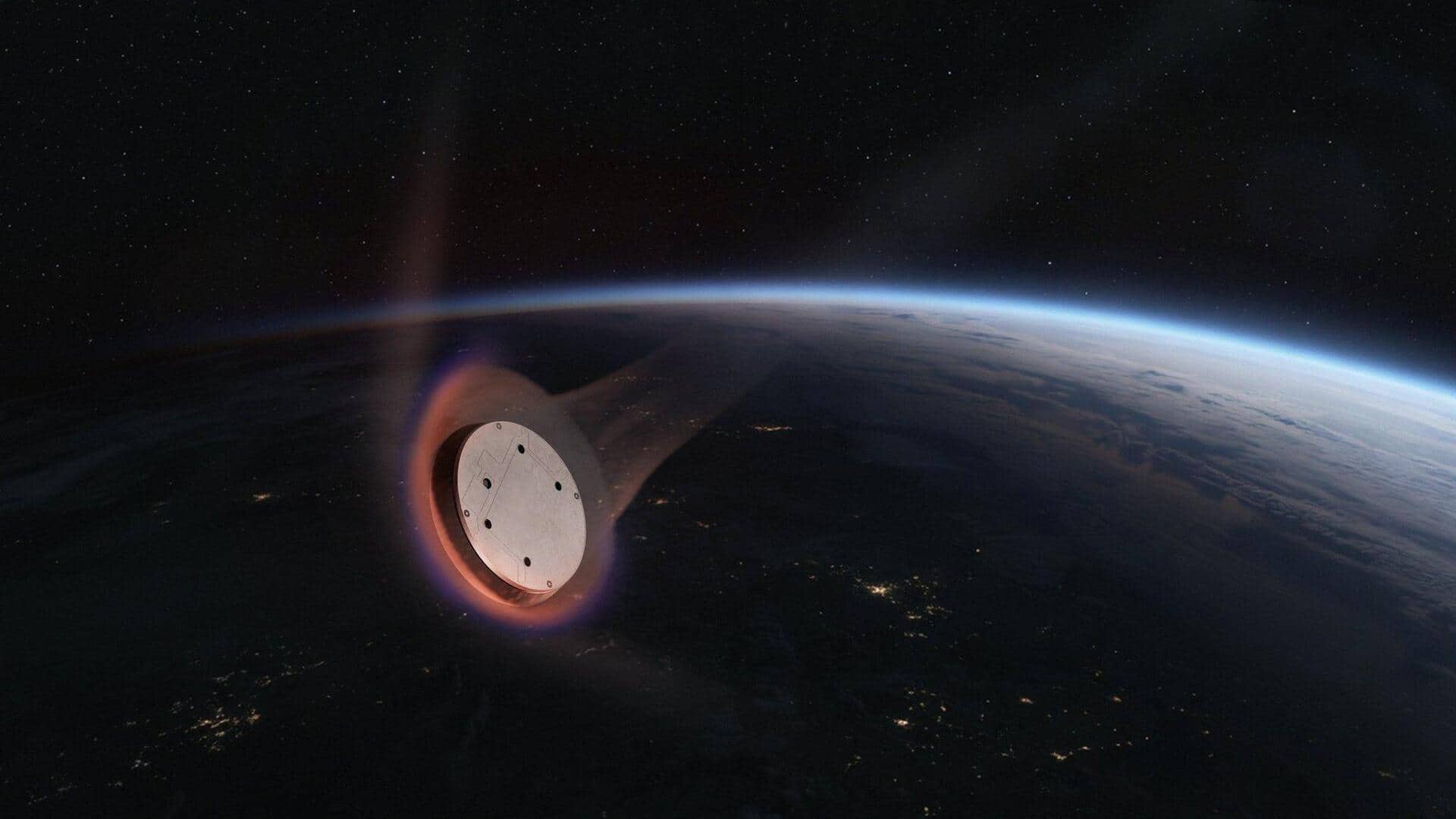
SpaceX launches mission to demonstrate its Starfall re-entry capsule
What's the story
SpaceX has launched its first-ever demonstration mission of the Starfall re-entry capsule. The historic flight took off from Cape Canaveral Space Force Station in Florida at 4:13pm (IST). The mission is a major milestone in space exploration as it marks the first real-world test of a spacecraft's ability to survive atmospheric re-entry and safely return payloads from space.
Capsule details
A look at the Starfall capsule
The Starfall capsule is a small autonomous re-entry vehicle, specifically designed to bring valuable cargo from low-Earth orbit back to Earth.
The spacecraft features a unique disc-shaped design, unlike the traditional cone-shaped capsules used for human spaceflight.
It can carry up to 1,000kg of payload and uses a heat shield during re-entry to withstand the extreme temperatures generated as it plunges through Earth's atmosphere.
Manufacturing potential
The mission and in-space manufacturing
The Starfall project is closely linked to the growing interest in in-space manufacturing, where products are made in the unique microgravity environment of orbit and then returned to Earth.
Some materials, pharmaceuticals, and advanced technologies can potentially be produced more efficiently in space than on the ground.
Regulatory filings indicate that Starfall is intended to support both commercial manufacturing in orbit and rapid cargo-return services from space.
Market impact
Competing with its own customers
The Starfall project puts SpaceX in direct competition with companies that currently rely on its launch services.
Varda Space Industries, which has flown six of its W-series spacecraft on SpaceX rideshare missions, performs microgravity research and manufacturing with capsules that have landed in Utah and Australia.
By vertically integrating both the rocket and cargo return capsule, SpaceX can offer end-to-end orbital manufacturing logistics independent of third-party competitors.