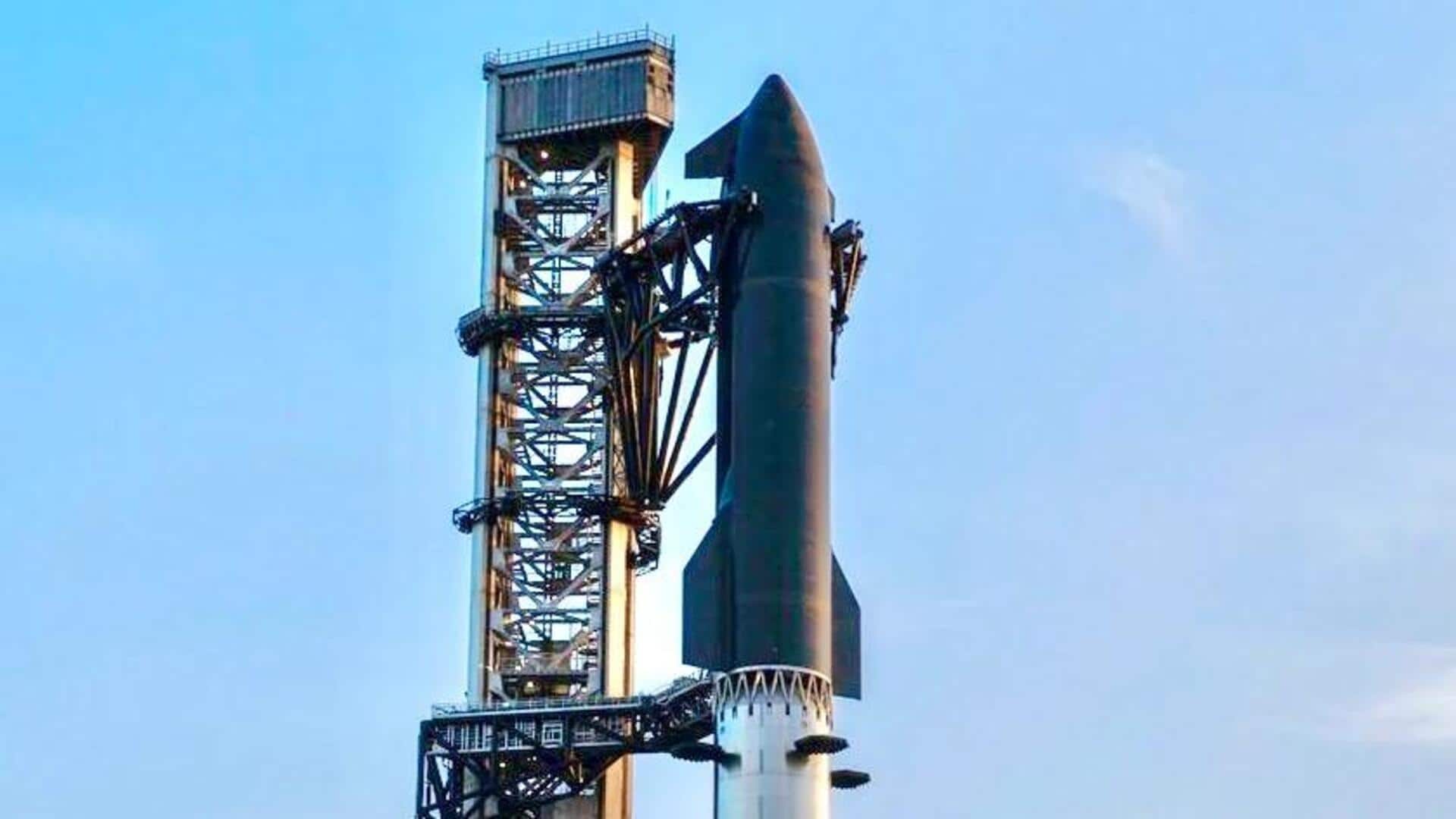
Starship set for historic orbital launch today: How to watch
What's the story
SpaceX is set for a historic event as its Starship megarocket prepares for its first-ever orbital launch. The mission is scheduled for today, during a 75-minute window starting at 8:15am EDT (5:45pm IST). The launch will take place from SpaceX's Starbase in South Texas. You can catch the live coverage of this momentous occasion on SpaceX's official website or X, starting around half an hour before liftoff time.
Rocket specifications
About Starship
The Starship is the largest and most powerful rocket ever built, standing at a staggering 407 feet (124m) tall when fully stacked.
It comprises two stages - the Super Heavy booster and Starship (also called Ship) upper-stage spacecraft.
Both are designed to be completely reusable within a short time frame, which SpaceX calls the "holy grail of rocketry."
Mission details
First orbital flight
The upcoming flight will be Starship's 14th mission and the third Starship flight this year, but its first to reach orbit.
The rocket will be sent into Earth's orbit, where it will deploy 26 next-gen Starlink Version 3 internet satellites.
These will be the first of a new megaconstellation in low Earth orbit (LEO), which Elon Musk has said could eventually include up to 100,000 spacecraft.
Twitter Post
Live coverage starts at 5:08pm
Starship’s 14th flight is set to launch on Monday, Sept 28. The 75-minute launch window opens at 7:15 a.m. CT. Live coverage of the mission starts ~35 minutes before launch → https://t.co/uQKQvgaTmJ
— SpaceX (@SpaceX) September 27, 2026
Return strategy
Splashdown in Pacific Ocean
After orbiting Earth six times, Starship will return for a splashdown in the Pacific Ocean off Chile's coast, nearly 10 hours after launch.
This is a major departure from Starship's suborbital flights, lasting a maximum of 65 minutes, and targeting the Indian Ocean near Western Australia.
Super Heavy booster, on the other hand, will splash down in the Gulf of Mexico about seven minutes after liftoff as it has done on previous flights.
Upcoming missions
Recovery after flight
SpaceX intends to bring both Super Heavy and Starship back to the launch pad after operational flights, where they'll be caught by the tower's "chopstick" arms.
The company has done this three times with Super Heavy but hasn't tried it with Starship yet.
Each Starship mission beyond Earth orbit will require multiple rendezvous with "tanker" Ships for refueling, a capability SpaceX has yet to demonstrate off-Earth propellant transfer.
Lunar mission
NASA's Artemis program
NASA has selected Starship as the first crewed lunar lander for its Artemis program.
The mission aims to land humans on the Moon for the first time in 2028, during the Artemis IV mission.
This highlights Starship's potential role in future space exploration endeavors beyond Earth's orbit.
SpaceX believes Starship could transform space exploration, enabling humans to settle the Moon, Mars, and eventually travel even farther.