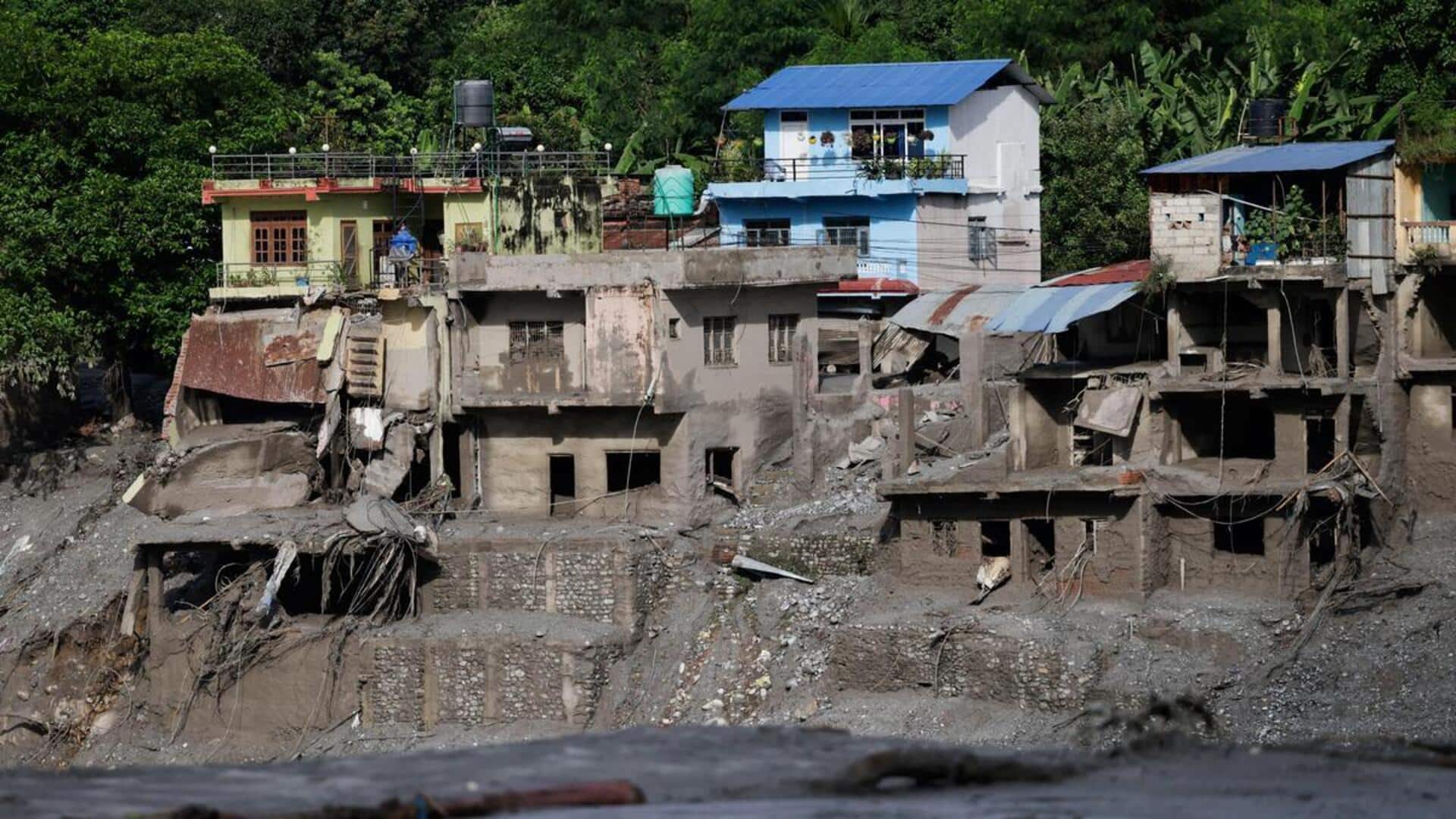
'Human-induced climate change' played role in Nepal-Tibet floods, study finds
What's the story
A recent study found that climate change likely contributed to the devastating floods on the Nepal-Tibet border. Dr. Friederike Otto, a climatologist at Imperial College London and co-author of the study, said there is "absolutely no doubt that human-induced climate change played a role here in the preconditioning of the disaster." The World Weather Attribution study described this disaster as a "compound event," triggered by rising temperatures, thinning glaciers, thawing permafrost and pre-existing geological weaknesses.
Disaster impact
Thousands missing in Nepal and Tibet
Scientists believe the floods were caused by a collapse of a rock wall and glacier ice near the peak of Langtang Lirung, a mountain on Nepal's side of the Himalayas.
According to data from the United States Geological Survey, the collapsing debris struck the bottom of a valley with enough force to register as a magnitude 5.2 earthquake.
On Wednesday, Nepali authorities revised the number of missing persons from 5,179 to 6,150. The death toll still stands at around 1,400.
Study findings
Human influence on regional temperatures
In a study published on Thursday, the World Weather Attribution said climate change was a "destabilizing factor acting on a pre-existing geological predisposition."
As per the study, July and August temperatures in the area were around 1.5°C warmer due to human influence.
Glaciers had also been thinning by about half a meter annually, which could weaken existing fractures and increase instability.
Heavy snowfall last October and November also contributed to large amounts of meltwater early this year.
Geological vulnerability
Potential impact of the 2015 earthquake
All these activities "may have interacted to amplify the compound event," the study said.
It also speculated that a 7.8-magnitude earthquake in 2015 could have weakened the underlying rock mass. However, authorities are unable to confirm its exact impact on last month's disaster.
Dr. Walter Immerzeel, another co-author of the report and a mountain hydrologist at Utrecht University, described the area as a "geologically vulnerable slope," "potentially weakened by the 2015 earthquake" and further destabilized by glacier and permafrost retreat.
Expert opinion
Monitoring high-mountain regions for early warnings
Dr. Simon Cook, a glacier expert at the University of Dundee, said while it's hard to attribute any single event to climate change, "climate warming ultimately destabilizes these high mountain environments."
He called the World Weather Attribution report a "very worthwhile study" that provides "some strong evidence that climate change was a key factor."
However, he noted that "we are not yet at a point of being able to say exactly how this happened."
Climate justice
Nepal calls for global action against climate change
In the aftermath of the disaster, Nepali authorities have called for global efforts to combat climate change.
They argue that despite being one of the lowest contributors to greenhouse emissions, Nepal is among the most vulnerable countries to global warming impacts.
Prime Minister Balendra Shah will address this issue at the United Nations General Assembly in New York next week during his first foreign trip as PM.