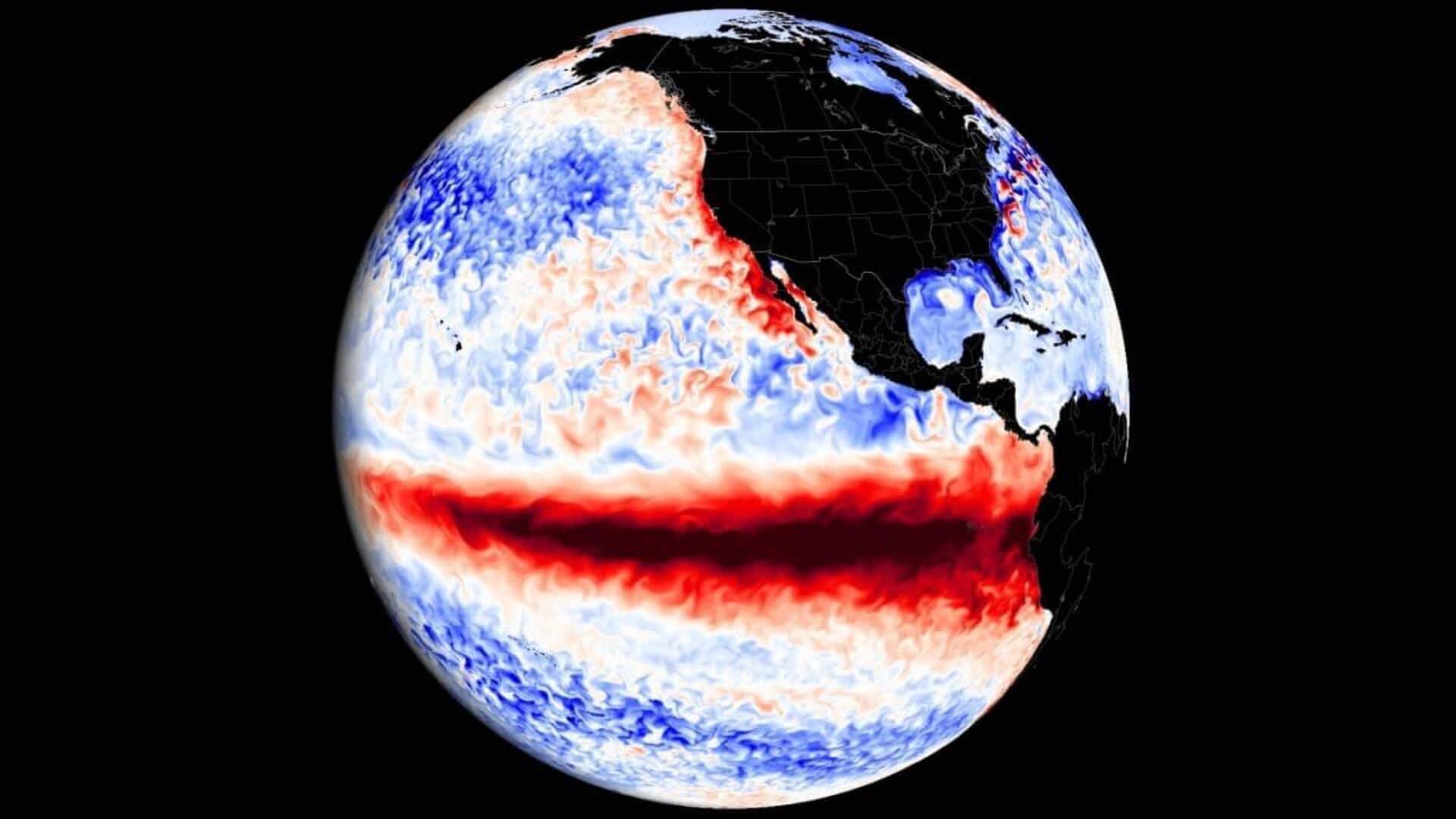
Super El Niño underway: NASA map confirms warmer-than-normal water temperatures
What's the story
NASA has confirmed the onset of a Super El Niño. The confirmation comes from satellite observations of sea surface height across the Pacific Ocean. The Sentinel-6 Michael Freilich satellite, led by the European Space Agency (ESA), detected higher-than-normal sea levels in parts of the equatorial Pacific on June 8. "When ocean water warms, it expands in volume and causes the sea surface to rise—making the water's height a reliable indicator of ocean temperatures," NASA explained.
Climate consequences
Super El Nino's potential impacts
The Super El Niño is characterized by warmer-than-normal temperatures and higher sea surface heights in parts of the equatorial Pacific Ocean.
This phenomenon is known to have a major influence on global weather patterns.
NASA has warned that this particular Super El Niño could have "widespread effects," including wetter conditions in the US Southwest and droughts in western Pacific countries like Indonesia and Australia.
Experts also say extreme heat can be expected "almost everywhere," including the UK.
Heat waves
Expected temperature changes worldwide
The World Meteorological Organization (WMO) has warned of above-normal temperatures in nearly all parts of the globe due to the Super El Niño.
The strongest heat signals are expected across southern and western North America, Central America, the Caribbean, Europe, North Africa, and much of Asia.
In the Southern Hemisphere, Northern South America is likely to see the strongest warming, while Southern Africa is forecasted to experience widespread above-normal temperatures.
Tropical effects
Comparison to past El Nino
Tropical regions around the world are also expected to be hotter than normal, especially Equatorial Africa and parts of Southeast Asia and the Maritime Continent.
Dr. Severine Fournier, deputy project scientist for the Sentinel-6 Michael Freilich satellite, said conditions in the western Pacific on June 8 were similar to those in 1997 when an exceptionally strong El Niño emerged.
This observation suggests that this could be a particularly intense event.
Rainfall changes
Changes in global rainfall patterns
The Super El Niño is also expected to affect rainfall patterns.
It is usually associated with increased rainfall in parts of southern South America, the southern United States, parts of the Horn of Africa and central Asia.
However, it can also bring drier conditions over Central America, northern South America, the Caribbean, Australia, Indonesia, and parts of southern Asia.
During the worst El Niño years in the 19th century, famines in India, China, and Brazil killed tens of millions.