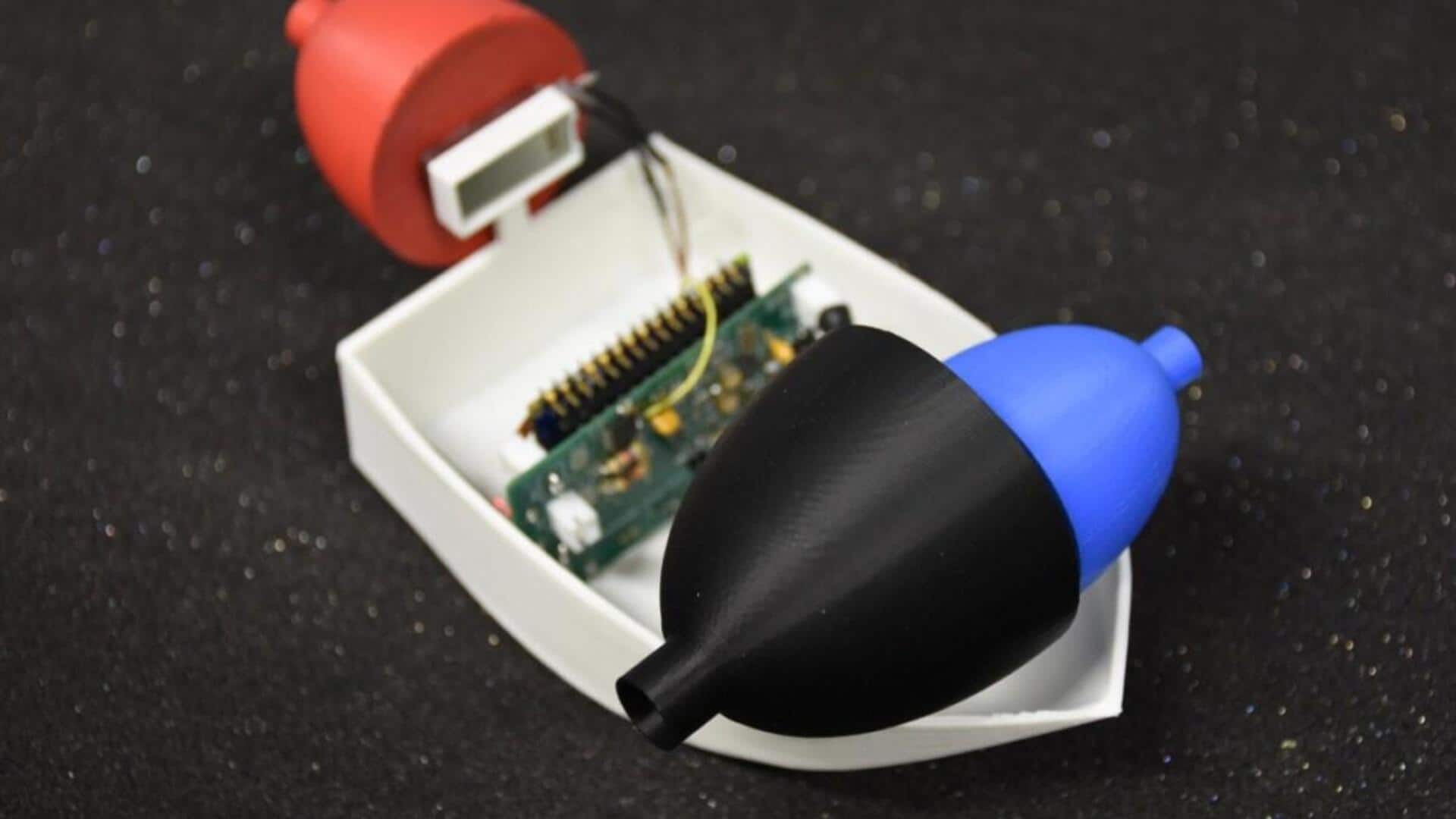
These tiny drones can run on sound waves
What's the story
Scientists at the Swiss Federal Institute of Technology in Lausanne (EPFL) have developed tiny drones that are powered by sound waves. The innovative technology was reported by Swiss Info. The researchers created special hollow structures, called "cavities," to enable these tiny vehicles to move through air and water using sound waves as propulsion.
Mechanism
How the drones work
The cavities, which are circular or bell-shaped, allow the air inside them to vibrate with sound waves.
This causes the air inside them to vibrate and be expelled as a concentrated jet, creating thrust that propels the drones forward.
The researchers used a principle known as Helmholtz resonance to achieve this effect.
Helmholtz resonance is when air trapped in a cavity vibrates and produces sound when exposed to certain frequencies of sound waves.
Application
Model boats and microdrones
The MicroBioRobotic Systems Laboratory (Microbs) at EPFL also built model boats of about one centimeter in length.
These boats had up to three cavities, each tuned to a different frequency.
By changing the sound frequency from a loudspeaker, the researchers could activate different cavities, allowing the boats to move in different directions and navigate around obstacles on their own.
Similar tests were conducted with flying microdrones as well.
Prospects
Future possibilities
The sound-powered drones are extremely small and light as they use hollow cavities instead of motors, gears, or magnetic parts.
In the future, multiple sound-sensitive cavities could be integrated into a single flexible device.
This could allow specific parts of a device to move, bend, or vibrate in response to different sound frequencies.
The technique has also been used to levitate objects in the air using sound waves.