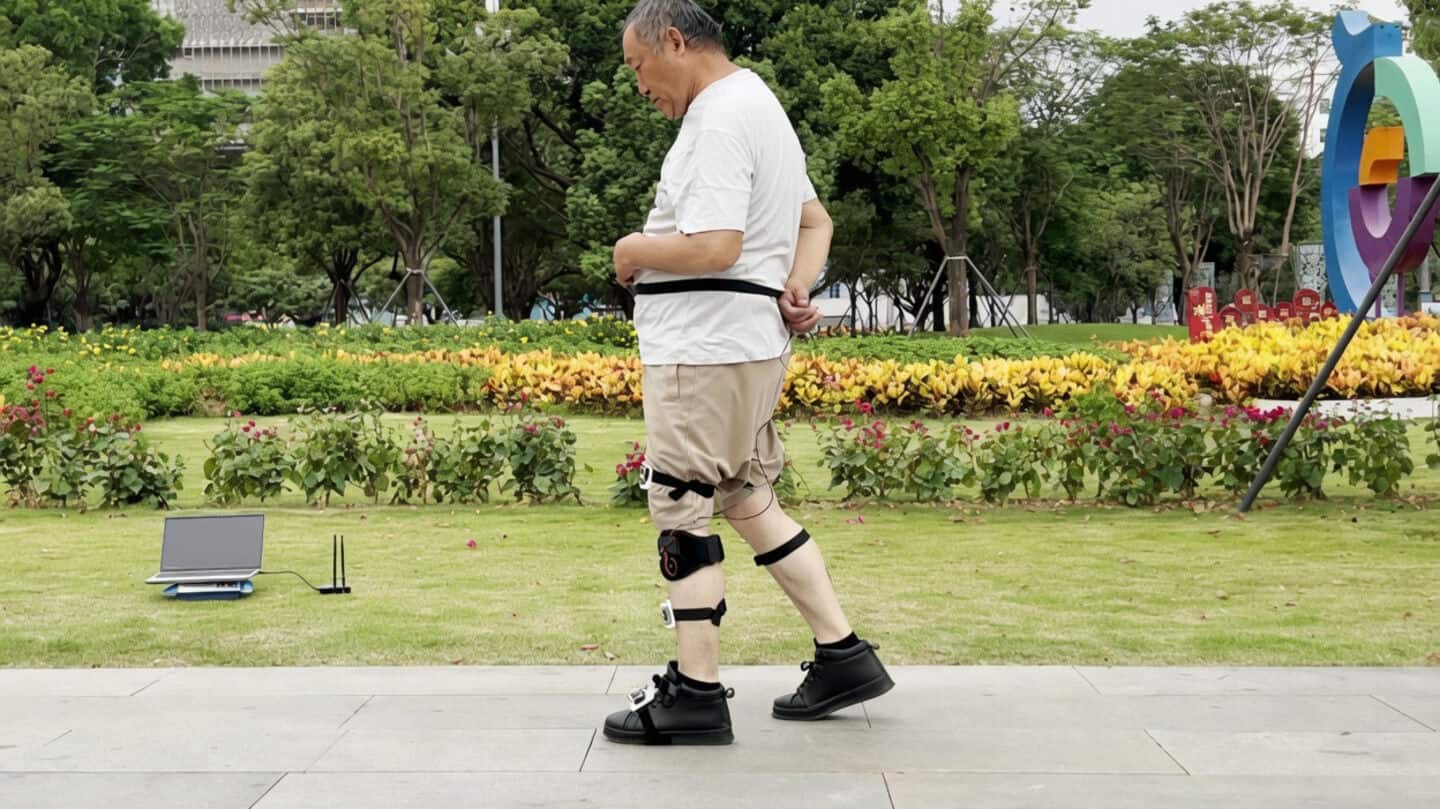
This battery-free neural device can help stroke survivors walk naturally
What's the story
Chinese scientists have developed a lightweight, battery-free neural prosthesis to improve mobility in people with walking difficulties, including stroke survivors. The innovative device works by using energy generated from the wearer's movements to electrically stimulate their muscles. This process helps flex the ankle and restore a natural walking pattern, potentially preventing falls in stroke survivors, elderly individuals, and others with mobility impairments.
Autonomous function
Device works autonomously while walking
The neural prosthesis works autonomously while walking, eliminating the need for external sensors or battery-powered controls.
It employs mechanically coupled energy harvesting and stimulation delivery to operate.
The device only needs a few steps to power up and has shown promising results in improving stride length and walking speed in stroke survivors, during both indoor treadmill trials and outdoor tests.
Immediate impact
Potential applications beyond rehabilitation
The improvements in walking speed and stride length were "immediate," according to the research team from Hong Kong University of Science and Technology (HKUST) and Hong Kong Polytechnic University.
They also noted that these enhancements were achieved without a complicated set-up.
The device could even be used by athletes during training, further expanding its potential applications beyond rehabilitation.