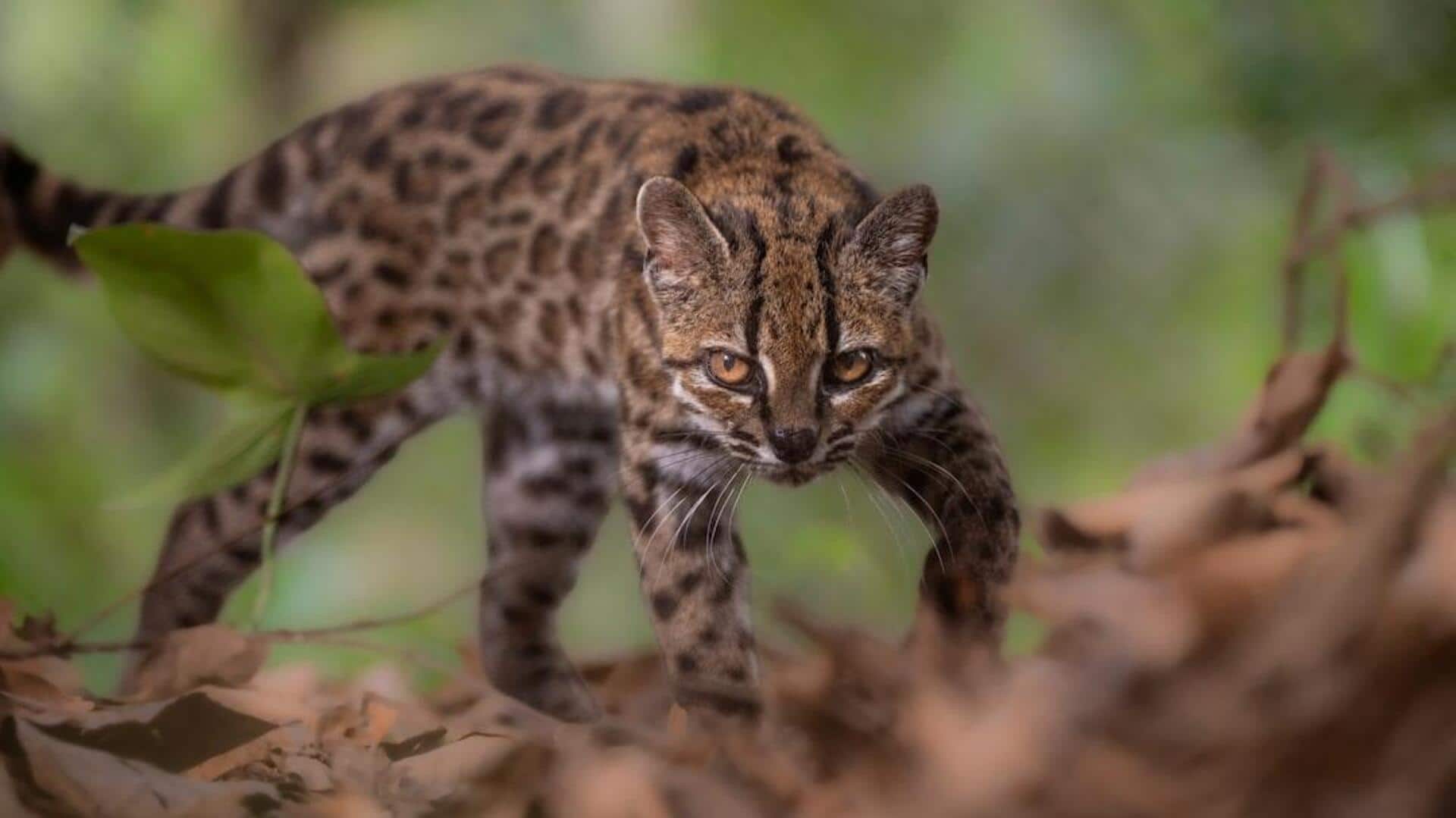
Meet tilcayo, first new feline species identified in over 100-years
What's the story
A small wild cat, found in the Yungas cloud forest of Bolivia, has been officially recognized as a new species. This is the first time in over 100 years that a new living feline species has been described and named. The findings were published in the journal Current Biology on Thursday. The newly identified feline has been named Leopardus tilcayo after its local name.
Physical description
What we know about the tilcayo
The tilcayo, a member of the tiger cat group, is a small wild cat species native to South America.
It inhabits the Yungas forest on the eastern slopes of the Andes, an area characterized by cloud cover and high humidity.
The tilcayo measures some 46cm in length and weighs around 1.4kg, making it smaller than an average domestic cat.
Its coat is light brown with irregular rosettes, short rounded ears and long whiskers.
Discovery process
Discovery of a new cat lineage
The discovery of the tilcayo began in 2016 when Bolivian biologist and National Geographic Explorer Paola Nogales-Ascarrunz was contacted by a wildlife sanctuary about an unusual cat.
A local man had found this animal as a kitten near a forest road and thought it was a domestic cat at first.
After keeping it for about a year, he realized it was wild and took it to Senda Verde Wildlife Sanctuary.
Identification confirmation
Genetic data confirmed it was a separate lineage
Initially, Nogales-Ascarrunz thought the cat was a tiger cat, which was then considered part of Leopardus tigrinus.
However, in 2019 she realized its markings didn't match reference images, particularly those of Brazilian tiger cats.
Genetic data from 38 cats across South America confirmed that the Bolivian cat represents a separate evolutionary lineage and named it Leopardus tilcayo.
The tilcayo lineage separated from other tiger cats around 1.4 million years ago.
Species knowledge
Very little is known about tilcayo's population size and diet
Currently, researchers have data from only two live individuals and a few camera-trap records of the tilcayo.
One of these cats is a 10-year-old male that now lives at Senda Verde after being kept by a local family.
Scientists still don't know much about this species' population size, distribution, reproduction or full diet.
Rodent remains found in scat suggest small rodents may be part of its diet.
Conservation impact
What is the IUCN status for tiger cats?
The International Union for Conservation of Nature (IUCN) currently assesses tiger cats as a vulnerable species with declining populations.
The researchers have shared their findings with the IUCN, which will assess the five lineages separately in its next review.
This could give a clearer picture of what each lineage faces, with Leopardus tilcayo possibly being assessed as endangered on its own.