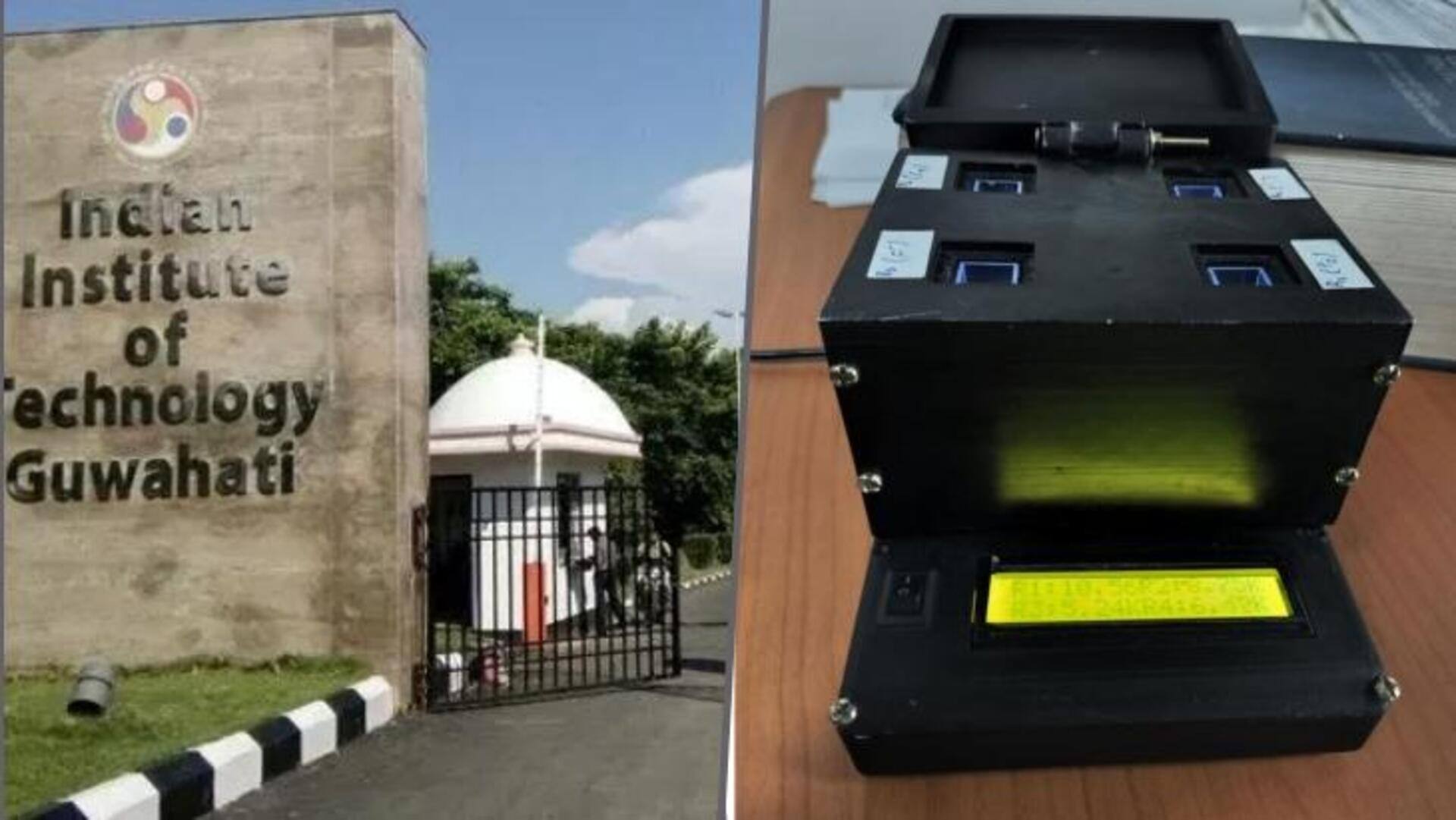
IIT develops portable device to detect toxicants in water
What's the story
The Indian Institute of Technology (IIT) Guwahati has developed a game-changing device, the E-Eye. This portable optical sensing device can quickly identify a range of toxicants in water and other biological samples. The innovation could revolutionize water quality testing by making it more affordable and accessible. The device works as an 'electronic eye' and is specifically designed for point-of-care testing.
Government alignment
Aligns with government's Jal Jeevan Mission
The development of E-Eye aligns with the Indian government's Jal Jeevan Mission, which aims to provide safe drinking water to every household.
Despite the increased access to tap water, monitoring contamination from different sources remains a major challenge.
The E-Eye device can detect toxicants directly at their source and wirelessly transmit recorded data to water treatment facilities.
Device functionality
Device can detect multiple toxicants
E-Eye employs a chemical reaction that produces a colored compound, with the color intensity indicating the toxicant's concentration.
It uses optical sensing and digital electronics to convert results into digital data and display the toxicant concentration.
The device can detect arsenic, lead, iron, chromium, fluoride, and Escherichia coli bacteria.
Its results were found to be comparable with those obtained using conventional UV-Visible and Atomic Absorption Spectrophotometers (AAS), while also offering digital connectivity.
Device affordability
Cost-effective solution for water quality monitoring
The E-Eye device costs around ₹3,500, with each test costing about ₹2. The researchers believe the cost could be further reduced through large-scale production.
Beyond water quality monitoring, the device can also analyze environmental and biological samples such as vegetables, food products, tea and herbal products, soil, and milk.
Over 2,700 samples have already been tested using this innovative technology.